
 E-Paper



CJI’s claim on need of judges not based on scientific research: Govt
Addressing a press conference to mark two years of the Narendra Modi government, Gowda said the adequacy of bench strength in a country is determined on the basis of workload on the courts and not judge-population ratio.


The government on Wednesday said the report cited by the Chief Justice of India to claim that the country needed 40,000 judges was not based on any scientific research, and added that it had hastened efforts to fill up vacancies in Supreme Court and the high courts.
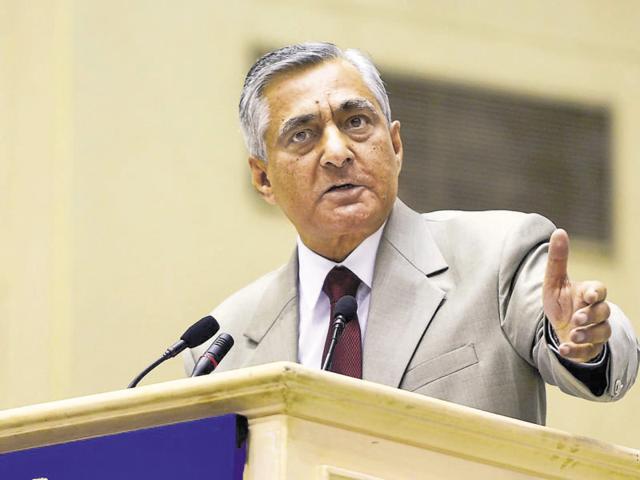
Addressing a press conference to mark two years of the Narendra Modi government, Sadananda Gowda, Minister of Law and Justice, said the adequacy of bench strength in a country is determined on the basis of workload on the courts and not judge-population ratio.
Virtually breaking down in the presence of the Prime Minister here on April 24, CJI T S Thakur had lamented the government’s “inaction” in increasing the number of judges from the present 21,000 to 40,000 to handle the “avalanche” of litigations, saying, “you cannot shift the entire burden on the judiciary”.
Read:Chief Justice breaks down before PM over burden on judiciary
“Nothing has moved” since 1987 when the Law Commission had recommended an increase in the number of judges from 10 judges per 10 lakh people at the time, to 50, an unusually emotional Thakur said.
Responding to a question on whether the government will ever be able to reach the target of 40,000 judges (judges in the lower courts as well as judges of the Supreme Court and the 24 High Courts), Gowda said the Law Commission report given in 1987 was based on the opinion of some experts and the public.
“In the report itself they said that this has to be calculated on the basis of scientific data. But no scientific data was available. Even recently, in the Imtiaz Ahmed case, the Supreme Court itself asked the Law Commission to once again look into the matter. They once again said that this may not be possible unless we get the scientific data,” Gowda said.
Read:Need more than 70,000 judges to clear pending cases: CJI


