Sign in

Cloudbursts go up, but no system for forecast

Cloudbursts in the western Himalayan region are now routine rather than an exception.

Updated on: Jun 28, 2013, 03:00:51 IST
Hindustan Times | By , New Delhi
Share
Share via
  • facebook
  • twitter
  • linkedin
  • whatsapp
Copy link
  • copy link

Cloudbursts in the western Himalayan region are now routine rather than an exception.

Article image

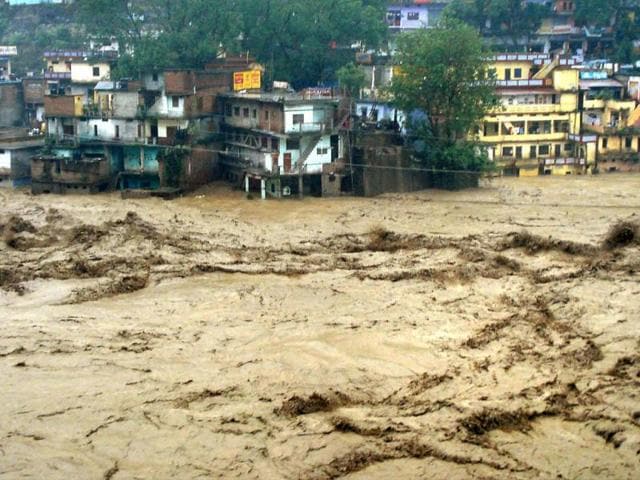
There have been around a half a dozen cloud-bursts between June 15 and June 25 in the flash flood hit states of Himachal Pradesh and Uttarakhand, shows the data of the Indian Meteorological Department (IMD).

The June 16 cloud burst follow by flash-flood in Uttarakhand had resulted in deaths of hundreds, whereas another cloud burst in Himachal had caused huge loss to
Article image

property in Kinnar district. After that two more cloud bursts each had hit the two states, the latest being on Wednesday in Mandi district of Himachal leaving three persons dead.

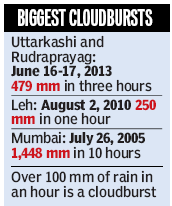
The June cloud bursts were much more than anything like that in the preceding years. Three major cloud bursts were reported from Uttarakhand in 2012 and two from Himachal that year. “The average cloudbursts in a year in last decade in these two states have been three as compared to 2.8 in 1990-200 period,” said a senior weather department official.

Even though frequency of cloud bursts has been increasing, many say because of climate change, India does not have a system to predict cloudburst resulting in flash-floods like the one for cyclones.

It is not that cloud-bursts cannot be predicted but for that one needs ground data and its proper analysis. “Installation of Doppler radars has improved cyclone warning system in coastal India. The same can be installed in the Himalayan region to predict cloud bursts,” said Chandan Ghosh, head of department of geo-hazard risk management at Indian Institute of Disaster Management (IIDM).

That many not suffice as there are many other factors that contribute to gush of water down in the hill after heavy rains.

One of them is the glacial lakes which became of faster melting of glaciers are getting excess water in the summer months. Himachal and Uttarakhand have over 250 glacial lakes which are not monitored on regular basis.

In 2004, a major disaster was averted when satellite monitoring of Parchu (glacial) lake on India-China border in Himachal showed it was over-flowing. “The ISRO (Indian Space Research Organisation) can monitor other glacial lakes also,” an official said.

Another key data required to gauge impact of flash floods in lower regions would geological and hydrological nature of upper Himalayan reaches. “The Central Water Commission can use 3D data modeling to predict floods in the hilly areas,” Ghosh said.

A study by the Indian Institute of Technology Roorkee on cloudbursts in Uttarakhand in 2012 said prediction of cloudbursts is challenging, and requires high-resolution numerical models and mesoscale observations, high-performance computers and Doppler weather radars.

The Department of Science and Technology has now proposed to install Doppler radars in the higher reaches of the Himalayas.

  • Chetan Chauhan
    ABOUT THE AUTHOR
    Chetan Chauhan

    Chetan Chauhan is the National Affairs Editor looking into all aspects of news and features from across India. A Chevening scholar with over three decades of experience in reporting and news management, Chetan has extensively covered all important aspects of the social sector, political economy, environment and climate change nationally and internationally. He did a journalism course at the Reuters Institute of Journalism in Oxford and Digital Media training at Nanyang Technological University in Singapore. He started as a reporter with The Statesman in 1996 and joined the Hindustan Times in 2000 in the metro bureau covering environment, crime and Delhi politics. He covered hot local news, from the Jessica Lal murder case to the rebellion of Delhi Congress MLAs against then Chief Minister Sheila Dikshit, to the replacement of toxic vehicle fuel with cleaner compressed natural gas (CNG) in the national capital. Some of his stories on air pollution became part of the Supreme Court’s landmark MC Mehta versus Government of India case in the National Capital Region (NCR), forcing the government to take corrective measures. As part of the national political bureau since 2004, he covered important central sectors such as environment, education, social justice, labour, rural development, water resources, renewable energy, agriculture, broadcasting and the Planning Commission for more than a decade producing several exclusive and investigative breaking stories. His specialisation is the environment, having covered at least a dozen United Nations global conferences on climate change, biodiversity and wildlife including climate summits in Paris, Copenhagen and Bali. He also covered India’s two five-year plans ---11th and 12th and reported on drafting and execution of right based laws such as Right to Education, Right to Information and rural job guarantee law, MG-NREGA, now being introduced in new format as VG-RAM-G Act. He has in-depth knowledge of social sector issues. He was one of the first to report on tigers vanishing from Sariska and Panna wildlife reserves in 2004 and 2008, respectively, leading to the setting up of the National Tiger Conservation Authority (NTCA) and the introduction of stringent penal provisions for poaching. He has written extensively on the rising human-animal conflict in India and the degradation of India’s biodiversity hotspots because of mining and other activities. Since 2004, Chetan has covered Parliament comprehensively and participated in training on the nuanced coverage of Parliament proceedings. He has travelled extensively across India to cover national and provincial elections since 1998, especially in the Hindi heartland states, considered India’s road to power. He writes a regular column for Hindustan Times, Ecostani, on important national politics, economy, Himalayan ecology and environmental issues. His other responsibilities include providing inputs for edits and edit page articles for the publication, apart from managing news flow from across India.Read More

Check India news real-time updates, latest news on Hindustan Times and more across India.