
 E-Paper



Death and despair in the hills of Assam
The ethnic conflict between the Rengmas and the Karbis in the remote forests of Assam has displaced many, caused suffering and turned the region into a political tinderbox.


On the night of January 3, nine decomposed bodies were found wrapped in plastic sheets in Pachaspura, 6 km from Chumukedima town in neighbouring Nagaland’s Dimapur district.
After initially shunning responsibility, the youngest militant organisation in the region, Rengma Naga Hills Protection Force (RNHPF), announced that they had killed the nine Karbi people.
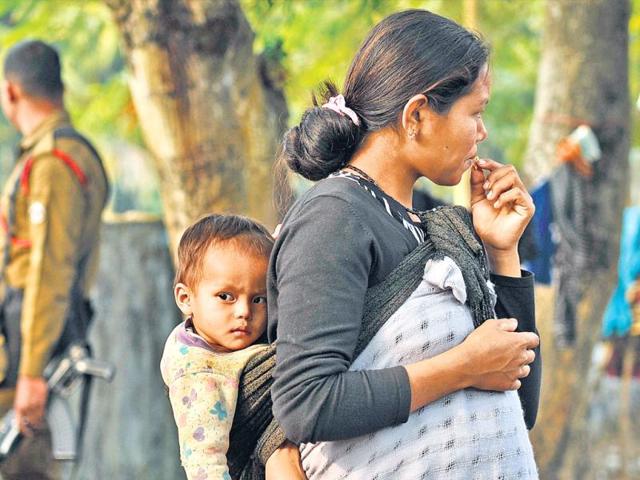
The move by the Rengma militant force was seen as retaliation to the killings of six Rengma Nagas and the destruction of homes in several Rengma villages a few days before by the Karbi People’s Liberation Tigers (KPLT). The Assam-Nagaland border has been tense since and the death toll has gone up to 17 — which includes six Rengma Nagas and 11 Karbis. Rengma Nagas are the indigenous people who have inhabited the region for centuries, while Karbis have settled there from the eastern part of the northeast region.

The conflict zone
In the early hours of December 27, 50-year-old Rangkheng Rengma was in the jungle with two others behind his house in Khoani, the first village to be attacked, when he saw armed men shielded by locals moving toward his house. “They fired at us but we somehow escaped and ran deep inside the jungle. I met my son in the next village where he told me about my wife,” says Rangkheng. His wife was the first victim of the violence that gripped the remote areas of the Karbi Anglong district.
“It was a clash between the cadres of militant groups RNHPF and KPLT that escalated the tension and displaced thousands,” said Shankar Raimedhi, sub-divisional police officer, Bokajan, who looks after the region where violence has broken out. According to Raimedhi, when the Karbi militants, after burning several houses, went to the next village, Khanari, they faced retaliatory attacks. The villagers of Khanari say they fought back themselves killing two KPLT cadres and that RNHPF was not involved.
The violence continued thereafter with several Rengma villages being raided. Houses and granaries in Khoani, Saathi, Balisanda, Khanari and Panjan were razed to the ground. Six Rengmas, five of whom were women, were killed. Kanti J Rengma, a resident of Balisanda, which is next to a CRPF camp, witnessed the burning of 14 houses, including a Rengma student’s hostel and a church. “We saw our houses going up in flames as we forced our way into the camp. The village was right next to the camp, even then the CRPF seemed reluctant to go and stop them,” he said.
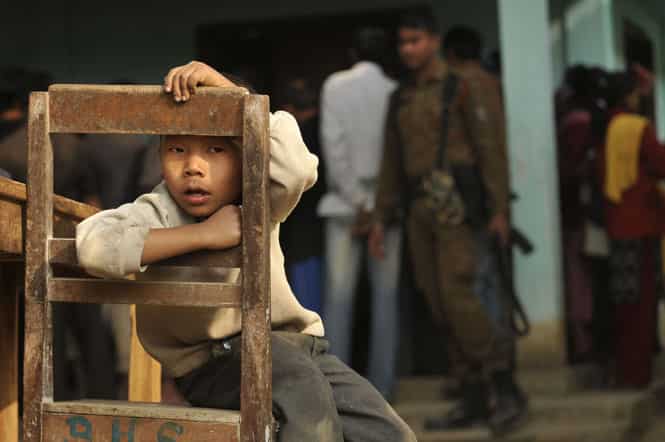
Genesis of the troublesThe seed of the recent violence between the two tribal communities was sown in late 2012 with the establishment of the RNHPF, a militant outfit that seeks to protect the Rengmas, a minority in the district. The Karbi extremist group KPLT (formed in 2011) saw this as a threat and a turf war engulfed the region. The looming fear made people from the remotest regions of the hills leave their homes in hordes to take refuge in the nine relief camps scattered in the Chokihola and Borpathar areas of Karbi Anglong.
In June 2013, the KPLT sent an ultimatum to the Rengmas to hand over the RNHPF militants or face the consequences. They also ordered the villagers to assume Karbi identities. The Karbi Anglong Peace Forum (KAPF), made up of over 30 civil society groups who, incidentally, are all Karbi, and formed after the December 27 killings, denies an ultimatum was given.
The deadline passed but no RNHPF members surrendered. Then, in late October, according to K Solomon Rengma of the Rengma Naga People’s Council (RNPC), the KPLT forced an economic blockade in the region and movement was restricted until December 14. Several narratives exist about the December 14 incident. The official version traces the genesis of the recent violence to one Mukrang Bey, a resident of Nihang village, who was beaten up by alleged RNHPF members. Next day, the gaon bura or village headman of Nihang village sent three young men with a peace proposal. When the boys reached the village they were met by militants. “We were blind-folded and taken to the jungle where we were tortured with knives and rifle butts,” said Deben Kiling showing the slashes all over his body.
Retaliatory incidents on both sides went on until December 25. Several gaon buras in the relief camps mentioned hearing of a possible KPLT attack on December 25. The mostly Christian Rengmas, left for the jungle soon after their Christmas service, and stayed there for two nights before moving to relief camps. According to the police, blank shots were fired that day and empty shells were recovered later when they visited the region. The Karbi version of the story is similar. Both sides are keen to show that they are not involved with the militants.
Taxing the locals
Most of the Rengma Nagas live in the hilly areas of the district, bordering Golaghat. However, even in these areas, the majority are Karbis. The two tribes, who rely on the cultivation of oranges, betel nut, chilly, paddy and forest produce, mostly live in separate villages. 150 kms from the district headquarter Diphu, the region is so remote that some villages can only be approached on foot on rudimentary roads that snake through the mountain forests.
The Karbi militants had imposed a 60% ‘tax’ on the produce grown by the villagers. “Karbi militants, since the 1990s, have been levying taxes on Rengma households, extorting money from our fishing, orchards and crops,” said K Solomon Rengma, general secretary, Rengma Naga People’s Council. The RNHPF, which local Rengma leaders claim was created in self-defence, in turn, extorts money to run the outfit. These hill ranges are also part of a notorious trafficking route for arms, drugs and animal body parts to Southeast Asia.
Political hijack
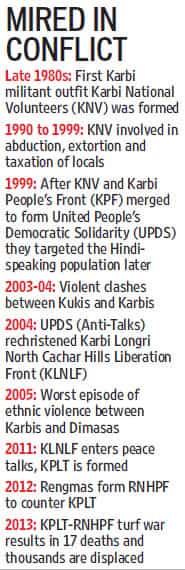
The region has seen countless killings but the recent violence involves young extremist outfits. In the late 1980s, Karbi National Volunteers (KNV) was created intending to use violence to secure a separate Karbi Anglong state. The KNV was the first to collect ‘taxes’ from villagers. In 1999, the KNV merged with the Karbi People’s Front (KPF), to form the United People’s Democratic Solidarity (UPDS).
When UPDS began peace talks with the government in 2002, the outfit split in two with one calling itself UPDS (Anti-Talks), later the Karbi Longri North Cachar Hills Liberation Front (KLNLF). “When the KLNLF started peace talks, a group of kids broke away and formed KPLT,” said the Pongbi Dilli alias Pradip Terang, the founder of KVN. “These young Karbis don’t follow the ideology that was once behind the armed group’s formation,” he adds.
The region has now become a political cauldron, where a number of organisations are competing for political gain. “We have asked the government to set up an inquiry into all the conflicts in the region since 2003,” said Benting Teron, chairman, KAPF. “We have condemned the act by both the outfits and are here for peace with our Rengma brothers”. The Rengma leaders, however, are apprehensive about joining the forum. “The Karbi politicians and militants are conspiring to drive Rengmas out of the district. So constituting a peace forum, no matter how noble the intention, seems shallow,” said K Solomon Rengma of RNPC.

She Saw her house burn
Premika Teronpi, 26
Premika was brought to her parent’s home after her mother heard that the Rengmas were going to be attacked. Premika, a Karbi, is married to Nangthi, a Rengma boy, who lives two houses down the road in Panajn village, some 15 kms from the Chokihola police station. When Premika was asked to return, she took her young daughter with her, while the Rengma side of her family fled to Diphu.
The next day, her house was burnt by Karbi militants. “I saw them burning our house. Everything we had including grains and the orange harvest went up in flames,” Premika says. Her in-laws were the only Rengmas living in Panjan and had never before faced any problems living in the Karbi village. The piece of land that once had a big house and several huts for grain and livestock now lies strewn with ashes, burnt utensils and fallen tin roofs.

Old and blind, forced to run
Chiru Rongpi, 101
Age and blindness had restricted Chiru Rongpi to his house in Maigaon village, but he was forced to flee along with other villagers.
His son supported him as he walked for around 25 kms to the Koilamati camp.
He doesn’t know why he has been forced to live in the camp and is unaware of the violence that has gripped the tribal communities.
“We stayed three nights in the jungle and ate the plain rice we brought with us,” said Chiru.
Pregnant, but walked 30 kms
Rodali Rongpipi, 28
Fearing retaliation from the RNHPF, Rodali, a Karbi, who is nine months pregnant walked 30 kms from her home in Langhonjar village to the relief camp in Bensing. The camp is occupied by both CRPF personnel and 243 Karbi villagers. Five women are in different stages of pregnancy, but medical help is not enough for all of them. “Nurses come here, but they asked me to stay here instead of going to a hospital,” said Rodali.

Walks with bullet pellets in his legs
Kegwachii J Rengma, 25
Kegwachii is from Khanari village, which was the second target of the Karbi outfit.
“We heard that the militants had burnt houses in the nearby Khoani village. All the men gathered with whatever weapons they could find and prepared to fight,” recalls Kegwachii.
The police, however, is of the opinion that RNHPF cadres were also present and that it was they who fought with the KPLT cadres who attacked the village.
Kegwachii was shot in the clash. On his X-ray, he points out the eight bullet pellets lodged in his thigh and groin. A pellet is lodged in one of his testicles. “I was brought to the relief camp in a makeshift stretcher and was later taken to a hospital in Guwahati. The doctors didn’t remove the pellets though,” he said. “It hurts a lot when I walk.”

Left home right after delivery
Chato and Shenshu Rengma
"Not even 20 minutes after my wife gave birth, we heard gun shots. She was still bleeding when we fled to the jungle,” said Chato Rengma, who is from Khanari village that was attacked by Karbi militants on December 27.
“We walked nearly 10 kms to reach the next village, Phangcherop, through the jungle where we spent a night. Then, we walked another 10km to the Chokihola police station the next day,” he said.
‘It’s better to die than live in these camps’
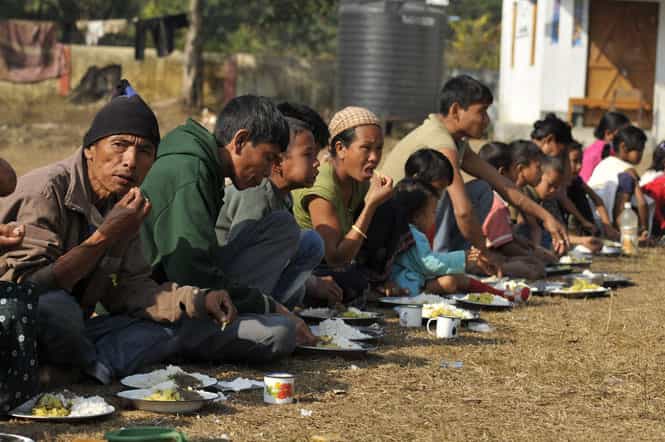
People living in the relief camps are afraid to go back home. All the camps in Karbi Anglong have been set up in government schools. Out of the nine relief camps set up in the region, three in the Borpathar region are occupied by Rengmas and the rest by Karbis. “We will not go back unless there is a peace agreement between the warring outfits or unless the government assures security,” says 68-year-old Ragi Rengma, who lost his house and now lives in the Borpathar LP school relief camp.
Far from their villages, living in relief camps is a struggle for people from both communities. Cold has started to take its toll. Of the eight relief camps that HT visited, one death from the Rengmas and two from the Karbi side were reported. There has been an outbreak of measles in Borpathar camp, where at least 10 children have been infected. “Medical help is being provided by the administration, but it isn’t enough for the hundreds living here,” said Kanti Rengma, who is part of the committee.
While the lower reaches have seen some help, camps in remote areas like Koilamati and Bensing have received a token amounts as relief from the administration. In Bensing, a major section of the camp has been taken over by the CRPF, leaving very little room for the 243 people there. Three Chokihola relief camps, which are more accessible than others, have received just 200 blankets for 1200 camp dwellers.
“It’s better to die than live in these camps in fear,” says 90-year-old Omphu Hansepi in Sardoka Engti school camp. “Have we lived our lives just to witness these conflicts?”


