
 E-Paper



EC goes slow on complaints against Modi, Rahul
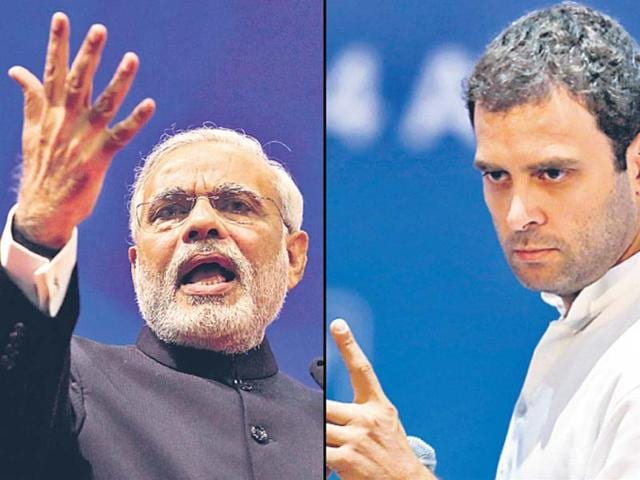
The Election Commission (EC) is going slow on complaints filed against Bharatiya Janata Party’s (BJP’s) prime ministerial candidate Narendra Modi and Congress vice-president Rahul Gandhi to stop vitiating the atmosphere in poll time.


The Election Commission (EC) is going slow on complaints filed against Bharatiya Janata Party’s (BJP’s) prime ministerial candidate Narendra Modi and Congress vice-president Rahul Gandhi to stop vitiating the atmosphere in poll time.
A verbal battle between Modi and Gandhi has been a key aspect of campaigns for assembly elections in Chhattisgarh (November 11 and 19), Madhya Pradesh and Mizoram (November 25), Rajasthan (December 1), and Delhi (December 4).
The poll watchdog unwillingly became a part of the mudslinging as both parties filed a series of model code of conduct violation complaints against their opponents.
Addressing an election rally in MP’s Indore on October 24, Gandhi had said Pakistan’s Inter-Services Intelligence had attempted to woo the Muslim youth whose kin were killed during the Muzzafarnagar communal riots in Uttar Pradesh this September. He had also accused the BJP of inciting the clashes.
Modi for his part made a reference to the “khooni panja” while addressing a rally in Chhattisgarh and touched a raw nerve. The Congress, whose election symbol is a hand, lodged a complaint with the EC. Read More: EC rejects Modi’s argument on ‘khooni panja’ remark
The EC sought an explanation first from Gandhi and then from Modi — within two days of receiving the complaints — and issued orders asking both to be cautious in their speeches during elections.
Agreeing that the level of political debate had shifted from criticism of opponents’ on policies and programmes as mandated under the model code to frequent personal barbs, the commission has discussed the issue at length.
“We are also concerned at the level of political debate in elections and are of the considered view that the commission platform cannot be used for scoring electoral points,” an EC functionary said.
Several former election commissioners such as SY Quraishi and N Gopalaswami have also expressed their anguish at the falling level of political debate in the current polls.
But with election campaigns going on in full swing, more such complaints were lodged with the EC. On November 18, the Congress filed two complaints against the BJP — one for issuing an objectionable poster of Union minister Kapil Sibal and the other for Modi’s “shehzada” barb at Gandhi. Read More: Modi ignores Cong tough talk on 'shehzada', says 'will stop if dynasty rule ends'
The BJP hit back four days later, filing as many complaints against the Congress, which came down heavily on the political rival.
The EC believes that a swift action on so many complaints could have had an adverse impact on the electoral atmosphere in the poll-bound states. However, officially the complaints are still under examination.
The commission also believes that its advisories to Modi and Gandhi had a positive impact as personal attacks on the opponents from the Congress and the BJP has come down in the last few days.
“The model code is a tool to be used judiciously,” said an official, while explaining the positive impact of its orders on various political parties.


