
IITs out, PSUs in for Aakash 2
With Aakash failing to take off, the HRD ministry has decided to keep premier educational institution -- Indian Institute of Technology -- out of procurement and distribution of the low cost tablets. Chetan Chauhan reports.
With Aakash failing to take off, the HRD ministry has decided to keep premier educational institution -- Indian Institute of Technology -- out of procurement and distribution of the low cost tablets.
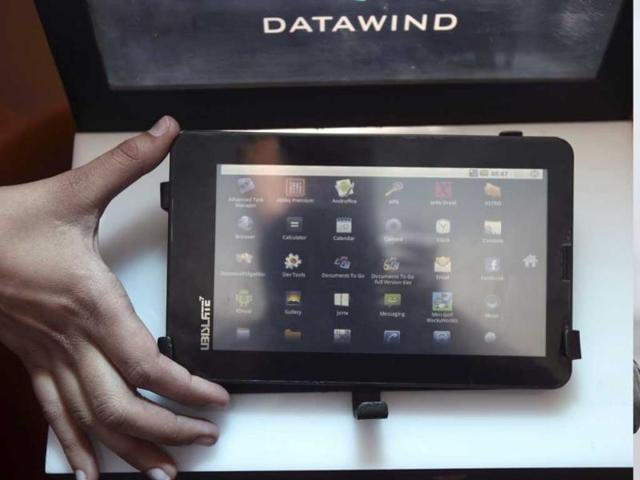
The ministry has decided that the public sector enterprises -- Indian Telephone Industries (ITI) and Bharat Electrical Limited (BEL) and Centre for Development of Advaned Computing (CDAC) -- will do the job of producing and distributing a million tablets to college students across India.
The HRD ministry plans to give 220 million Aakash tablets to college students in the next five years to bridge the e-literacy gap. The ambition is complete internet penetration among college students from present less than 50%.
The HRD ministry experience with Indian Institute of Technology, Jodhpur, in managing the first version of Aakash launched in October 2011 had not been good. The IIT had not been able to distribute even a single table to college students, other than 650 given for testing to IIT students.
What has irked the ministry is that the IIT rejected most of the tablets given by Montreal based Datawind on the grounds of poor quality. The IIT, Jodhpur, officials told HT that the tablets provided by the company failed to test to meet the rigid Indian conditions.
"The tablet should run anywhere from Kashmir to Kanyakumari and in high rain zones of north-east," an IIT official, requesting anonymity said, adding that most of the tablets failed the test.
HT was first to report that the ministry will not procure any tablet from Datawind, which had been able to supply only 10,000 out to of the one lakh order, in future.
The company, however, said it has not been informed about any such decision and denied the claims on quality saying the tablet meet all the conditions required to run in normal conditions.
Fed up with the wrangling between Datawind and IIT Jodhpur, the job of finalizing the specifications of second version of Aakash has been given to IIT Kanpur, IIT Madras IIT Delhi and IIT Bombay.
"They have provided preliminary specifications which sound good," an official said, adding that they were lower than what IIT Jodhpur had prescribed.
IIT Jodhpur had said that Aakash 2 should be able to run in temperature ranging from – 20 degree Celsius and 50 degree Celsius and should work in heavy rain.
It will lead to higher cost for Aakash 2, as HT had reported earlier. The ministry has now fixed a range of US $35 to US $50 for the new tablet with the final procurement price to be around US $70.
ABOUT THE AUTHORChetan ChauhanChetan Chauhan is the National Affairs Editor looking into all aspects of news and features from across India. A Chevening scholar with over three decades of experience in reporting and news management, Chetan has extensively covered all important aspects of the social sector, political economy, environment and climate change nationally and internationally. He did a journalism course at the Reuters Institute of Journalism in Oxford and Digital Media training at Nanyang Technological University in Singapore. He started as a reporter with The Statesman in 1996 and joined the Hindustan Times in 2000 in the metro bureau covering environment, crime and Delhi politics. He covered hot local news, from the Jessica Lal murder case to the rebellion of Delhi Congress MLAs against then Chief Minister Sheila Dikshit, to the replacement of toxic vehicle fuel with cleaner compressed natural gas (CNG) in the national capital. Some of his stories on air pollution became part of the Supreme Court’s landmark MC Mehta versus Government of India case in the National Capital Region (NCR), forcing the government to take corrective measures. As part of the national political bureau since 2004, he covered important central sectors such as environment, education, social justice, labour, rural development, water resources, renewable energy, agriculture, broadcasting and the Planning Commission for more than a decade producing several exclusive and investigative breaking stories. His specialisation is the environment, having covered at least a dozen United Nations global conferences on climate change, biodiversity and wildlife including climate summits in Paris, Copenhagen and Bali. He also covered India’s two five-year plans ---11th and 12th and reported on drafting and execution of right based laws such as Right to Education, Right to Information and rural job guarantee law, MG-NREGA, now being introduced in new format as VG-RAM-G Act. He has in-depth knowledge of social sector issues. He was one of the first to report on tigers vanishing from Sariska and Panna wildlife reserves in 2004 and 2008, respectively, leading to the setting up of the National Tiger Conservation Authority (NTCA) and the introduction of stringent penal provisions for poaching. He has written extensively on the rising human-animal conflict in India and the degradation of India’s biodiversity hotspots because of mining and other activities. Since 2004, Chetan has covered Parliament comprehensively and participated in training on the nuanced coverage of Parliament proceedings. He has travelled extensively across India to cover national and provincial elections since 1998, especially in the Hindi heartland states, considered India’s road to power. He writes a regular column for Hindustan Times, Ecostani, on important national politics, economy, Himalayan ecology and environmental issues. His other responsibilities include providing inputs for edits and edit page articles for the publication, apart from managing news flow from across India.Read More

E-Paper


