
 E-Paper



Maharashtra, Punjab top producers of green energy from farm waste
Every November, farmers in the northern states of Punjab, Haryana and Rajasthan burn their agricultural waste increasing the air pollution in the national capital region and neighbouring cities — home to over 25 million people.


Three years ago, when representatives from Sukhbir Agro approached farmers in Punjab proposing they sell their farm waste to the company to generate bio-energy, no one believed them.
“They proposed to buy our waste… We didn’t believe them,” said Amolak Singh, a farmer.
However, as the farmers slowly came around to the idea the green benefits of this move became apparent.
Every November, farmers in the northern states of Punjab, Haryana and Rajasthan burn their agricultural waste increasing the air pollution in the national capital region and neighbouring cities — home to over 25 million people.
The waste collected is enough for the company’s biomass plant to generate green electricity around the clock, which then is sold to the Punjab government at a price higher than thermal power.
“They buy my produce and my waste,” said an elated Amolak Singh, adding that by selling the waste helps him cover his annual farm labour costs.
Since the quality of the waste is also good, the company’s efficiency is about 80% — almost the same as thermal power and much higher than that of solar power which currently stands at 13-18%.
Maharashtra shows the way
A 2012 study by IIT-Kharagpur said that since most farmers do not find buyers for their waste, they burn it — which releases a huge amount of emissions — or dump it leading to soil and water contamination.
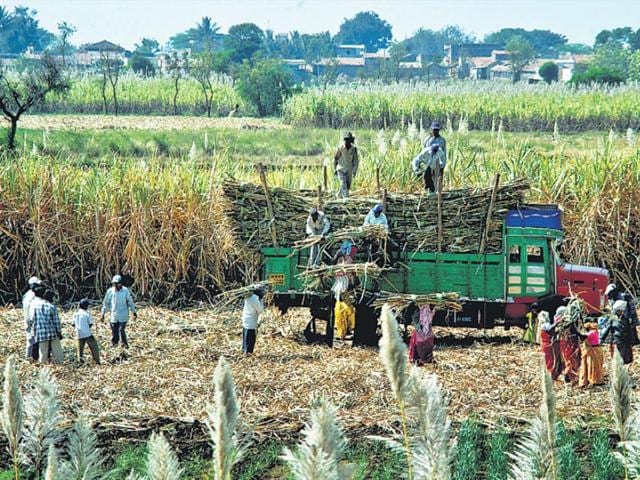
India generates about 350 million tonnes of agricultural waste every year, which can generate more than 18,000 MW of power a year. While its productive use is limited, Maharashtra’s Satara district has shown it can be done by processing sugarcane molasses for to generate electricity and act as fertilizer for fields.
A unit, set up by a company in collaboration with Sugarcane Farmers’ Cooperative and German federal technical agency GIZ, collects the waste from around 10,000 sugarcane farmers. It is then treated and fed into a boiler at the unit to generate electricity.
Suresh Aklekar, chairperson of the cooperative, told HT it is a win-win situation. “The productivity has improved since the fertiliser was used and the problem of dealing with the waste has also been taken care of,” he said, adding many other cooperatives in Maharashtra have now started adopting this new development model.
Biomass mission
While Punjab and Maharashtra have taken a lead in setting up biomass plants, other states like Uttar Pradesh, Haryana, Gujarat and Madhya Pradesh — which contribute half of India’s annual agricultural waste worth Rs 50,000 crore —are lagging behind because of low tariff.
The ministry of new and renewable energy’s review found that tariff as low as Rs 2.2 in Kerala, Rs 3.3 in Madhya Pradesh, Rs 3.6 in Karnataka and Rs 4 in Uttar Pradesh as compared to Rs 5.05 per unit in Punjab and Rs 4.98 per unit in Maharashtra, thus making them attractive destination for investors in the new-age green power.
To provide a level-playing field across the states and give them an incentive, the government had planned to set up a national biomass mission to harness 620 million tonnes of bio-resources.


