
 E-Paper



Millennia-old glitch with new trait caused Nepal earthquake: Experts
The earthquake of 7.9 magnitude that jolted Nepal on Saturday may have felt like a terrifying ‘here-and-now’ event, but its origins go back some 50 million years— it was caused by the same seismic forces that produced the Himalayas, the world’s tallest mountain range, experts say.


The earthquake of 7.9 magnitude that jolted Nepal on Saturday may have felt like a terrifying ‘here-and-now’ event, but its origins go back some 50 million years— it was caused by the same seismic forces that produced the Himalayas, the world’s tallest mountain range, experts say.
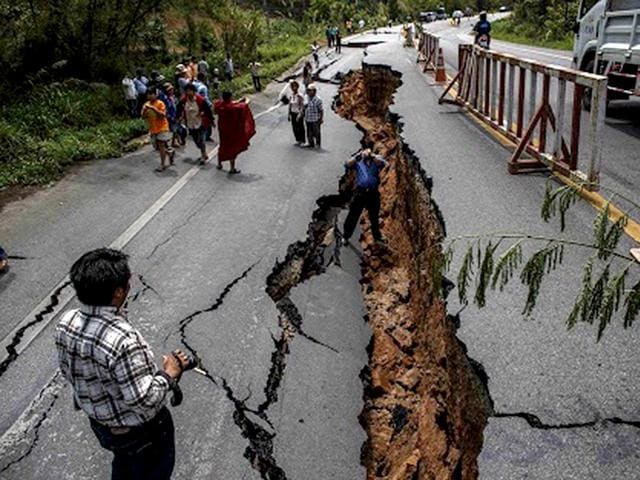
Millennia ago, the Indian subcontinent —which comprises India, Pakistan, Bangladesh and Sri Lanka — began racing northwards to crash into Eurasia. That caused landmass to wedge up, forming craggy terrain, such as the Himalayan peaks, the Karakoram range, Pamirs and Hindu Kush mountain ranges.
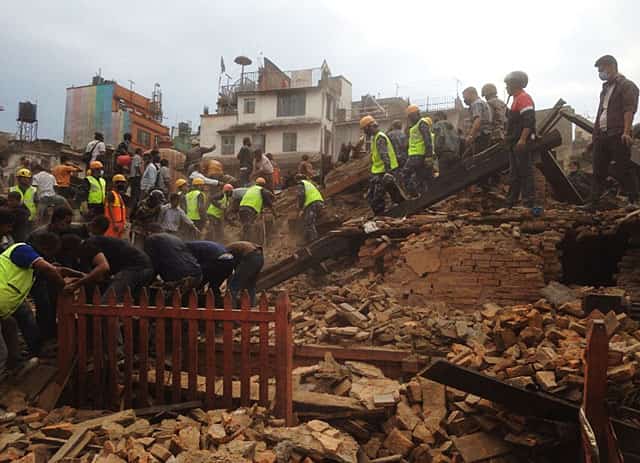
Rescuers clear the debris at Durbar Sqaure after the earthquake in Kathmandu.(AP Photo)
A relatively new phenomenon within that process is that of the Indian continental plate – or a sheet of landmass -- trying to “subduct” or lodge itself beneath the Eurasian plate towards the north. Saturday’s Nepal quake, which had its epicenter 77 km northwest of Kathmandu, was the direct result of that.
“It is clearly the result of all that activity. There was probably a very large rupture because of that momentum, which still continues,” R Baidya, a seismologist with the India Meteorological Department said.
Just like a large passenger jet that takes time to come to a complete halt after landing, the Indian landmass is yet to lose the momentum of that great event. It currently is pressing against the Eurasian landmass at a rate of about 1.6 inches (40 mm) a year.
However, the “subduction” of the south Indian plate with the north Eurasian plate has resulted in much more “shallower faults”, or seismic events not far from the Earth’s surface, which makes the “Indo-Nepal border very seismically busy”, Francis Katovick, a geologist with Cunningham University who studies the region, said on Twitter .
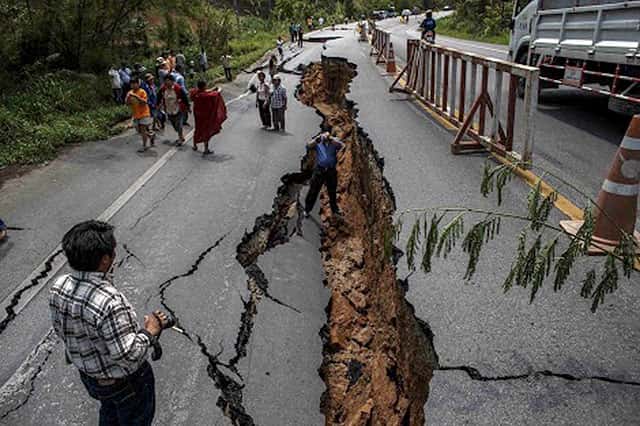
A damaged road after a powerful earthquake hit Kathmandu, Nepal. (Photo by Special Arrangement)
According to the “plate tectonics” theory, the Earth’s solid outer crust — the lithosphere —comprises numerous disjointed “sheets” of land floating around the asthenosphere or the molten upper part of the Earth’s core or mantle. These plates tend to behave like blindfolded people slamming into each other.
Baidya said there is no surefire way of saying how many aftershocks may be generated.
“In the Jabalpur quake in 1997, all aftershocks happened within two-three days, but in the 2001 Bhuj quake, the tremors kept happening until months,” he said. However, “theoretically”, there is no immediate major risk of another earthquake with a seven plus magnitude, Baid


