
Sign in

NOTA verdict, from Chhattisgarh villages to Delhi colony

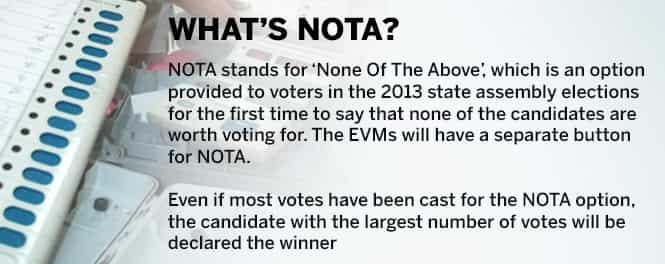
The none of the above (NOTA) option in the EVMs made its debut in the 2013 assembly elections. While its effects were quite pronounced in the Maoist affected areas of Chhattisgarh, it failed to make a huge dent in most urban locations.

Updated on: Dec 8, 2013, 20:28:30 IST
Hindustan Times | By , New Delhi
Share
Share via
  • facebook
  • twitter
  • linkedin
  • whatsapp
Copy link
  • copy link

The none of the above (NOTA) option had its visible impact on the outcome of election results in many constituencies in the Maoist-hit areas of Chhattisgarh.

HT Image
HT Image

The number of people who pressed the NOTA button in the Dantewada assembly constituency was more than the margin with which Devati Karma, wife of slain Congress leader Mahendra Karma, defeated her nearest rival Bhimaram Mandavi.

She won by a margin of 5,987 votes, less than the 9,670 voters who opted for NOTA.

The Election Commission had for the first time introduced the NOTA option on Electronic Voting Machines in five states - Madhya Pradesh, Rajasthan, Delhi, Chhattisgarh and Mizoram - on the directions of the Supreme Court in October.

Before that, the NOTA could be exercised only through a paper ballot.

In Maoist-affected areas of Chhattisgarh, which recorded the all-time high turnout of 75%, voters exercised NOTA option to show dissent, though more than 3 lakh voters pressed NOTA button in the four states where votes were counted on Sunday.

In Narayanpur area of Chhattisgarh too, the NOTA votes outnumbered the victory margin of the winning candidate.

The results clearly show that the NOTA option played an important role in raising the polling percentage, with about 3% of the total votes polled falling in this category.

While the maximum number of NOTA votes was polled in Dantewada, about 10% of voters in Bijapur exercised the option showing they indirectly supported the call of Maoist leaders to boycott the polls.

About 70,000 people had come out to vote, double the number in 2008 polls.

The response to NOTA in the national capital was poor, but Shazia Ilmi of Aam Aadmi Party’s margin of defeat was less than the number of NOTA votes in the RK Puram constituency.

As many as 528 people opted for NOTA, whereas Azmi lost by about 326 votes. In most of the constituencies the people opting for NOTA in Delhi was less than 0.5% of the total votes polled.

In Rajasthan the BJP may have swept the polls but about 90,000 people exercised the option. In several constituencies in the state such as Ghotol, Deoli-Uniara and Chittorgarh, more than 3,000 people rejected all the candidates in fray.

In Madhya Pradesh, more than 1,000 voters used NOTA option in chief minister Shivraj Singh Chouhan’s assembly constituency Vidisha.

In all about 50,000 people rejected all the candidates in fray. The NOTA option was used more in tribal areas than in urban locations.
Article image
  • Chetan Chauhan
    ABOUT THE AUTHOR
    Chetan Chauhan

    Chetan Chauhan is the National Affairs Editor looking into all aspects of news and features from across India. A Chevening scholar with over three decades of experience in reporting and news management, Chetan has extensively covered all important aspects of the social sector, political economy, environment and climate change nationally and internationally. He did a journalism course at the Reuters Institute of Journalism in Oxford and Digital Media training at Nanyang Technological University in Singapore. He started as a reporter with The Statesman in 1996 and joined the Hindustan Times in 2000 in the metro bureau covering environment, crime and Delhi politics. He covered hot local news, from the Jessica Lal murder case to the rebellion of Delhi Congress MLAs against then Chief Minister Sheila Dikshit, to the replacement of toxic vehicle fuel with cleaner compressed natural gas (CNG) in the national capital. Some of his stories on air pollution became part of the Supreme Court’s landmark MC Mehta versus Government of India case in the National Capital Region (NCR), forcing the government to take corrective measures. As part of the national political bureau since 2004, he covered important central sectors such as environment, education, social justice, labour, rural development, water resources, renewable energy, agriculture, broadcasting and the Planning Commission for more than a decade producing several exclusive and investigative breaking stories. His specialisation is the environment, having covered at least a dozen United Nations global conferences on climate change, biodiversity and wildlife including climate summits in Paris, Copenhagen and Bali. He also covered India’s two five-year plans ---11th and 12th and reported on drafting and execution of right based laws such as Right to Education, Right to Information and rural job guarantee law, MG-NREGA, now being introduced in new format as VG-RAM-G Act. He has in-depth knowledge of social sector issues. He was one of the first to report on tigers vanishing from Sariska and Panna wildlife reserves in 2004 and 2008, respectively, leading to the setting up of the National Tiger Conservation Authority (NTCA) and the introduction of stringent penal provisions for poaching. He has written extensively on the rising human-animal conflict in India and the degradation of India’s biodiversity hotspots because of mining and other activities. Since 2004, Chetan has covered Parliament comprehensively and participated in training on the nuanced coverage of Parliament proceedings. He has travelled extensively across India to cover national and provincial elections since 1998, especially in the Hindi heartland states, considered India’s road to power. He writes a regular column for Hindustan Times, Ecostani, on important national politics, economy, Himalayan ecology and environmental issues. His other responsibilities include providing inputs for edits and edit page articles for the publication, apart from managing news flow from across India.Read More

Get the latest India News, breaking headlines and real-time updates from across the country. Stay informed about politics, government policies, crime, weather and major national developments.