Sign in

Paris talks: India opposes US-backed plan to measure climate finance

India has given its “nuanced consent” to proposals for a tougher temperature goal to combat global warming and reviews every five years of countries’ climate plans but has opposed a US-backed contentious plan to measure climate finance, sources said on Tuesday.

Updated on: Dec 8, 2015, 19:27:32 IST
Hindustan Times | By , Paris
Share
Share via
  • facebook
  • twitter
  • linkedin
  • whatsapp
Copy link
  • copy link

India has given its “nuanced consent” to proposals for a tougher temperature goal to combat global warming and reviews every five years of countries’ climate plans but has opposed a US-backed contentious plan to measure climate finance, sources said on Tuesday.

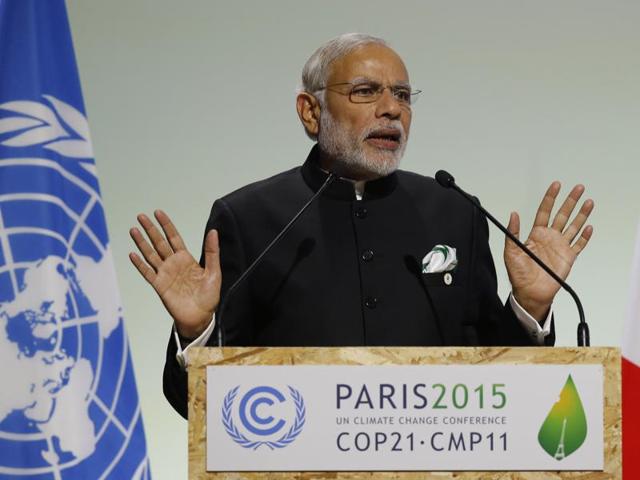
US Secretary of State John Kerry waves as he walks off stage after speaking at the Mashable/UN Foundation "Earth to Paris" Summit in Paris. India has agreed to proposals for a tougher temperature goal, but has opposed a US-backed plan to measure climate finance. (REUTERS Photo)

Two days of discussions in Paris anchored by 14 international ministers serving as facilitators saw developed countries like India showing much more “flexibility”, agreeing to voluntary expansion of the donor base for climate finance with reference to a proposed global treaty.

“We don’t mind being part of the Paris agreement, but South-South climate finance (from developing to developing countries) should not be under the UN convention,” said an Indian negotiator, adding that it was now the developed world’s responsibility to provide a clear road map for funding post 2020.

India and China both have increased their financial help to vulnerable countries recently with Prime Minister Narendra Modi holding separate summit-level meetings with heads of island and African nations, the two regions most at risk.

Harjeet Singh of the non-profit Action-Aid said India has been “very flexible” in the last 10 days and has moved ahead on almost all issues, but countries responsible for climate change such as the US and European nations are sticking to their stand.

The United States has proposed a methodology used in a controversial Organisation for Economic Co-operation and Development (OECD) report to measure climate finance from the rich nations, a move that India has resisted. US climate negotiator Todd Stern raised the issue at a meeting with the facilitators on Monday.

The OECD report in October claimed rich countries have provided climate finance of about $60 billion which the developing world has termed an “exaggeration”.

India and other developing countries have described the methodology to measure climate finance as “flawed” and “unacceptable”.

New Delhi has come out with a discussion paper, saying the Green Climate Fund had less than $6 billion till mid-2015 against the commitment of $10 billion a year.

While there appears to be some forward movement on expanding the base of donors, sources say talks are stuck on the issue of embedding differentiation as defined in the 1992 UN climate convention in all six elements of the Paris agreement.

A lot of discontent was expressed over the work of the facilitators on the differentiation issue, which rich nations want to dilute, as developing nations said the ministers failed to provide clarity on matters raised by various countries.

  • Chetan Chauhan
    ABOUT THE AUTHOR
    Chetan Chauhan

    Chetan Chauhan is the National Affairs Editor looking into all aspects of news and features from across India. A Chevening scholar with over three decades of experience in reporting and news management, Chetan has extensively covered all important aspects of the social sector, political economy, environment and climate change nationally and internationally. He did a journalism course at the Reuters Institute of Journalism in Oxford and Digital Media training at Nanyang Technological University in Singapore. He started as a reporter with The Statesman in 1996 and joined the Hindustan Times in 2000 in the metro bureau covering environment, crime and Delhi politics. He covered hot local news, from the Jessica Lal murder case to the rebellion of Delhi Congress MLAs against then Chief Minister Sheila Dikshit, to the replacement of toxic vehicle fuel with cleaner compressed natural gas (CNG) in the national capital. Some of his stories on air pollution became part of the Supreme Court’s landmark MC Mehta versus Government of India case in the National Capital Region (NCR), forcing the government to take corrective measures. As part of the national political bureau since 2004, he covered important central sectors such as environment, education, social justice, labour, rural development, water resources, renewable energy, agriculture, broadcasting and the Planning Commission for more than a decade producing several exclusive and investigative breaking stories. His specialisation is the environment, having covered at least a dozen United Nations global conferences on climate change, biodiversity and wildlife including climate summits in Paris, Copenhagen and Bali. He also covered India’s two five-year plans ---11th and 12th and reported on drafting and execution of right based laws such as Right to Education, Right to Information and rural job guarantee law, MG-NREGA, now being introduced in new format as VG-RAM-G Act. He has in-depth knowledge of social sector issues. He was one of the first to report on tigers vanishing from Sariska and Panna wildlife reserves in 2004 and 2008, respectively, leading to the setting up of the National Tiger Conservation Authority (NTCA) and the introduction of stringent penal provisions for poaching. He has written extensively on the rising human-animal conflict in India and the degradation of India’s biodiversity hotspots because of mining and other activities. Since 2004, Chetan has covered Parliament comprehensively and participated in training on the nuanced coverage of Parliament proceedings. He has travelled extensively across India to cover national and provincial elections since 1998, especially in the Hindi heartland states, considered India’s road to power. He writes a regular column for Hindustan Times, Ecostani, on important national politics, economy, Himalayan ecology and environmental issues. His other responsibilities include providing inputs for edits and edit page articles for the publication, apart from managing news flow from across India.Read More

Follow India news real-time updates and the latest news covered on Hindustan Times, featuring today's critical updates on Sonam Wangchuk Hunger Strike LIVE and more across India.