
 E-Paper



SC empowers voters, gives them option to reject electoral candidates
The apex court directed the Election Commission to have an option of ‘None Of The Above’ (NOTA) on the electronic voting machines and ballot papers, which can be used by voters to reject all candidates contesting the polls. Chetan Chauhan reports. POLL: Will you exercise your right to reject poll candidates? | Not sure if 'right to reject' will work: Twitter, Facebook


The Supreme Court on Friday upheld the right of voters to reject all candidates contesting the elections, saying it would go a long way in cleansing the political system of the country.
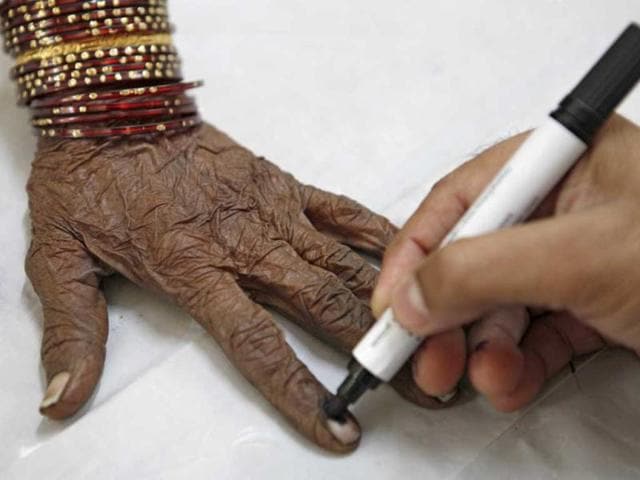
In yet another electoral reform, the apex court directed the Election Commission to have an option of ‘None Of The Above’ (NOTA) on the electronic voting machines (EVMs) and ballot papers, which can be used by voters to reject all candidates contesting the polls.
So far, people casting negative votes were required to enter their names in a register and cast their vote on a separate paper ballot.
But now the secrecy of votes cast under the NOTA category must be maintained by the EC, the court said.
The order will be effective in the assembly elections to be announced soon in five states.
However, a senior EC official said the NOTA option would not impact the results of the elections.
“The ‘None Of The Above’ option on EVMs has no electoral value,” said the EC official.
“Even if the maximum number of votes cast is for NOTA, the candidate getting the most of the remaining votes would be declared winner.”
The court said negative voting would encourage even people who are not satisfied with any of the candidates to turn up to express their opinion and reject all contestants.
“Negative voting will lead to a systemic change in polls and political parties will be forced to project clean candidates. If the right to vote is a statutory right, then the right to reject candidate is a fundamental right of speech and expression under the Constitution,” said a bench headed by the Chief Justice of India, P Sathasivam.
The court passed the order on a PIL filed in 2004 by an NGO, People's Union for Civil Liberties (PUCL), which had submitted that voters be given the right to negative voting.
The bench also pointed out that the system of negative voting existed in 13 countries. Even in the Parliament of India, the MPs have the option to abstain during a vote, the court observed.
The right to vote for no candidate is defined under Section 49 (O) of the Conduct of Election Rules 1961, but was not effective as the government did not agree to amend the rules. Under the rules, a voter who does not want to cast his vote had to fill a form and cast his or her vote on a separate paper ballot.
Since 2004, the EC had been asking the government to change the rules to provide a negative vote option on the EVMs.
Former chief election commissioner Navin Chawla welcomed the order and said it was a huge step in improving the electoral system. Former chief election commissioner SY Quraishi said the order would give a legal stamp to the commission’s demand of providing a negative voting option on the EVMs.
The Aam Aadmi Party (AAP) also welcomed the Supreme Court order. “This move will bring a change leading to an opportunity for deserving candidates to contest polls,” said AAP member Shazia Ilmi.
The Supreme Court in the past two months has issued several orders on electoral reforms, including disqualification of MPs and MLAs who get convicted of crimes and not allowing persons in police custody to contest.
HT POLL
REACTIONS
Petitioner Sanjay Parekh talks to reporters
The SC has said that tight to vote and right not to vote has to stand on the same pedestal: Sanjay Parekh
This is not a negative vote, it is a positive vote in terms of a democracy: Sanjay Parekh
This law is a warning to political parties to not field tainted ministers in elections: Sanjay Parekh
This ruling will send out a strong message to political parties: Sanjay Parekh
This is a positive message, please don't take it negatively: Sanjay Parekh
It sends a message to political parties only to pick candidates with a clean report: Sanjay Parekh
Members of Aam Aadmi Party say
We welcome the Supreme Court's decision on right to reject: Arvind Kejriwal
The right to reject is a fundamental right: AAP's Prashant Bhushan
Parties react cautiously, CPI(M) opposes it
Political parties today reactedcautiously to a Supreme Court verdict holding that citizens have the right to reject candidates contesting polls with CPI (M) saying that the judgement has led to an "abnormal situation" that needs to be corrected. Read more.
Activists hail SC view on negative voting
The Supreme Court verdict on negative voting - allowing voters to exercise the option of None of the Above (NOTA) in EVMs and ballot papers - is being seen as a positive development by advocacy firms and activist Friday. Read more.
Those responsible for ordinance should resign: Jaitley
BJP leader Arun Jaitley today said those responsible in the government for the ordinance on convicted lawmakers should resign in the wake of Rahul Gandhi's denunciation of the move. Read more.


