
Shrinking green cover escalating tiger-human conflict
Experts say as tigers are being forced to remain in confines of protected areas, conflicts among the big cats are increasing. This has led to the 'weaker' tigers moving out to human areas, resulting in increasing man-animal conflicts.
More tigers in India are being forced out into human habitation because rising mining activity is reducing their habitat, leading to a spike in deadly man-animal conflict.
Experts said that as tigers are being forced to remain in confines of protected areas, conflicts among the big cats are increasing. This has led to the "weaker" tigers moving out to human areas, resulting in increasing man-animal conflict.
A member of the National Tiger Conservation Authority (NTCA) confirmed that "the environment ministry has allowed mining in many of these green corridors despite reservations expressed by the NTCA".
The NTCA member, who spoke on condition of anonymity, also claimed that the Forest Advisory Committee – the statutory body to allow diversion of forest land -- formed its own committees to "over-rule the NTCA view".
Ulhas Karanth, director of highly-respected Wildlife Conservation Society (WCS) said,"tigers are coming in conflict with humans in areas which were their traditional routes to move from one green landscape to another."
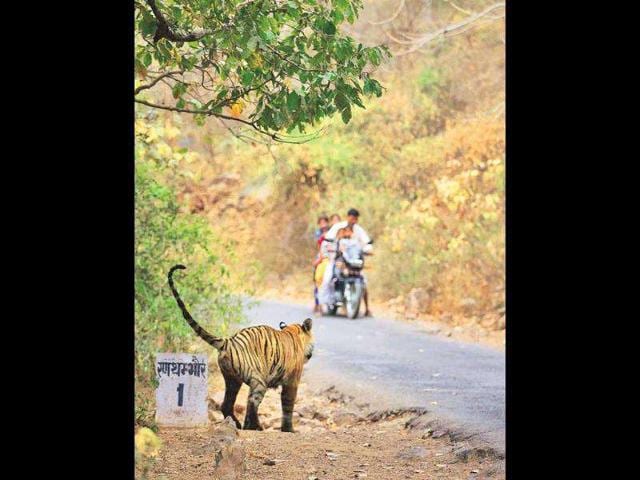
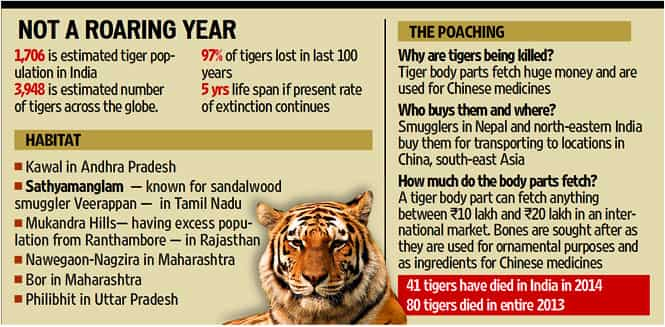
Over 20 people were killed in different parts of India in the past one year by tiger which were pushed out of forest areas by stronger tigers.
A tiger marks its territory of approximately 10 sq km and move out only when defeated by a stronger feline.
The last one year has seen a man-eating tigress emerging in the buffer zone of Corbett National Park and spreading terror in Uttarakhand and neighbouring Morababad district of Uttar Pradesh killing nine persons.
A tiger in Philibhit also entered a village killing a man.
Maharashtra saw a tiger killing a villager near the Tadoba Andhari tiger reserve. Ranthambore in Rajasthan had also been in news for human-animal conflict.
Experts say that tigers don't hunt humans unless provoked or for self-protection.
As many as 80 tigers died in the country last year due to various reasons, while 41 have died so far this year.
Many of the affected tiger corridors in Uttar Pradesh, Jharkhand, Maharashtra, Rajasthan and Madhya Pradesh now have human habitations which interfere in free movement of tigers.
The last State of Indian Forest Report of 2013 show a decline in forest cover in wildlife corridors across India compared with previous reports.
An officer said that forests inside tiger reserves may have improved but they have gone down outside due to grazing and encroachments.
A global report released on the eve of World Tiger Day on July 29 says that if the present pace of extinction of tigers continues, the species will become extinct in the next five years.
ABOUT THE AUTHORChetan ChauhanChetan Chauhan is the National Affairs Editor looking into all aspects of news and features from across India. A Chevening scholar with over three decades of experience in reporting and news management, Chetan has extensively covered all important aspects of the social sector, political economy, environment and climate change nationally and internationally. He did a journalism course at the Reuters Institute of Journalism in Oxford and Digital Media training at Nanyang Technological University in Singapore. He started as a reporter with The Statesman in 1996 and joined the Hindustan Times in 2000 in the metro bureau covering environment, crime and Delhi politics. He covered hot local news, from the Jessica Lal murder case to the rebellion of Delhi Congress MLAs against then Chief Minister Sheila Dikshit, to the replacement of toxic vehicle fuel with cleaner compressed natural gas (CNG) in the national capital. Some of his stories on air pollution became part of the Supreme Court’s landmark MC Mehta versus Government of India case in the National Capital Region (NCR), forcing the government to take corrective measures. As part of the national political bureau since 2004, he covered important central sectors such as environment, education, social justice, labour, rural development, water resources, renewable energy, agriculture, broadcasting and the Planning Commission for more than a decade producing several exclusive and investigative breaking stories. His specialisation is the environment, having covered at least a dozen United Nations global conferences on climate change, biodiversity and wildlife including climate summits in Paris, Copenhagen and Bali. He also covered India’s two five-year plans ---11th and 12th and reported on drafting and execution of right based laws such as Right to Education, Right to Information and rural job guarantee law, MG-NREGA, now being introduced in new format as VG-RAM-G Act. He has in-depth knowledge of social sector issues. He was one of the first to report on tigers vanishing from Sariska and Panna wildlife reserves in 2004 and 2008, respectively, leading to the setting up of the National Tiger Conservation Authority (NTCA) and the introduction of stringent penal provisions for poaching. He has written extensively on the rising human-animal conflict in India and the degradation of India’s biodiversity hotspots because of mining and other activities. Since 2004, Chetan has covered Parliament comprehensively and participated in training on the nuanced coverage of Parliament proceedings. He has travelled extensively across India to cover national and provincial elections since 1998, especially in the Hindi heartland states, considered India’s road to power. He writes a regular column for Hindustan Times, Ecostani, on important national politics, economy, Himalayan ecology and environmental issues. His other responsibilities include providing inputs for edits and edit page articles for the publication, apart from managing news flow from across India.Read More

E-Paper


