
Sports ministry seeks changes in anti-fixing bill
The sports ministry has expressed concern over the lack of protection for honest sportsperson, inadequate definition of dishonesty and differentiation in punishment for players and bookies involved in unfair means in sports. Chetan Chauhan reports. The concerns
The sports ministry is not happy with the first draft of the anti-match fixing bill of the law ministry and wants it to be completely re-written.
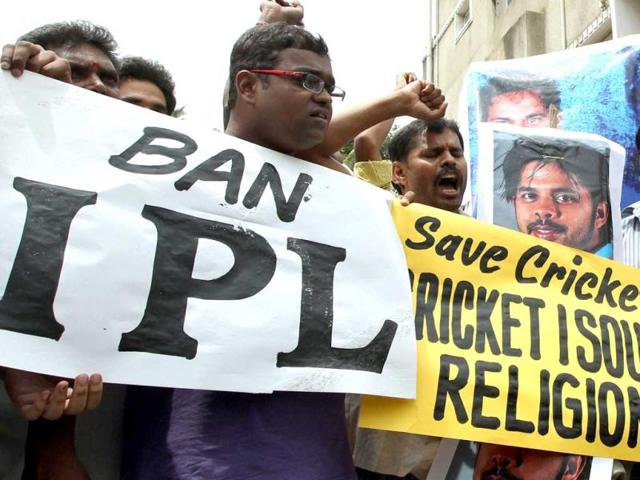
In a communication to the law ministry sent on Wednesday, the sports ministry has expressed concern over the lack of protection for honest sportsperson, inadequate definition of dishonesty and differentiation in punishment for players and bookies involved in unfair means in sports.
It also expressed amazment at the fact that the reason behind the proposing prevention of dishonesty in sporting events bill - spot fixing in recent T20 cricket

season - was not explicitly covered in the draft bill. The draft only covered national and international matches and was silent on club sports, where fixing is believed to be most rampant.
"We have a lot of issues with the draft," a senior ministry official told HT.
"The draft does not cover unfair means in sports in the present context".
The ministry wants the definition of dishonesty in sports to be replaced with 'sports fraud', a more comprehensive term defined by the International Olympic Committee (IOC).
The IOC officials have given an initial draft on what amounts to sports fraud and the ministry would consult them further once the proposed law takes a concrete shape.
The ministry also has its reservations on punishment of up to five years to players for failing to report any unfair practice to anti-corruption unit of the sporting federation.
"This clause can be misused and can result in plethora of complaints against budding sports persons," a senior ministry official said, adding there was a need for providing adequate protection to honest players.
The ministry also failed to see the logic behind punishment of five years for unfair practice in sports to a player and just three years for a bookie.
"How can a law distinguish between a player and a bookie for a similar crime?" the official asked.
Senior officials also said the average punishment for sports fraud in countries is 6.7 years with minimum being two years and maximum 10 years. A bookie involved in spot fixing in England recently was jailed for 10 years.
"The punishment should act as a deterrent," an official said.
Despite the differences, the ministry expressed confidence of introducing the bill in the budget session of Parliament, which started in July end.
"We expect to finalise the draft bill by mid-June," a ministry official said.
ABOUT THE AUTHORChetan ChauhanChetan Chauhan is the National Affairs Editor looking into all aspects of news and features from across India. A Chevening scholar with over three decades of experience in reporting and news management, Chetan has extensively covered all important aspects of the social sector, political economy, environment and climate change nationally and internationally. He did a journalism course at the Reuters Institute of Journalism in Oxford and Digital Media training at Nanyang Technological University in Singapore. He started as a reporter with The Statesman in 1996 and joined the Hindustan Times in 2000 in the metro bureau covering environment, crime and Delhi politics. He covered hot local news, from the Jessica Lal murder case to the rebellion of Delhi Congress MLAs against then Chief Minister Sheila Dikshit, to the replacement of toxic vehicle fuel with cleaner compressed natural gas (CNG) in the national capital. Some of his stories on air pollution became part of the Supreme Court’s landmark MC Mehta versus Government of India case in the National Capital Region (NCR), forcing the government to take corrective measures. As part of the national political bureau since 2004, he covered important central sectors such as environment, education, social justice, labour, rural development, water resources, renewable energy, agriculture, broadcasting and the Planning Commission for more than a decade producing several exclusive and investigative breaking stories. His specialisation is the environment, having covered at least a dozen United Nations global conferences on climate change, biodiversity and wildlife including climate summits in Paris, Copenhagen and Bali. He also covered India’s two five-year plans ---11th and 12th and reported on drafting and execution of right based laws such as Right to Education, Right to Information and rural job guarantee law, MG-NREGA, now being introduced in new format as VG-RAM-G Act. He has in-depth knowledge of social sector issues. He was one of the first to report on tigers vanishing from Sariska and Panna wildlife reserves in 2004 and 2008, respectively, leading to the setting up of the National Tiger Conservation Authority (NTCA) and the introduction of stringent penal provisions for poaching. He has written extensively on the rising human-animal conflict in India and the degradation of India’s biodiversity hotspots because of mining and other activities. Since 2004, Chetan has covered Parliament comprehensively and participated in training on the nuanced coverage of Parliament proceedings. He has travelled extensively across India to cover national and provincial elections since 1998, especially in the Hindi heartland states, considered India’s road to power. He writes a regular column for Hindustan Times, Ecostani, on important national politics, economy, Himalayan ecology and environmental issues. His other responsibilities include providing inputs for edits and edit page articles for the publication, apart from managing news flow from across India.Read More

E-Paper


