Sign in

Super Friday: Election Commission all set to bring curtains down on Mandate 2014

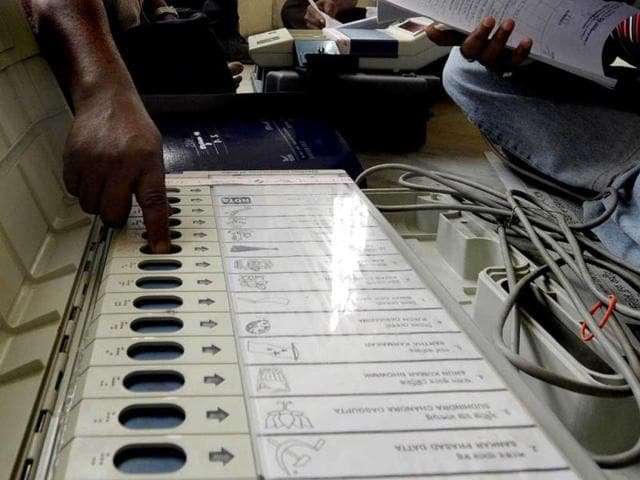
India’s mammoth electoral exercise will come to an end on Friday with the Election Commission gearing up to count 550 million votes sealed in more than 1.8 million electronic voting machines (EVMs) in about 12 hours.

Updated on: May 15, 2014, 18:38:01 IST
Hindustan Times | By , New Delhi
Share
Share via
  • facebook
  • twitter
  • linkedin
  • whatsapp
Copy link
  • copy link

India’s mammoth electoral exercise will come to an end on Friday with the Election Commission gearing up to count 550 million votes sealed in more than 1.8 million electronic voting machines (EVMs) in about 12 hours.

Article image

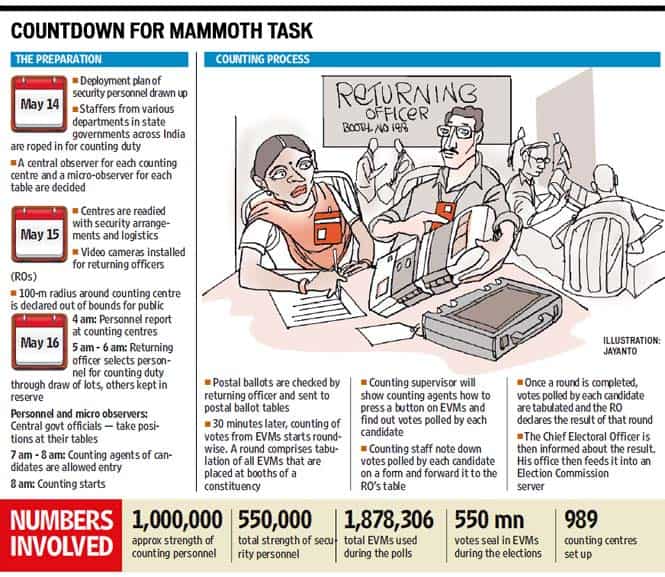
A daunting task by all standards, considering that around a million people will be engaged in the counting activity and half a million security personnel would be there to ensure that it happens without any hassles.

Friday’s exercise will bring the curtains down on Mandate 2014 that began with its announcement on March 5. The polling was conducted in nine phases between April 7 and May 12.

The counting centres – mostly in close proximity to EVM store rooms – are being manned by the central paramilitary forces, home ministry officials said.

In addition, about half a million police personnel from the states will also be deployed besides the local administration sanitising areas near the counting centres.


Article image

“We are fully prepared for the last big thing (counting),” said a senior EC functionary, adding that specific instructions have been issued to the returning officers of the 543 Lok Sabha seats for seamless counting of votes. “No unauthorised person is allowed within 100 metres of a counting centre.”

Those with gun-toting security personnel will not be allowed inside the counting centres even if they hold top positions in the government. Candidates having security cover would be allowed if they voluntarily leave their security personnel behind. The only exception to the rule would be those enjoying SPG protection, such as Congress vice-president Rahul Gandhi, who is contesting from Amethi in Uttar Pradesh.

The EC has advised the candidates not to nominate elected representatives or government officials as their counting agents, who would be allowed entry at 989 counting centres set up across India an hour before the exercise starts.

It would be a long day for the counting personnel as they have to report at work at about 4 am. In a couple of hours, they would be allocated counting tables in different halls through a draw of lots. By eight in the morning, the counting will start with postal ballots. EC officials expect the fate of about 8,251 candidates to be decided in the next 8-12 hours in most of the constituencies.

“Normally, the delay in announcing final results happens if a candidate seeks re-counting and the returning officer agrees with it,” an official said.

The majority of counting centres will have broadband connectivity for seamless flow of trends after each round of counting to an EC control room at Nirvachan Bhawan in Delhi.

To ensure that trends and results from counting centres are available on the Election Commission’s website on a real-time basis, the National Informatics Centre – the government’s information technology arm – has provided additional servers to the poll panel.

Full coverage:My India my vote - May 16 countdown

  • Chetan Chauhan
    ABOUT THE AUTHOR
    Chetan Chauhan

    Chetan Chauhan is the National Affairs Editor looking into all aspects of news and features from across India. A Chevening scholar with over three decades of experience in reporting and news management, Chetan has extensively covered all important aspects of the social sector, political economy, environment and climate change nationally and internationally. He did a journalism course at the Reuters Institute of Journalism in Oxford and Digital Media training at Nanyang Technological University in Singapore. He started as a reporter with The Statesman in 1996 and joined the Hindustan Times in 2000 in the metro bureau covering environment, crime and Delhi politics. He covered hot local news, from the Jessica Lal murder case to the rebellion of Delhi Congress MLAs against then Chief Minister Sheila Dikshit, to the replacement of toxic vehicle fuel with cleaner compressed natural gas (CNG) in the national capital. Some of his stories on air pollution became part of the Supreme Court’s landmark MC Mehta versus Government of India case in the National Capital Region (NCR), forcing the government to take corrective measures. As part of the national political bureau since 2004, he covered important central sectors such as environment, education, social justice, labour, rural development, water resources, renewable energy, agriculture, broadcasting and the Planning Commission for more than a decade producing several exclusive and investigative breaking stories. His specialisation is the environment, having covered at least a dozen United Nations global conferences on climate change, biodiversity and wildlife including climate summits in Paris, Copenhagen and Bali. He also covered India’s two five-year plans ---11th and 12th and reported on drafting and execution of right based laws such as Right to Education, Right to Information and rural job guarantee law, MG-NREGA, now being introduced in new format as VG-RAM-G Act. He has in-depth knowledge of social sector issues. He was one of the first to report on tigers vanishing from Sariska and Panna wildlife reserves in 2004 and 2008, respectively, leading to the setting up of the National Tiger Conservation Authority (NTCA) and the introduction of stringent penal provisions for poaching. He has written extensively on the rising human-animal conflict in India and the degradation of India’s biodiversity hotspots because of mining and other activities. Since 2004, Chetan has covered Parliament comprehensively and participated in training on the nuanced coverage of Parliament proceedings. He has travelled extensively across India to cover national and provincial elections since 1998, especially in the Hindi heartland states, considered India’s road to power. He writes a regular column for Hindustan Times, Ecostani, on important national politics, economy, Himalayan ecology and environmental issues. His other responsibilities include providing inputs for edits and edit page articles for the publication, apart from managing news flow from across India.Read More

Follow India news real-time updates and the latest news covered on Hindustan Times, featuring today's critical updates on Sonam Wangchuk Hunger Strike LIVE and more across India.