
 E-Paper



Think local and act local
The entire debate after the Uttarakhand disaster appears to have been hijacked by a lobby that is against hydel projects, rather than talking about a Himalayan development model based on environmental sustainability and the creation of livelihood avenues for Paharis. Chetan Chauhan writes.


The entire debate after the Uttarakhand disaster appears to have been hijacked by a lobby that is against hydel projects, rather than talking about a Himalayan development model based on environmental sustainability and the creation of livelihood avenues for Paharis.
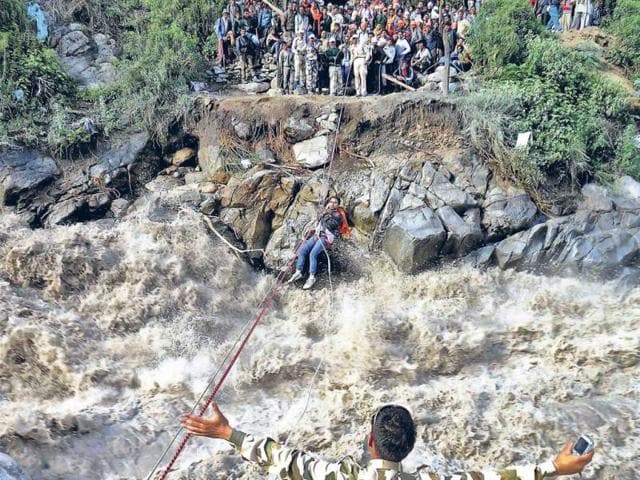
More than 60 years after Independence, India does not have a comprehensive study on the carrying capacity of the Himalayas. As a result, decades of unplanned growth have ravaged the hills and the locals unknowingly have had to bear the brunt.
Paharis everywhere, from Jammu & Kashmir to Arunachal Pradesh, have been left out of India’s economic growth, while the Himalayas have been harnessed for money by politically linked outsiders, thereby alienating the locals who could protect the local ecology.
Half of the hotels around popular tourist destinations in Himachal Pradesh and Uttarakhand are owned by non-residents. Most of the hydel projects coming up in Himachal Pradesh, Uttarakhand, Sikkim and Arunachal Pradesh are by companies with no stake in the economic empowerment of the locals.
The reply to an RTI filed by an activist in Himachal Pradesh showed that of the total white-collared jobs created in the state by the private sector in the last five years only nine per cent went to the locals. This was despite the fact that the companies were required to give half of the jobs to Himachalis in return for acquiring land on the fragile mountains at subsidised rates.
Skewed development models have made the Paharis slaves to outsiders in their own land, and this is why they protest against any talk of controlling the number of pilgrims at the Char Dhams or a ban on hydel projects. Thousands of villagers in Uttarakhand depend on the annual pilgrimage for their livelihood.
The support for hydel projects stem from the assumption of the locals that they will provide employment and better infrastructure. The widening of the national highway from Rampur to Kinnaur because of the Nathpa Jhakri hydel project is an example. Denying this right to the economically-deprived people to save the ecology would be suicidal for any state government in the hills.
The government needs to allow projects as per the carrying capacity of the region and ensure it leads to inclusive development. That can happen if the government introduces mandatory revenue sharing for hydel projects with village bodies as being proposed for mining projects under the Mines and Minerals Development Act.
The government needs to push the companies involved in hydel projects to employ high-cost tunnelling technologies that cause minimal damage to the mountains. The environment ministry should penalise companies that fail to adhere to the laws. In the case of any violation, the courts should give their verdict within a stipulated timeframe, preferably six months. This will create the impression that the government is serious about protecting the environment.
The need of the hour is to think about the people in the hills rather than activists sitting in air-conditioned offices calling for a ban on all development in the hills. Without the active participation of the local community, protecting the environment is not possible.
There is no better example of this than Uttarakhand, the birth place of the Chipko movement. Thanks to Magsaysay award-winner Sundarlal Bahuguna and his team, around 62% of the state’s geographic area is still categorised as forest.


