Sign in

Tiger deaths increase inside protected areas

The latest data shows that the number of tiger deaths within reserves in India has increased in the first 11 months of this year, as compared to the last two years.

Updated on: Dec 1, 2014, 01:12:01 IST
Hindustan Times | By , New Delhi
Share
Share via
  • facebook
  • twitter
  • linkedin
  • whatsapp
Copy link
  • copy link

Tigers are not safe even in their most protected haven - the tiger reserves.

Article image

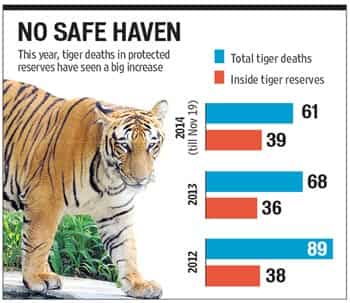
The latest data shows that the number of tiger deaths within the reserves has increased in the first 11 months of this year, as compared to the last two years. And the government officials attribute the increase in deaths to multiple reasons; poaching, infighting between tigers and human-tiger conflict.

Even though the overall tiger deaths till November 19, 2014 had fallen as compared to previous years, the number of deaths inside the reserves had witnessed an increase. As many as 39 tigers died in 2014 as compared to 36 in 2013 and 38 in 2012.

In percentage terms, the tiger deaths within the reserves were about 63% in first eleven months of 2014 as compared to 52% in 2013 and 42% in 2012. The official records showed that a high number of cases inside the reserves were still under investigation for the cause of death.


Article image

"Action taken on individual cases is not collated at the Centre government level as the day to day management including field protection is vested with the state governments," the environment ministry told Parliament in a written reply last week.

The increase in tiger deaths in protected areas has taken place despite the National Tiger Conservation Authority providing funds to the state governments for setting up special tiger protection forces for each reserve. The NTCA officials, however, said that the states have been slow in responding and only about a dozen tiger reserves have set up the special force.

Officials say that tiger deaths reported from many of the reserves such as Corbett National Park and Kaziranga National Park were because of high density of the felines. Tigers, being territorial animals, kill the older or weaker big cats to claim his territory, an official said, without ruling out the possibility of some of the animals been targeted by poachers.

Poachers arrested in Uttarakhand had admitted to killing a tiger inside the protected area in Pilibhit tiger reserve and escaping with the body parts without any hindrance.

As Indian tiger reserves are spread in an area of over 68,000 square kilometres, guarding every nook and corner of the dense forest is not possible. The NTCA is considering usage of satellite imagery to protect and track radio-collared tigers.

  • Chetan Chauhan
    ABOUT THE AUTHOR
    Chetan Chauhan

    Chetan Chauhan is the National Affairs Editor looking into all aspects of news and features from across India. A Chevening scholar with over three decades of experience in reporting and news management, Chetan has extensively covered all important aspects of the social sector, political economy, environment and climate change nationally and internationally. He did a journalism course at the Reuters Institute of Journalism in Oxford and Digital Media training at Nanyang Technological University in Singapore. He started as a reporter with The Statesman in 1996 and joined the Hindustan Times in 2000 in the metro bureau covering environment, crime and Delhi politics. He covered hot local news, from the Jessica Lal murder case to the rebellion of Delhi Congress MLAs against then Chief Minister Sheila Dikshit, to the replacement of toxic vehicle fuel with cleaner compressed natural gas (CNG) in the national capital. Some of his stories on air pollution became part of the Supreme Court’s landmark MC Mehta versus Government of India case in the National Capital Region (NCR), forcing the government to take corrective measures. As part of the national political bureau since 2004, he covered important central sectors such as environment, education, social justice, labour, rural development, water resources, renewable energy, agriculture, broadcasting and the Planning Commission for more than a decade producing several exclusive and investigative breaking stories. His specialisation is the environment, having covered at least a dozen United Nations global conferences on climate change, biodiversity and wildlife including climate summits in Paris, Copenhagen and Bali. He also covered India’s two five-year plans ---11th and 12th and reported on drafting and execution of right based laws such as Right to Education, Right to Information and rural job guarantee law, MG-NREGA, now being introduced in new format as VG-RAM-G Act. He has in-depth knowledge of social sector issues. He was one of the first to report on tigers vanishing from Sariska and Panna wildlife reserves in 2004 and 2008, respectively, leading to the setting up of the National Tiger Conservation Authority (NTCA) and the introduction of stringent penal provisions for poaching. He has written extensively on the rising human-animal conflict in India and the degradation of India’s biodiversity hotspots because of mining and other activities. Since 2004, Chetan has covered Parliament comprehensively and participated in training on the nuanced coverage of Parliament proceedings. He has travelled extensively across India to cover national and provincial elections since 1998, especially in the Hindi heartland states, considered India’s road to power. He writes a regular column for Hindustan Times, Ecostani, on important national politics, economy, Himalayan ecology and environmental issues. His other responsibilities include providing inputs for edits and edit page articles for the publication, apart from managing news flow from across India.Read More

Check India news real-time updates, latest news on Hindustan Times and more across India.