E-Paper



Under new norms, 36 industries may not need environmental clearance
The government is set to hack away a great deal of red tape with a new classification of industries that uses colour codes to denote environmental impact, a move that means 36 industries may need no green clearance at all.


The government is set to hack away a great deal of red tape with a new classification of industries that uses colour codes to denote environmental impact, a move that means 36 industries may need no green clearance at all.
The national pollution watchdog’s proposal also increases the minimum duration of environmental consent while trimming the list of most-polluting businesses in an attempt to boost flagging economic growth.
The new mechanism also replaces a host of unwieldy state rules —which have different time-frames for renewal of approvals for different regions—with a uniform national system that will promote more efficient environmental monitoring.
Read:New 'colour' classification to ease norms for industries
“The new rules will bring uniformity in the period for which consent to operate is given to industries,” a senior official of the Central Pollution Control Board said. For the first time, the classification was based on “scientific parameters” decided by a committee of experts, he added.
Senior officials said the government is likely to adopt and notify the same rules with minimal changes as the CPCB came up with the system after consultation with the states.
The new system will also complement tamper-proof online submission of emission and affluent data and replace a festering inspector raj for environmental inspections that hobble small- and medium-scale industries.
“This will take care of 80% of emissions from industrial sector and will bring transparency in implementation of pollution control regulations,” the official said.
The NDA rode to power last year on a promise to kickstart the economy but experts have raised doubts recently about the sputtering pace of reforms amid an Opposition-sponsored logjam in Parliament that has compromised the Centre’s legislative agenda.
The government has managed to pull Asia’s third-largest economy out of its worst slump in 25 years but data from Tuesday showed the country’s GDP growth rate has slowed down to 7% this quarter over worrying symptoms of weak investment and poor consumer spending.
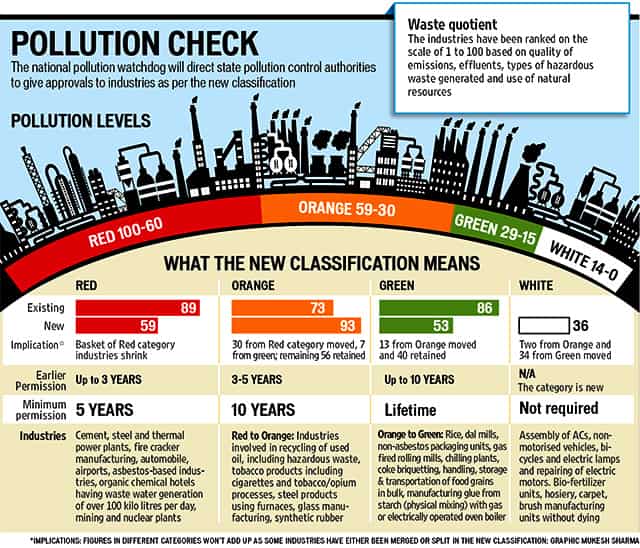
The CPCB measured the possible impact of each industrial sector on air, water, ground and the amount of hazardous waste generated. Each category was measured on a pollution potential index, with one symbolising the least polluting and 100 the worst.
A group of 59 industries which scored between 60 and 100 points were classified “red”—down from 89 in the 2012 system.
Similarly, 93 industries with a score of 30-59 were listed as orange, up from 73. Green, with a score of 15-29, had 53 industries as compared to 86 earlier.
A new category, white, was introduced, applicable to industries with a score of less than 15 that would not have to seek the approval of state pollution control boards. This category has several small-scale industries, such as motor repair shops and hosiery units, which can run hassle-free. Moreover, the duration of the permissions was also increased. For a “red” industry, a green nod will now last for a minimum of five years – up from three years earlier. In orange, permissions will lapse after 10 years – up from 3-5 years – and for orange, approvals will last for a lifetime.
The new classification is aimed to improve the ease of doing business in India by removing a host of hurdles in obtaining environmental permissions – often a headache for small and medium businesses but some environmentalists worried it might lead to further contamination of water and air.