
 E-Paper



‘I have Parkinson’s, and so I dance’


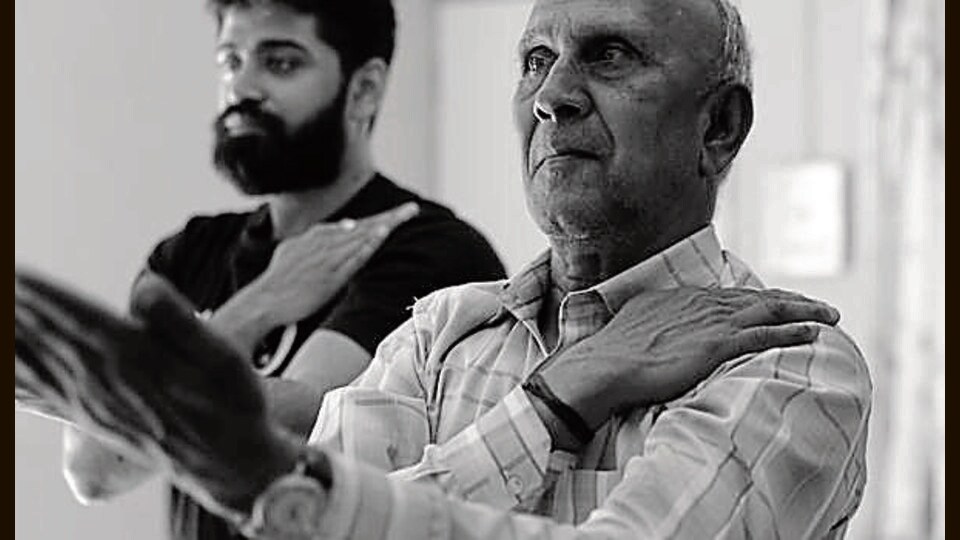
Vijay Deshpande, 77, transforms tremors into the flight of a bird or the flutter of a butterfly. He is now in his 15th year of dancing with Parkinson’s.
Vijay Deshpande’s arms tremble as they soar.
Bach’s Orchestral Suite No 3 fills the air. He bends, rises slowly; spreads his arms out like a phoenix.
Deshpande is 77. He lives in Pune. He has Parkinson’s disease and so, he says, he dances.
Every Monday, Wednesday and Friday, he leaves his home in Kothrud, rides a bus for 25 minutes, and heads into the Centre of Contemporary Dance, set up by kathak and contemporary dance exponent Hrishikesh Pawar.
Just getting there and back tells him Deshpande is doing okay. “When I was diagnosed 17 years ago, they said I’d eventually need a caretaker. I’ve never needed anyone to accompany me,” he says.
Parkinson’s can be a frightening diagnosis to navigate. It is a degenerative disease, and unpredictably so. Studies indicate that movement therapy can help keep its impact on the nervous system from intensifying. Other studies indicate better outcomes for people who have regular social contact; maintain a hopeful attitude. The dance class helps check these boxes.
There are about 15 others with Parkinson’s at this free class, aged 50 to 90. “This makes us feel a little less alone,” says Deshpande, who lives with his wife Snehal Deshpande, 69.
A warm-up, some stretches and seated chair exercises mark the start of each session. (Physiotherapists and movement therapists from the city’s Sancheti Healthcare Academy provide guidance, and help evaluate the progress of participants.) Then the group performs the choreography of the month, taught to them by Pawar and his associate, Tanvi Hegde.
For two months, they have been celebrating the monsoon with rain songs from Hindi cinema. Ghanan Ghanan from Lagaan (2001) is a favourite. “Every other month, we pick a new theme. There are shlokas for Ganesh Chaturthi, garba during Navratri. Sometimes it’s retro Bollywood music, songs in different languages or instrumental compositions,” says Pawar, 41.
On some days, the group just cues a few of their favourites and dances. Deshpande usually picks Sar Jo Tera Chakraye (When Everything’s Making Your Head Spin), from Pyaasa (1957). “It’s a lot of fun. It refreshes me,” he says.
Pawar first encountered dance movement therapy for those living with Parkinson’s in the film Why Dance for PD?, released by the New York-based Mark Morris Dance Group, in 2005. He was then enrolled in a course in Germany, and had been seeking answers to some core questions: What was dance’s purpose, beyond entertainment and expression? What was its role in a society? Watching the film, he felt he had stumbled upon an answer.
Back in India in 2007, he began holding workshops in a small flat. He switched venues multiple times, as rents rose. Then he found the 2,500-sq-ft studio where the institute is now based and, with help from CSR funding for his non-profit foundation, offers a range of free classes as part of his community outreach.
Each class stages an annual show, for friends, family “and the dance-lovers of Pune”, as Deshpande puts it. There are lights, costumes and make-up. It’s a time of intense preparation.
“Each of us has a different speed, a different set of symptoms. Will we all remember the steps? Will we be able to make our formations? Will our bodies listen?”
Before this centre, the retired technical assistant with the National Chemical Laboratory had never danced before an audience. Now, he is adept at holding their attention, says Pawar. He also delivers talks about his experience with Parkinson’s and dance, at seminars in the city. He sometimes demonstrates with a solo or duet performance.
“Some people I have talked to are embarrassed by what their body has gone through. They’re anxious about the freezing, stiffness or tremors,” Deshpande says. “The first and the hardest step is to accept the disease. After that, every day is an act of trying to win against it.”
Winning, at its most elemental, can be the act of allowing a trainer to show you how to weave specific symptoms into the dance. “In the case of Deshpande Uncle,” says Pawar, “he transforms his tremors into the flight of a bird or the flutter of a butterfly.”
Deshpande is now in his 15th year of dancing with Parkinson’s. It has been a close companion in his journey with the disease. He is no longer testing his body, or training it, when he dances. He is barely noticing it’s there.
“When the music starts to play, the world outside is gone,” he says. “I stop thinking about everything else… what I can do, what I can’t do. I just dance.”


