E-Paper



Add to cart: A Wknd chat with award-winning product designer A Balasubramaniam

 Prefer HTon Google


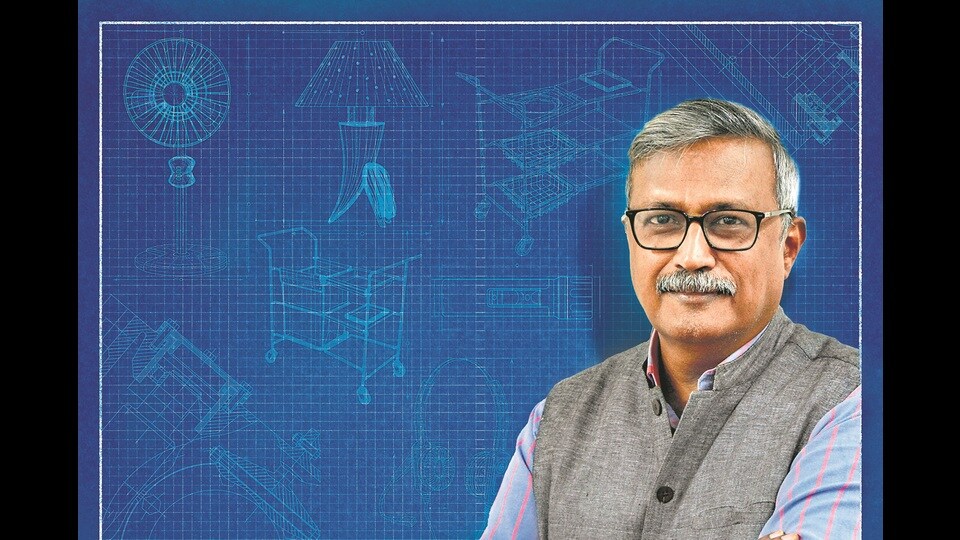
He won for working to improve product design, pushing for a national design ministry. ‘It is our job to ask: How can this be done better,’ he says, smiling.
Design is everywhere, says A Balasubramaniam, 64.
In the sheen of a flashlight’s reflective rim. In the distance between two steps in a staircase. In the way a newspaper folds so readily to fit into the hand.
“And yet there are no fixed rules,” Balasubramaniam says, smiling. “One doesn’t have to work with pre-established choices. In fact, design, especially product design, compels one to reimagine the status quo.”
Over five decades, Balasubramaniam, founding director of the Institute of Design at JK Lakshmipat University (JKLU) in Jaipur, has helped shape hundreds of products: torches, trucks, hospital trolleys, pedestal fans for outdoor venues, headphones, refrigerators, table lamps.
He has worked with companies such as Hero, Eveready, Usha, Singer and Eicher, as well as with state crafts councils, handicraft enterprises and the NGO Oxfam. A graduate of the National Institute of Design (NID), he has also taught at NID and the National Institute of Fashion Technology (NIFT).
Earlier this month, Balasubramaniam became the first Indian to win the Hills Millennium Award. Presented annually by the UK-based Institute of Engineering Designers, past winners have included a car designer for Ford, Ferrari and McLaren, and the creative director of Ikea Retail.
Balasubramaniam has won for his tireless campaign to get India to focus more on how form influences function. He has been pushing for a Ministry of Design, which he believes would help superlative but languishing sectors such as the handicrafts industries fare better in the 21st century. He has been arguing for greater emphasis on design in a changing world of increasingly scarce resources.
Simple questions like “Can this cistern save more water” can have a deep impact, he says.
How does he feel about the award? He sees it not just as a personal win but as a nod to an early batch of product designers in the ’70s and ’80s, he says, who laid the groundwork in what was then barely recognised as a profession. “We were hopeful and driven,” he adds. “We believed that design could make a difference in the world.”
Still, the award came as a big surprise, Balasubramaniam says, laughing. “I first thought perhaps it was a hoax. I still can’t quite believe it. But I do think it is also recognition of the design practices emerging out of India, and how these ancient and modern ideas are influencing the world.” Excerpts from an interview.
* How did you end up studying industrial product design at NID?
I was 16 and had just finished school. I was considering studying architecture, when I came across an advertisement for NID’s design courses in the newspaper. A few days later, I read that the institute had won a few awards, so I went back to that advertisement. The application fee was just ₹2, so I decided to just apply, on my own.
The application process itself drew me in. The form encouraged applicants to think of design in new ways. There were questions like: “Who is closest to a designer — a potter, tailor or textile weaver?” The exam involved hands-on activities such as sorting multiple grains into various kinds of packaging. At the interview too, I was asked questions such as “How would you improve the chair you’re sitting on?” and “What colour would you paint a chimney?”
What intrigued me was that there really weren’t any pre-set choices or right or wrong answers. Till today, it thrills me that design compels you to question what you can see, challenge the status-quo.
My parents were thankfully supportive, although none of us really had any idea about the course. I was 16 when I stepped into NID for a five-year course. I feel like I grew up there, as a person and a professional. That place taught me that confusion is a good thing. It means that you are thinking.
* What was it like entering the industry as a fresher, in the mid-1980s?
This was a new profession in India. Not a lot of companies understood the specialisation. For instance, my first job was with a Bhopal-based company that manufactured TV screens. They were only willing to hire me as a management trainee. I convinced them to let me work and be paid as a full-time industrial designer, helping them make, improve and market their products. Thankfully, they took me in. That taught me to ask and fight for what I wanted and deserved.
When that company shut down, I landed a freelance gig in Delhi, as a product design consultant with Fedders Lloyd. At the time, freelancing wasn’t a popular option. But, together with a few of my peers and seniors, we managed to establish freelance consulting as a viable way to approach companies, conduct audits of their products and pitch ideas on how they could be improved.
Across the country, we were a tight-knit group, looking out for each other. And we avoided treading onto each other’s portfolios. You don’t see that so much now.
* You’ve said that there was a sense of idealism attached to the profession...
Yes. We truly believed that what we did could make a difference in the world.
We believed that excellence in this field mattered. Our professors, people like my gurus Mohan Bhandari and MP Ranjan of NID, taught us to chase problems, think of solutions, work on them, market that design, and then just drop the whole approach and think about how else it could be done. How it could be done better.
* The Eveready flashlight you drew up is still talked about. Can you tell us about it?
Well, it was a product meant for rural India in 1989-90, so it had to be durable and affordable. But the company didn’t want it to look cheap. It was also meant for a place and time when a power cut or even just nighttime could mean complete darkness.
One had to be able to spot the torch in the dark. So, I designed the rim of the flashlight so that it would glow. The switch also had a zinc-and-sulphur-based coating that glowed.
It was available in different colours, cost the company only ₹7 to make, and sold for ₹35. Lakhs of the flashlights sold over 15 years. If only I had asked for royalty!
* Do you think it’s strange that a culture as ancient as ours doesn’t really have a modern design philosophy?
One of the reasons we rarely acknowledge good design or the lack of it around us in modern India is that, as a people, we are constantly adjusting. A corner seat made for two on the metro will inevitably be taken up by three, if not four.
But India has an underlying design philosophy, and it is a beautiful one: functional, frugal, aesthetic but also circular. A sari or a bedsheet turns into a razai or quilt, which then turns into a mop or a hand-towel. We are seeing a resurgence of these ideas in certain areas, and this is what the world is drawing inspiration from too, in certain cases.
Part of the problem in India and around the world, of course, is corporate greed shaping the smallest of things. We can’t even register a complaint on a call with a customer helpline anymore. Apps are designed in a way where we are just passed on to a bot and have to wait days for any response.
* That certainly isn’t great design, from the customer’s point of view. What do you think makes a good designer?
Empathy, creativity and ethics. That last one is perhaps most crucial in today’s world, because designers do have a lot of power, and should know how to use it responsibly.
A good designer also needs the ability to think critically, so that their solution doesn’t end up creating a problem for someone else.
Product designers today are contributing significantly to the climate crisis. We aren’t stopping to think about what impact a slightly different version of the same product could have.
The future hinges on sustainable design. I think the younger generation is more mindful of this. Hopefully, they will build a more human-centric and planet-centric design philosophy for our world.
* Is that the kind of legacy you aim to leave behind too?
While pitching myself as a consultant to companies, even in the early years, I realised I was educating them. Education became an extension of my love for design.
I like to think that I created products, and product designers. I would like to leave behind a legacy of good designers who will make this world a better place.