
 E-Paper



An automatic life sentence: Poonam Saxena takes a fresh look at the play Aadhe Adhure

 Prefer HTon Google


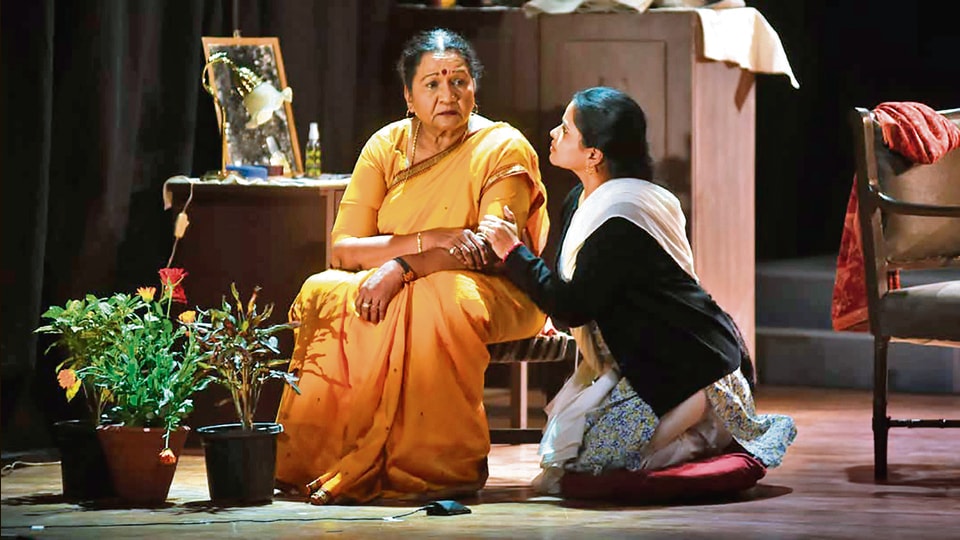
The tale of a woman trapped in a life she didn’t design and doesn’t want, can feel stifling, disturbing, resonant. A recent revival by NSD is a riveting watch.
Last month, I went to see a play staged by the National School of Drama (NSD).
It wasn’t just any play; it was a revival of the landmark Aadhe Adhure. Written in 1969 by Mohan Rakesh, it shook the theatre world then, and is regarded as a modern classic today.
It is fitting that Aadhe Adhure should be revived now; 2025 marks Mohan Rakesh’s centenary year (he lived from 1925 to 1972). What made the revival more special was that NSD brought back the stellar cast from their production 35 years ago, led by the supremely talented duo of Ravi Khanvilkar and Pratima Kazmi.
That 1990 production was directed by Tripurari Sharma (1956-2023) and, as a mark of respect, the play was re-enacted along the lines she set, and carried her name as director.
I have read Aadhe Adhure and seen it staged before, but I was still spellbound by the searing intensity that grabs you by the collar from the first scene and doesn’t let go until the end.
This is the story of a dysfunctional family made up of Mahendranath, his wife Savitri and their three children, the unhappily married Binny, the unemployed Ashok, and a school-going teenager named Kinni.
Savitri is the sole earning member, yet the entire family (except for the married daughter Binny, who offers some sympathy) is hostile, uncaring or cruel towards her. Mahendranath is a defeated, pathetic man who resents the fact that she is the breadwinner, and that she knows, and has known, other men. Kinni is rebellious and peevish. And when Savitri invites her boss to their house so he can meet Ashok and perhaps help him find work, Ashok, full of accusation and anger, refuses to meet him and storms out of the house.
Aadhe Adhure is about the emergent urban nuclear family, the lower-middle-class grind for survival, and a woman’s daily battles.
As the play unfolds, we learn of the terrible violence Mahendranath has inflicted on his wife in the past. We learn that Savitri longs to be free but cannot bring herself to abandon her ungrateful family. What will happen to them if she leaves?
Fiery and outspoken, she still yearns for a better life and partner. We learn about the men she has attempted to find happiness with. Among them is her current boss and an old flame. Towards the end, we also meet Mahendranath’s friend, Juneja, who delivers a monologue about how Savitri will never be satisfied with any man, because of her hunger for money and status. Did Mohan Rakesh intend to suddenly paint Savitri in a less-sympathetic light? That is a depressing thought. Each time I watch it, though, the monologue only serves to increase my sympathy for her.
In his instructions for production, Rakesh said he wanted the same actor to play all the male characters (underlining, perhaps, how the men are essentially all the same). Consequently, the role of “Man” in Aadhe Adhure has become something of a legendary challenge for male actors.
When it was first staged in Delhi in 1969, by the theatre group Dishantar, Om Shivpuri (1938-1990) served as director and played Man, working in close conjunction with Rakesh. In the recent NSD revival, Ravi Khanvilkar was stellar as “Man”, subtly altering his walk and mannerisms as he switched from one role to another.
Aadhe Adhure is not an easy play to watch. It can feel stifling and disturbing. The dialogue, written in plain, everyday language, hits hard. It may have been written in 1969, when women supporting their families and having male friends was still unusual, but, sadly, I have no difficulty seeing its relevance today.
Rakesh offers no solutions and no relief. The play ends with the family still trapped in their version of hell. There will be no escape for Savitri.
(To reach Poonam Saxena with feedback, email poonamsaxena3555@gmail.com)


