
 E-Paper



Hope on the water: A Wknd interview with Olympian sailor Vishnu Saravanan

 Prefer HTon Google


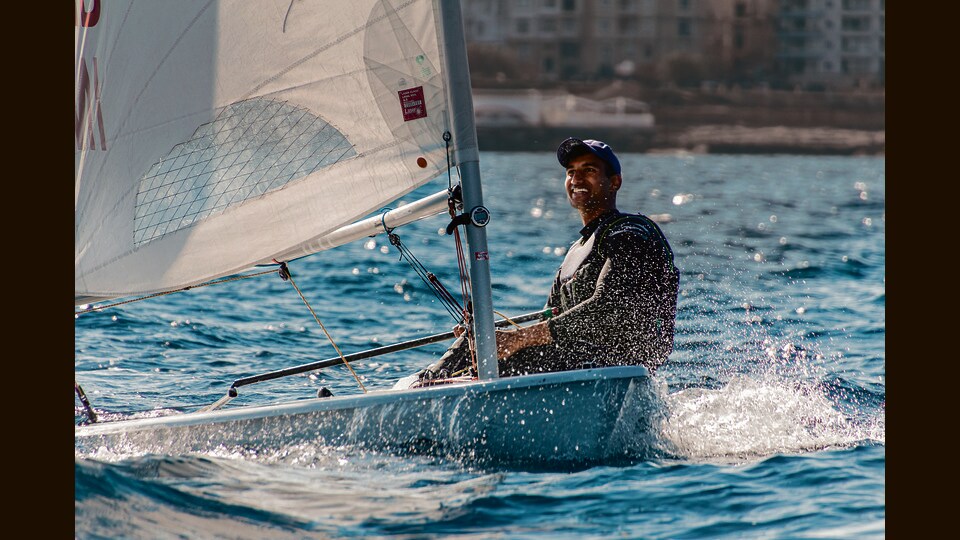
He’s sailed amid sharks, 7-metre waves. Feels a kinship with the sea, its calm and strength. Meet the first Indian sailor to qualify for consecutive Olympics.
The thing that intrigued him most about the water as a child was how it could be so powerful and so calm at the same time, says Vishnu Saravanan.
As he heads to the Paris Olympics, the first Indian sailor to qualify for consecutive Games, those are both qualities he aims to master.
Saravanan, 24, is from a family of sailors. His father, Subedar Major (Retd) Ramachandran Saravanan, is a multiple Nationals medallist who began taking his son out onto the water when he was four. They sailed on lakes in Pune, often with Saravanan’s younger sister Ramya, who is currently in the running for an Olympic berth too. (Success here would make them the first brother-sister duo to represent India in the sport.)
Then, in 2009, Saravanan Sr was allotted family accommodation in Mumbai. His wife Rajeshwari Saravanan, a homemaker then and now a restaurateur, moved from Pune with the children. And a whole new world opened up to the boy, now nine years old.
For a child who had never seen the sea, it left an indelible mark, as you can imagine, he says laughing. “I stood there absolutely mesmerised. The sheer expanse of it was something else.” Saravanan started to train in earnest now, under his father, and began to rack up the wins almost immediately.
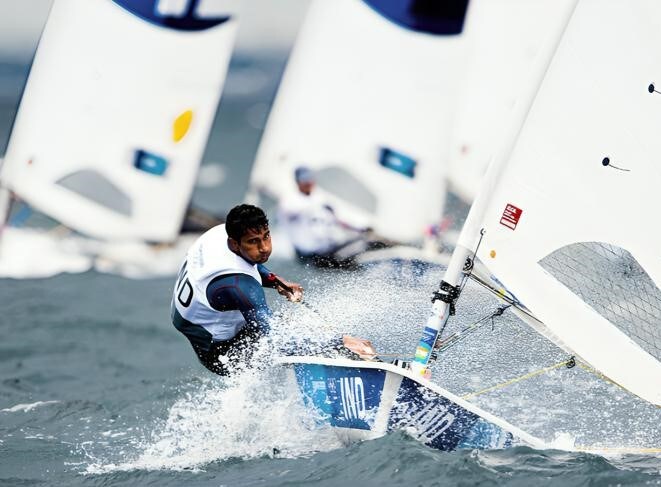
In a year, he had secured a top-four finish at the Nationals and participated in the Youth Sailing World Championships. “With each competition, it became clearer to me that I was born to do this,” he says. At 10, he was already gaining the confidence of a career sportsman. “I began to spend more time on the water. International exposure opened me to a world of possibilities.”
At this point, an Olympic medal became the family’s goal. “I was a backbencher but there was no fuss about it. After school, I would cycle down to the Army Yachting Node sailing centre in Colaba and train.”
As he grew into adolescence and his long limbs extended, Saravanan seemed made for the sport. By 17, he was competing with experienced sportsmen more than a decade older than him, in the big leagues — the Olympic-level International Laser Class Association races (ILCA 7). He competed in his first senior Nationals, racing against 28- and 29-year-olds, and won. He remains India’s youngest nationals champion ever.
“As a sailor, you mature between the ages of 29 and 33, because by then your mind and body are completely conditioned. So I entered without any expectations,” Saravanan says. “Beating sailors of that age group was quite special.” He never felt intimidated, he adds. “In fact, the senior sailors were all very encouraging and proud, as were my parents.”
That day, he began to believe that he had a real shot at the Olympics. He stepped up his physical training. “The first thing you need as a sailor is strength. Your quads, core and back should be like steel,” he says.
He began training his mind too. An ILCA 7 event packs 10 races into a week, each one typically an hour long. “You are all alone in the sea, using your body to counter nature. The race is so frenetic that you don’t have much time to feel or think,” Saravanan says.
In about 45 minutes of this, concentration can start to flag. “You need supreme spatial awareness, and your instincts should be on point to navigate changes in conditions. Out there, the elements can be your friend as well as your enemy. Thirty seconds of carelessness can wreak havoc on your chances.”
Such a lapse cost him potential gold at the Asian Games in Hangzhou last year. Saravanan was penalised for too much propulsion (through the use of body movements, rather than through wind and water alone), and finished with bronze.
“I use meditation and breathing exercises to train my mind,” he says. “Out in the sea, you are on your own. But if you are awake to the present, nothing bad will happen. I have sailed on seven-metre waves and in shark-infested waters and I haven’t been afraid.” The one time he was “a bit intimidated”, he adds, was when he hit a dolphin during a race. “It happened so suddenly that it threw me, but the dolphin was fine and swam away. At moments like these, the key is to stay calm.”
A subedar with the Mumbai-based Army Yachting Node, Saravanan secured the Olympics berth after finishing 26th of 152 participants in the ILCA 7 World Championship. On that clear blue day in Adelaide, he negotiated winds that reached 25 knots and waves that rose two metres.
He has been preparing intensely, training in Valencia for three years, with Croatian coach Milan Vujasinovic. But he is realistic about his chances in Paris. “Tokyo was my debut Olympics and I was a bit overwhelmed. This time, I am more experienced and better prepared. I will target a Top-10 finish,” he says. “If I have a good week, I may even be in a medalling position.”
The important thing, he knows, is to try to improve on last time. After all, there is plenty of open ocean ahead of him.


