
 E-Paper



Look ma, no hands: Rachel Lopez pays a visit to India’s atomic clocks

 Prefer HTon Google


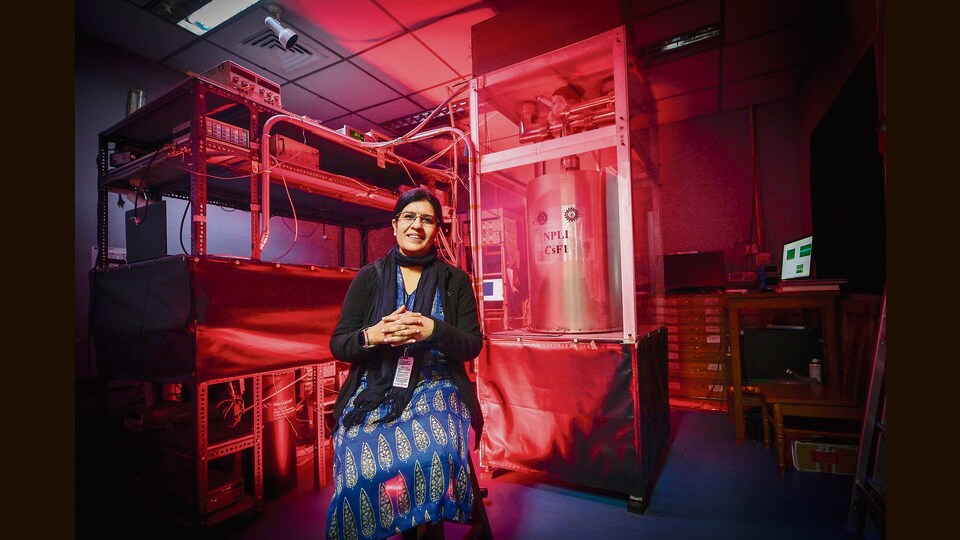
Our caesium fountains are among only 12 worldwide. Meet the timekeepers who watch over them at the IST Metrology Division in New Delhi.
“There’s never a dull moment in timekeeping,” says Poonam Arora, senior principal scientist and head of the Indian Standard Time Metrology Division of the National Physical Laboratories (NPL) in Delhi.
Think of her as India’s ultimate clock-watcher. Arora oversees the machines that set and maintain the most accurate time for the nation, down to the nanosecond.
So, don’t go in expecting Big Ben. The most precise time-keeping devices on the planet no longer have hands, a face or even quartz mechanisms. “A clock is simply a combination of an oscillator and a counter,” Arora says. At NPL, caesium atoms do the oscillation inside a sealed cylinder that looks like a craft-brewery tank.
A maze of lenses on one side cool the atoms, so they’re slow enough to track when they get launched into the tank. Inside, in a magnetically shielded vacuum cavity, each atom moves up and down, forming a vertical fountain, its precise resonant frequency feeding data into five separate clocks in a sealed room on the other side.
“They’re monsters, these clocks,” Arora says. “They are expensive devices that need stablising and monitoring day and night. I’m often checking them at home from my laptop.”
They are also India’s pride. Only 12 caesium fountains exist worldwide, and when Arora and her team began operating our indigenous one in 2011, we were only the ninth country to do so.
DAYS OF HOUR LIVES

They’re worth the fuss. Quartz timekeeping — the battery-powered vibration-based system that powers wristwatches, wall clocks and Swiss collectibles — can only take us so far. “They count milliseconds, a thousandth of a second, which is sufficient for daily life,” Arora says. For more intricate operations, such as GPS, if timekeeping is out of sync by even a nanosecond — that’s a billionth of a second — satellite navigation readings are off by 500 miles on the ground.
Atomic clocks on the other hand, operate on the picosecond level; they are precise to within one-trillionth of a second. “Even when operated continuously, they neither lose nor gain a second in about a million years,” Arora says. And they don’t wear out (because atoms will always do what atoms do).
This is the kind of accuracy big nations need in order to smoothly run stock exchanges, mobile-phone networks, space missions and digital banking. And to know, as Arora says, that your Zomato delivery is four minutes away. “There should not be a case, in a diverse country like ours, that one company’s data centre follows one time source and another follows a different clock,” says Venu Gopal Achanta, director of NPL. “We’re in the age of electronic warfare, financial disruptions and infrastructure and power-grid failures. Marking time with pinpoint precision is what keeps large systems stable.”
It’s what defends our borders too. India’s indigenous, independent satellite system NavIC (Navigation with Indian Constellation) was developed by the Indian Space Research Organisation, and uses time data from NPL. Being able to determine the precise positioning and time for India and the 1,500-km surrounding region, without waiting for data from another nation, is one more way to operate independently.
MINUTE DETAILS

We are now headed into a future in which even picos may fall short.
Optical clocks, which measure visible light waves, are many times more accurate and stable. They don’t lose a second in over 13.8 billion years.
“Right now, some 10 countries have them, and India’s version is a couple of years away,” says Achanta. “It’s a group we should be part of. We are a growing country, proud of our technology, with a growing economy. We can match these scientific achievements.”
Optical clocks are already helping scientists conduct dark-matter experiments, map Earth’s gravity, work out new systems for deep-space navigation and earthquake monitoring. Will we ever have one universal time? Unlikely, says Arora, chuckling.
“The universe has its own rhythm,” she adds, “while timekeeping is entirely a manmade convention.”
.
SO, DO I NEED A CLOCK OR A MAP?: TUSSLES OVER TIMEKEEPING, AROUND THE WORLD

Russia: It announced last year that the four Ukraine regions it annexed in 2022 would have to switch from Ukraine time to Moscow time, one hour ahead. Russia’s full-scale invasion of Ukraine is now in its fourth year.
China: The country has a contentious relationship with the clock. Everyone is expected to follow a Beijing Time despite vast geographical differences. So, in the Xinjiang region, the summer sun sets at midnight. Communities that break from the official time have been prosecuted.
Kiribati: The Pacific nation used to have a unique problem. Of its 33 islands, nine were on the other side of the International Date Line. That meant some islands had a 23-hour time difference with their neighbours. On January 1, 1995, the country simply hit reset and brought all its islands onto the same page of the calendar. The date line now bends around the archipelago to accommodate the shift.
Malaysia: The country is in the middle of a mini-reckoning, after a minister posted about his morning run in Borneo, in November. The island is east of the mainland; sunrise comes at a decent 6 am. In Kuala Lumpur, the sunrise can be as late as 7 am. Mainlanders are now arguing that the unified time zone denies them the chance to enjoy the early hours as their minister is doing.
Kazakhstan: It went from two time zones to one, in 2024. Many in the east (including the capital Astana and the country’s biggest city, Almaty) are now waking up in darkness. Public backlash has been so strident that President Kassym-Jomart Tokayev recently issued a plea for people to drop the issue.
Nepal: The country followed Indian Standard Time until 1986, when it created its own time zone, aligned with the longitude of the sacred Gaurishankar mountain. This puts their clocks 15 minutes ahead of India’s, an unusual increment of change.


