
 E-Paper



What’s the score in Saudi Arabia?: Rudraneil Sengupta on the country’s football ambitions

 Prefer HTon Google


Amid an aggressive push – acquisitions include Ronaldo and Neymar – half-empty stands still feature no women at all. Could the game change the region?
Saudi Arabian football is here, bankrolled by that country’s crown prince, Mohammed bin Salman. His exhaustive long-term plan involves boosting infrastructure and visibility for the game at various stages.
It began with an astounding sweep in which the Saudi Pro League acquired some of Europe’s top players — starting with Cristiano Ronaldo in January, then Karim Benzema, Riyad Mahrez, N’Golo Kante, Ruben Neves, Jordan Henderson, Sadio Mane, and now Neymar.
These acquisitions took the league from a non-existent broadcast event outside its own country (SPL has been around but unnoticed since 1976) to something that the world is watching. Sony Liv, which airs the Saudi Pro League in India, reported that within weeks of signing Ronaldo, viewership went from nothing to at par with the Bundesliga here.
In that spirit, I tuned in this week, for the first time. I was curious to see the European giants in their new, unfamiliar environment. I wanted to see how the game would play out, when some of the world’s finest footballers were placed alongside team members from a very different league.
Well, the football was ragged, the heat seemed sapping, and some of the European stars looked out of sorts (they are likely still adjusting to their new world). Something else really stood out. Over and over, across half-empty stadiums, there was not a woman spectator in sight.
In the global north, the sporting ambitions of countries such as Iran and Saudi Arabia are often dismissed as “sportswashing”. They are said to be trying to replace their global image as countries with poor human-rights records with an image of gilded athletic achievement. The sportswashing claim has felt cynical and hypocritical to me, but this was one of those times when it rang true.
To be sure, the Saudi football development plan has a solid budget and plan for women’s football, and for more women in coaching and administration. In 2019, a ban on women entering sporting venues was lifted under certain conditions (separate seating areas, a dress code, female police personnel, etc). These changes coincided with a larger shift on civil laws relating to mandatory dress codes, gender segregation and the ban on women driving.
Yet, in the three Saudi Pro League games that I watched, there was not a single woman spectator or official in view.
It reminded me of the Jafar Panahi film Offside (2006), a poignant, funny, and deeply immersive movie about a group of football-mad girls who, separately, try to enter a stadium in Tehran disguised as boys, to watch a high-stakes World Cup qualifying match.
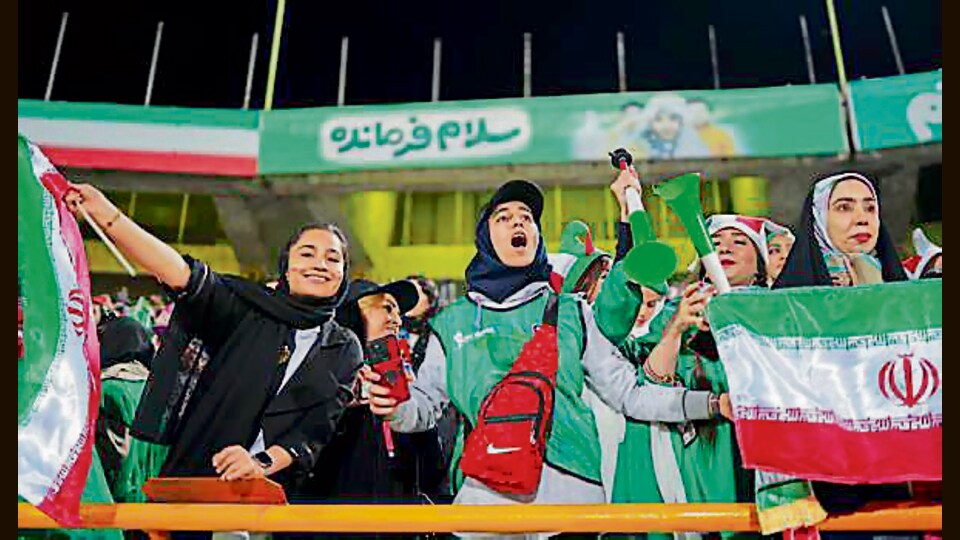
In 2019, Iran finally lifted a blanket ban on women entering stadiums, when a limited number were allowed into the Azadi Stadium in Tehran (through a separate gate, to sit in a separate enclosure, with policewomen as supervisors) for a football match.
It’s only been five or six years since a similar norm (not a law, but a custom) was eased in India: women in Haryana were traditionally not allowed to enter dangals or wrestling tournaments. Now, women wrestlers from Haryana are Olympic medallists and international stars. Today, in Haryana during dangal season, there are pockets of women at most events.
Perhaps footballing success will bring similar change to countries such as Iran and Saudi Arabia.


