
 E-Paper



Shadows on the bedroom wall: At home with Satyajit Ray

 Prefer HTon Google


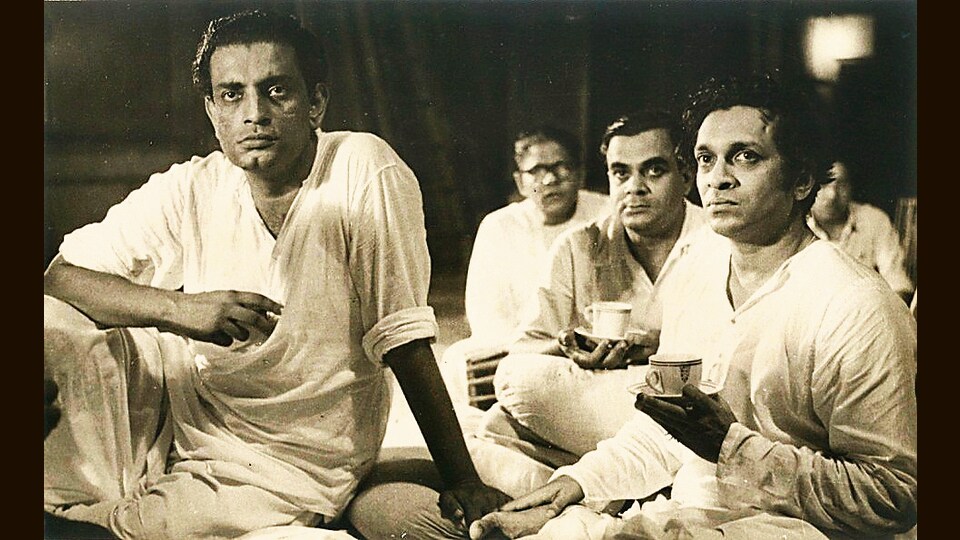
Ray had an imagination rooted, from the start, in moving images. See how Santiniketan, Tagore, and the simple beauty of Bengal shaped his art.
Satyajit Ray had a rather turbulent early life, followed by a rather idyllic childhood.
His father, the renowned Bengali poet Sukumar Ray — known for his delightful nonsense verse and whimsical illustrations — died when the boy was two years old. Under financial duress, his mother Suprabha Ray moved with her toddler to the home of her brother, Prashanta Kumar Das.
Here, in Bakul Bagan in South Calcutta, the idyllic part began. Ray grew up amid the love of mother, grandparents, uncles, aunts and cousins. Among these were cultural giants such as his uncle, composer Atul Prasad Sen, and aunt Kanak Das, a renowned Rabindrasangeet artist. Ray visited Santiniketan with his mother, to meet Rabindranath Tagore, who had been his father’s friend.
The company of these stalwarts would spark the child’s imagination, in ways that were seemingly rooted, from the start, in moving imagery. As a child, he would later tell batchmates at Santiniketan, he spent long idle afternoons making up stories about the shadows that formed on his bedroom wall, as the sun made its dappled way across the sky.
In the backdrop, a gramophone often played Beethoven, Bach and the works of other classical composers from his uncle’s vast library of music.
Years later, his mother expressed a wish that he study at the fine-art school Kala Bhavana at Santiniketan, a period that would shape Ray’s life and career. In 1982, delivering a lecture in Calcutta, the filmmaker would describe his time at the university as a period that “opened his eyes and ears” to the world around him.
It was quite a world, the one he inhabited as a young man.
On the one hand, he led the idyllic life of a city boy discovering bucolic small-town life, while immersed in the arts at an experimental riverside university (set up by Tagore, incidentally, as an alternative to colonial education). The tenderness for nature that Ray acquired in these years, and the love for the quiet, exquisite worlds of rural Bengal, would resurface over and over in his cinema.
At the same time, Calcutta, that city that was the beating heart of his creative endeavours, retained its hold. He returned home almost every weekend.
Meanwhile, out there, worlds were colliding.
“Ray was learning to observe nature on the one hand,” says Meenakshi Shedde, film curator, critic and South Asia programmer for the Toronto and Berlin international film festivals, “and on the other, Gandhiji had launched the Quit India Movement, which was spreading across the country; a world war was being fought; Japan had bombed Calcutta.”
***
Ray’s life as an artist would begin amid this tumult.
On a field trip across central India with his classmates, the young men slept under the stars or in cowsheds, determined to live off their art or do without. It was a test of their mettle, an internship of sorts, the artist Dinkar Kowshik would later write, in a 1992 article in the Bengali magazine Anandamela.
As they toured rock-cut temples and ancient caves, Kowshik writes, they marvelled at how inextricably nature had once been woven into the human experience; and how frayed that connection had become, particularly in the cities.
At Ajanta and Ellora, they saw “plants and trees shed tears while bidding farewell to Shakuntala… Ahilya live on in a block of stone for centuries”.
Months after that trip, Tagore died. Soon after, Ray left Santiniketan and began a career in advertising, then publishing, then film.
Today, one doesn’t have to watch a Satyajit Ray film to encounter his legacy.
The intimate street sequences in Mean Streets (1973), with their improvised dialogue and handheld footage depicting life in New York’s Little Italy, were heavily inspired by Ray’s “lyrical humanism on screen”, director Martin Scorsese has said.
Wes Anderson has spoken of the influence of Ray’s aesthetic, his humanistic storytelling and his use of music, on films ranging from The Darjeeling Limited (2007) to Asteroid City (2023).
Adoor Gopalakrishnan’s Malayalam film Swayamvaram (1972), with its focus on ordinary lives, economic fragility and quiet emotional disintegration, recalls Ray. So does his Elippathayam (1982), a tale of a crumbling feudal household. There is the use of natural light, unforced performances and empathetic portrayal of a woman navigating indignity and poverty, in Balu Mahendra’s Tamil film Veedu (1988), and similar echoes in J Mahendran’s Mullum Malarum (1978).
Entire schools of cinema have shared roots in his work. But perhaps one of the greatest tributes to one of the world’s greatest filmmakers is the way so many still mark an exceptional frame or a quietly devastating story with the words: That could have been a Ray.
Satyajit Ray’s legacy remains, in his cinema and beyond it, a living, breathing entity.


