
 E-Paper



The 25-million-year itch: Ancient lice are telling new tales about humans

 Prefer HTon Google


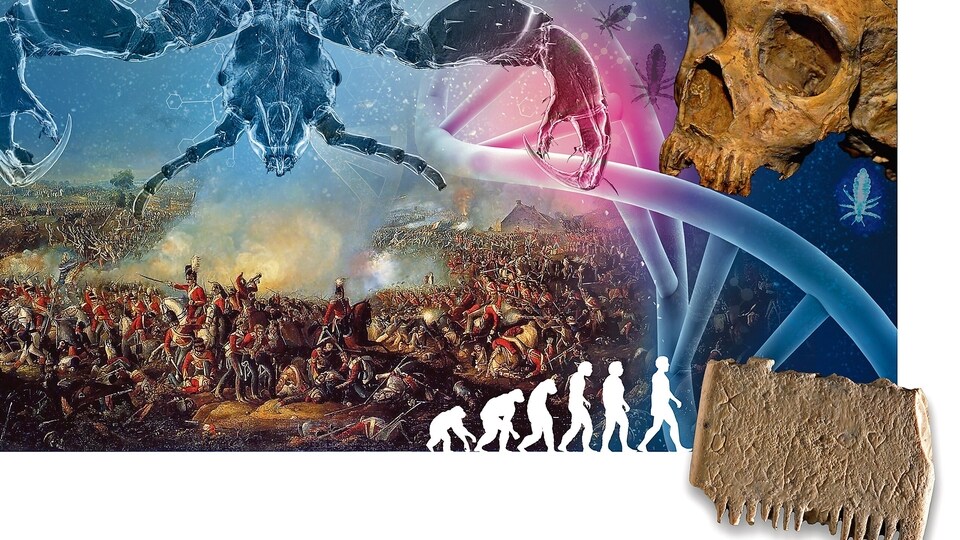
They’re providing new answers to pivotal questions: Whom did early humans raise families with? When did clothing begin? How did we get crab lice from gorillas?
Man’s best friend may be you-know-who, but his earliest companion was likely the head louse.
Lice have been so intrinsically linked to humans, evolving alongside us for over 25 million years, that their genetic data is providing clues to our genetic history. They are helping archaeologists map, more accurately, how early and modern humans may have dispersed around the world.
In a study published in Plos One in November, researchers from the University of Florida and Argentina’s CIPEIN (Centro de Investigaciones de Plagas e Insecticidas) were able to trace the settlement of the first Americans and the colonisation of the Americas by Europeans, through a genetic variation in modern lice.
The researchers analysed six genetic markers in the DNA of 274 specimens from 25 geographical regions around the world, and found two distinct genetic clusters or lineages that arrived in the Americas through different human hosts.
One cluster of genetic markers was present in present-day specimens from Africa, Asia and the Americas, supporting the theory that the first American settlers, today’s Native Americans (believed to have settled there about 30,000 years ago), had origins in East Asia.
The second cluster of markers was found in samples from Europe, Mexico, the US and Argentina, indicating that they arrived in the Americas on the heads of European colonisers.
“Modern louse populations today still retain a genetic signature from their distant Asian ancestors. The patterns observed in the new study support existing ideas about human migration and provide additional knowledge about how lice have evolved,” a press release on the finding, published by the University of Florida’s Florida Museum of Natural History, said.
This is just a small corner in a very large puzzle that the tiny louse has been helping piece together.
It’s an added advantage that ancient lice are among the best-preserved human parasites. When two Peruvian mummies dating to about 1000 CE were unearthed in 2008, one was found to have 407 fossilised lice on its head, while the other had 545.
The many fossilised lice thus recovered have been telling tales. The period in which lice diverged into two species — Pediculus humanus capitis or head lice, as distinct from Pediculus humanus humanus or body lice — for instance, has been key to determining when humans first began to use clothing.
Body lice, armed with tiny claws seemingly designed to cling to fabric, evolutionarily diverged from head lice between 83,000 and 170,000 years ago, according to a 2011 study by geneticists from the University of Florida, published in Molecular Biology and Evolution.
Before this finding, the advent of clothing had been dated to only about 75,000 years ago. Because early clothes were entirely biodegradable, evidence of the garments is unlikely to ever be found, but estimates were made based on tools such as bone awls and stone blades, likely used to turn fur and leather into cladding.
Since the lice study, more such tools have been found, including some in a cave in Morocco that have been dated to the beginning of the last Ice Age, 120,000 years ago, fitting the revised timeline that the lice indicated.
Incidentally, humans are the only species known to host three kinds of lice (head; body / clothes; and crab lice in the groin). Other animals generally host just one.
Our head lice (and body lice) can be traced to the lice that live on chimpanzees. The genetic signatures of the two species diverged about 5.5 million years ago, around the same time that the first apes began to walk on two legs, a University of Florida study published in BMC Biology in 2007 showed.
Crab lice trace their ancestry to an entirely different genus (Pthirus) that lives on gorillas too. It is believed that humans only began to host crab lice (Pthirus pubis) about 3 million years ago.
“Humans most likely got the gorilla’s lice from sleeping in their nests or eating the giant apes,” David Reed, a biologist and curator at the Florida Museum of Natural History (and lead author of the 2011 paper on body lice and prehistoric clothing) said in a statement. “About 3.3 million years ago, lice found on gorillas began to infest humans. That they took up residence in the pubic region may have coincided with humans’ loss of hair on the rest of their bodies and the lack of any other suitable niche.”
Tip of the liceberg
What other stories can lice tell? Well, they provided the first hard evidence that our early ancestors, Homo sapiens, lived alongside and procreated with Neanderthals.
The homo sapiens, the only species of this genus that has survived, was taller than the Neanderthal, with a rapidly evolving brain. The overlap between the two was extensive. Homo sapiens evolved about 300,000 years ago; Neanderthals, already on the scene, went extinct about 40,000 years ago.
In 2004, a study by Reed indicated that the two species shared lice, indicating that they likely shared habitation and inter-bred. About a million years ago, a set of early humans left Africa, carrying their lice with them, and picked up others from the soon-to-be-extinct hominids such as the Neanderthal, already living in parts of present-day Europe, stated the report published in Plos Biology.
The findings sparked intense debate. At the time, there were still large parts of the scientific community that argued that sub-species as different as these two would not have intermingled.
In 2010, when ancient Neanderthal DNA was fully sequenced, they confirmed the study’s findings. Today, it is acknowledged that many humans alive have Neanderthal genes making up as much as 4% of their DNA.
A life of itch own
It hasn’t been a friendly bond, of course, the one between humans and lice. Through recent history, they have so plagued us, in fact, that one of the oldest known sentences wishes the reader luck in beating the minuscule menace.
Inscribed on a double-edged ivory comb from about 1700 BCE (surprisingly similar to those still in use today), an inscription in an early Canaanite script reads: “May this tusk root out the lice of the hair and the beard.”
Body lice contributed to Napoleon’s downfall. They spread typhus among his Grande Armée of 500,000, reducing them to about 30,000 by 1812, at which point he eventually lost to forces of a Prussian-British-Dutch coalition, at Waterloo.
They also spread “trench fever” among young soldiers during World War 1. The lice acted as vectors for the Bartonella quintana bacterium, which spread rapidly through the packed trenches, causing intense fevers, headaches, muscle aches and weakness.
Body lice still transmit diseases, given the chance. Grooming and hygiene have helped finally evict these ancient companions, in a large number of human settlements. They still hang on in others. They likely have more stories to tell.


