
 E-Paper



Tide and prejudice: In coastal Kerala, a play serves as a prayer for drowning villages

 Prefer HTon Google


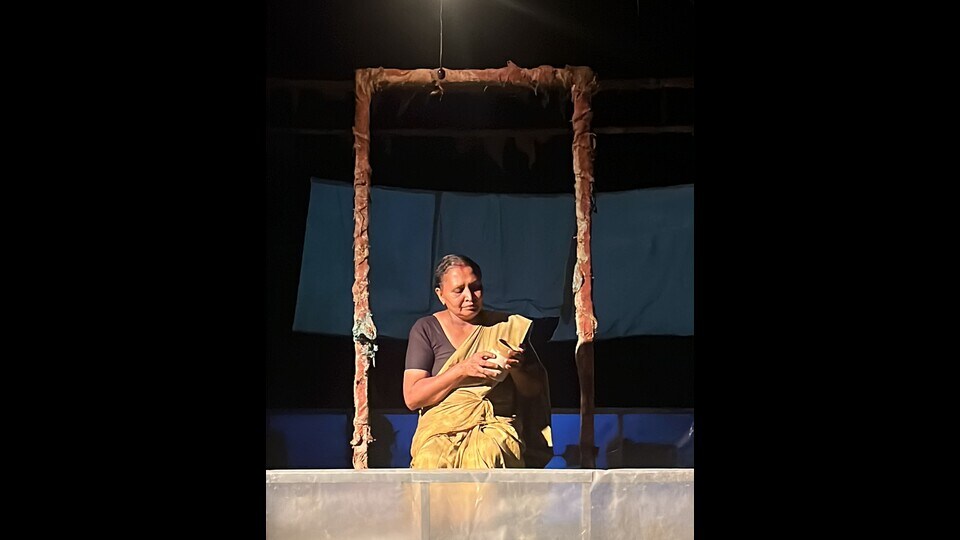
Tidal flooding is disrupting homes and lives in coastal villages. The play invites villagers to stand on an inundated stage and tell their stories.
What does it look like, a prayer for the drowning?
On a stage in Kochi, it is a wooden frame built to replicate a coastal home. Within the frame, Vilasini Surendran, 64, a daily-wage labourer from Ernakulam, performs in ankle-deep water. She isn’t acting, really; she is narrating the story of her life. She speaks of 43 years of learning to “resurface”. Of losing objects, a home, a sense of self and place.
The routine inundation of her home is a natural disaster, she says, but it isn’t considered one. It is called tidal flooding.
Amid the climate crisis, as sea levels rise and storms intensify, the flooding has worsened.
Along India’s extensive coastal and estuarine regions, residents (fisherfolk, policemen, farmers, shopkeepers, daily wage earners and a host of others) are watching from the margins, anxious and alone. There is little to no government response; no mitigative measures are being discussed here.
In Kochi, as a call to action, an ancient ritual is being played out on an urban stage. The objective is to record this period of change and offer a reminder: the seas affect us all. We have been wise to be wary in the past. It would be foolish to turn away now.
The play is titled Chevittorma, Malayalam for Prayer for the Dying. The name comes from a local Catholic ritual in which loved ones whisper prayers into the ear of a person on their deathbed, as a means of comfort.
“These villages are dying. Chevittorma is also a prayer for these villages,” says director Sreejith Ramanan, who was roped in by the local climate-tech start-up Equinoct, to stage the production (more on that in a bit).
Over the past year, the play has been staged across Kerala, and in Delhi and Mumbai. Later this month, it will be performed again in Kochi and in Thrissur. An allied exhibition is also underway at the Kerala Museum in Kochi, until October 19.
SURGE RATES
How did all this come about?
It began with a data-gathering effort, says KG Sreeja, director of research at Equinoct.
Across Kochi’s estuarine belts, such flooding now occurs long after the monsoon, late into November and December. Sunny-day flooding, it is locally called. (Kochi is not alone in this, of course; large parts of coastal India, from Mumbai’s Colaba to Kolkata and the Sundarbans are now home to such neighbourhoods.)
“Because the phenomenon of rising tides is silent and gradual, it doesn’t have the dramatic impact of a cloudburst, hurricane or other such disaster,” Sreeja says. One has to be looking in order to notice. Hence the play.
The effort that led to Chevittorma began in 2020, when Jayaraman Chillayill, co-founder and managing director of Equinoct, began to work with journalist KPM Basheer and researcher Manjula Bharati to build a repository of data on tidal flooding in Ernakulam.
They began by sitting down with two panchayats, and ended up talking to people from across 20 villages. “There were no real statistics available. Nobody really knew how many houses were affected,” Chillayill says. “So we devised a calendar, distributed it across 10,000 households, and asked residents to note down the time, water levels and the number of times water entered their homes.”
Data came back from 10,000 households across 15 villages.
Water levels were causing walls to crack and foundations to sink; utensils were being washed away; sickness and skin rashes were reported; homes were abandoned for a time, returned to and restored.
There was no government intervention, and no sense among residents of how to press for mitigative action. This is where art comes into play, Chillayill says. The team decided to tell this story through an experimental play that featured members of the community.
Bharati invited theatre director Ramanan to helm this effort. He began by sending video artist Akarsh Karunakaranan and production assistant Vipin Kumar VU to tour the villages, over a week. They returned with local history, myths, songs and rituals.
CROSS CURRENTS
Chevittorma plays out on a stage erected within a tank of water.
After a brief history of the region, projected onto garments on a clothesline, items chosen from the actors’ homes are beamed onto the screen, and the 12 villagers take turns to speak about them. The objects include a water-stained suitcase, a frayed notebook, kitchen utensils, worn toys and, in one instance, a precious flute.
At one point, a woman narrates the story of a death in her home, as actors build a mound to keep the deceased person’s body above water. In the end, the traditional theatrical character of the king performs to exhaustion on the inundated stage, while carrying a broken door.
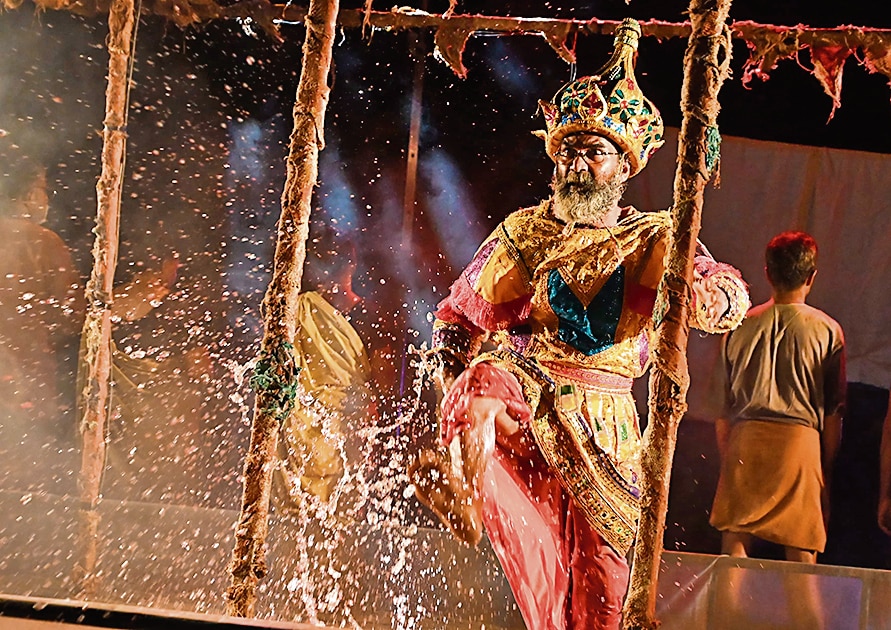
About 30 people from the 15 villages stepped forward to be part of the production; 12 feature in the final cast. Over six weeks, they honed their stories and storytelling, and selected the items that would serve as props.
“I came to this village in 1982. My husband’s house was surrounded by mango trees and coconut trees. It was a beautiful home. A lot of our livelihood depended on making coir from the coconut yield. Today I stand in an almost-desert,” says Surendran.
Latha Dileep, 47, another daily-wage labourer, says she wouldn’t be able to play her role if it required her to act. “I don’t think I have the talent. We are talking about our lives, just as they are. That is not acting,” she says.
Buoyed by the response from audiences, the cast of 12 recently formed the Jalam (Malayalam for Water) Theatre Company. Between tours, they hold workshops for children in their villages.
The scientists, meanwhile, continue their research into the tidal flooding, gathering data on its changing nature and its fallout.
“I think all researchers need to move beyond the shackles of data,” Sreeja says. “As much as we talk about the necessity of it, it is only when one realises there is something beyond that data that one can realise the fullest power of the data itself.”


