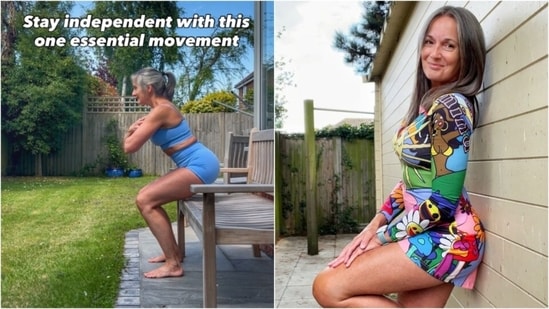
Let’s be real: no one grows up dreaming of the day they need to rethink how they sit down on the toilet. But if you want to keep living independently as you age, mastering the fundamental ability to stand up and sit down is non-negotiable. Also read | Grandmother shares her secret to staying fit: 'Exercise won’t make you look younger than you are but...'
For many older adults, joint pain — particularly osteoarthritis — creates a daunting barrier to functional movement. The immediate instinct when knees begin to ache is often to avoid bending them altogether.
Adapt, don't abandon movement
However, 63-year-old fitness coach and grandmother Jacqueline Hooton is on a mission to challenge that precise instinct, offering a pragmatic approach to maintaining lower-body strength well into retirement. Also read | Fitness coach shares 11 squat variations to burn extra fat, build strength and tone legs
"I know you think you hate squats because you have knee pain," she acknowledged candidly in a June 20 video posted to her Instagram, adding, "But you’re always going to need to be able to do this."
Jacqueline, who shared that she manages her own osteoarthritis, reframed the exercise not as a rigid gym discipline, but as an indispensable daily movement pattern. She wrote in her caption, “Knee pain is tricky. I know, because I have osteoarthritis. But don’t quit squats. Instead, find a variation that works for you, minimises discomfort, and maintains strength in your legs.”
{{/usCountry}}Jacqueline, who shared that she manages her own osteoarthritis, reframed the exercise not as a rigid gym discipline, but as an indispensable daily movement pattern. She wrote in her caption, “Knee pain is tricky. I know, because I have osteoarthritis. But don’t quit squats. Instead, find a variation that works for you, minimises discomfort, and maintains strength in your legs.”
{{/usCountry}}Four practical variations for every mobility level
The key to sustaining mobility without exacerbating joint pain lies in adaptability. Jacqueline demonstrated several practical modifications tailored to different physical abilities and comfort levels:
⦿ Stand-to-sit or chair squats: lowering yourself onto a chair or garden bench and standing back up mimics essential household movements while allowing you to control depth.
⦿ Box squats: squatting to a set height — such as a gym box — helps reduce joint stress while maintaining resistance.
⦿ Supported squats: holding onto a stable structure, such as a staircase bannister, provides balance and offsets body weight.
⦿ Goblet squats: holding a modest weight at chest level can help anchor posture for those who can handle resistance.
Building a sustainable strength routine
"Modify the depth of your squat," Jacqueline advised while demonstrating various forms, urging people to 'try any variation that works for you so you can continue to do this as you get older and remain independent'. Also read | Veteran actor Ranjeet shows how he stays fit in his 80s in new workout video, credits daughter for being his gym trainer
To gain benefits without overtaxing joints, Jacqueline recommended performing two sets of any chosen variation at least twice a week. The focus is not on heavy loads, but on consistent effort. By adapting movement to respect physical limits rather than abandoning it entirely, ageing adults can preserve vital autonomy, ensuring that everyday life remains within comfortable reach.
Note to readers: This report is based on user-generated content from social media. HT.com has not independently verified the claims and does not endorse them.
This article is for informational purposes only and not a substitute for professional medical advice.
Catch your daily dose of Fashion, Taylor Swift, Health, Festivals, Travel, Relationship, Recipe and all the other Latest Lifestyle News on Hindustan Times Website and APPs.
Catch your daily dose of Fashion, Taylor Swift, Health, Festivals, Travel, Relationship, Recipe and all the other Latest Lifestyle News on Hindustan Times Website and APPs.