FOR DECADES, surveys have suggested that middle age is the low point of life. While young and old generally reported high levels of life satisfaction, those in mid-life endured a slump. This “U-bend of happiness” or “hump of despair”, depending on perspective, has been documented hundreds of times across many countries. The age of peak misery varied—the Swiss were saddest at 35, Ukrainians in their 60s—but the pattern was consistent.
Tourists walk on a slope on Mount Etna as the volcano emits smoke, near Catania, Sicily, Italy, August 21, 2025. REUTERS/Antonio Denti (REUTERS)
Recently, however, the curve seems to have become warped. A study published on August 27th in PLOS ONE by economists David Blanchflower, Alex Bryson and Xiaowei Xu finds that young people across the world are now reporting the highest levels of misery of any age group. “We’ve seen a change from a hump shape to a ski slope,” says Dr Bryson.
Chart
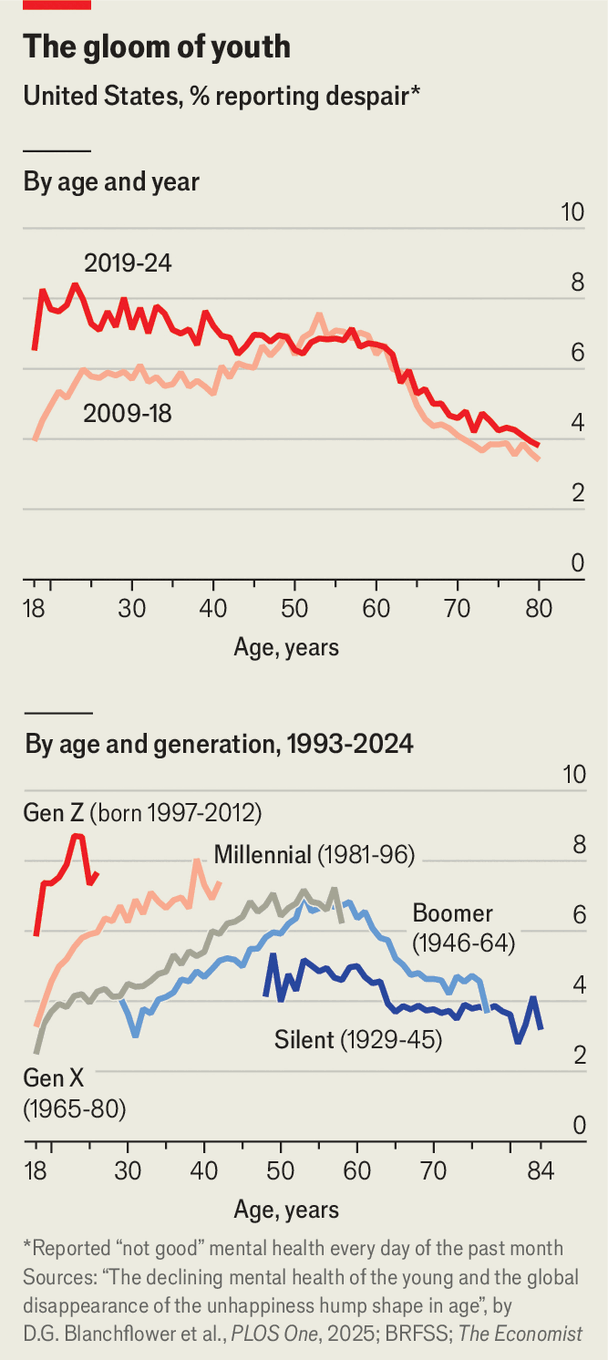
The authors first spotted the shift in the Behavioral Risk Factor Surveillance System (BRFSS), a long-running survey of Americans. They calculated the share of respondents of each age who reported having poor mental health every day in the past month. Between 2009 and 2018, the familiar hump was present: misery peaked in middle age. But from 2019 to 2024, the pattern changed. Levels of unhappiness in middle-aged and older adults remained roughly stable while despair among younger people rose (see top chart).
Britain shows the same trend. Using data from the UK Household Longitudinal Survey and the Annual Population Survey, the authors found that both anxiety and despair increased sharply among the under-40s after 2016, erasing the hump by 2019–2021. There is also some evidence outside the anglophone west. The authors analysed data from the Global Mind Project, a web-based survey, and in each of the 44 countries across Africa, Asia, Europe, Latin America and the Middle East, for which sufficient data was available, young people reported worse mental health than their elders.
The hump could still emerge, however. Because the new study provides a simple snapshot of unhappiness by age at a single point in time, today’s miserable 20-somethings might follow their predecessors’ path and become even gloomier in middle age. “It’s not inconceivable that if young people start out this badly, they could be even worse off in midlife,” says Dr Bryson.
Longitudinal studies of well-being, which track changes in the same people over time, can reveal such long-term developments. But they are rare. The few that do exist also find the hump, with unhappiness peaking in midlife. That lends credence to the depressing prospect that Generation Z may get sadder still.
Cohort data also support the idea that the hump could prevail. The Economist split the data from the BRFSS by generation (see bottom chart) and found that each cohort has become more unhappy as they have reached middle age. Generation X and millennials have slid into mid-life malaise earlier than boomers did, though, and Generation Z are starting their adult life far more miserable than any generation before. At a population level, these trends mean older people now look progressively less downcast than younger groups.
Why youngsters are so depressed is still unclear. One clue may come from the labour market. In a separate study from July this year, Dr Blanchflower and Dr Bryson found that despair has risen most sharply among young American workers, particularly the least educated. In the past, having a job seemed to provide a protective effect against poor mental health. That effect appears to have weakened for young Americans, perhaps because of falling job satisfaction among the same group.
But although it may be the case in America, it does not explain the data elsewhere. In a third working paper, published in June, the pair found that in some southern European countries life satisfaction among young people has actually risen since 2015, thanks in large part to a decrease in youth unemployment.
Another oft-cited culprit of teenage angst is smartphone and social-media use, which has risen in lockstep with youth mental-health problems since the early 2010s. There is some evidence for a causal link, but the most rigorous studies, which track teenagers’ mood and social-media use over long periods of time, do not find a strong relationship between such app use and subsequent mental ill-health.
Of course, things may yet turn around. Analysis by The Economist earlier this year found that the mental health of young Americans has somewhat improved recently, perhaps hinting at a return to youthful cheerfulness. If so, mid-lifers might find themselves the saddest once again—though ideally with fond memories of better times.
Catch every big hit, every wicket with Crick-it, a one stop destination for Live Scores, Match Stats, Quizzes, Polls & much more. Explore now!.

 E-Paper