
 E-Paper



Counting of votes for Uttar Pradesh assembly bypolls today
An average of over 53% of voters had exercised their franchise to decide the electoral fate of 88 candidates, including nine women, for the Naugawan Sadat, Tundla, Bangarmau, Bulandshahr, Deoria, Ghatampur and Malhani assembly seats


The counting of the votes polled in seven Uttar Pradesh (UP) assembly seats, where bypolls were held last Saturday (November 3), started from 8 am on Tuesday (November 10) amid precautionary measures due to the coronavirus disease (Covid-19) outbreak.
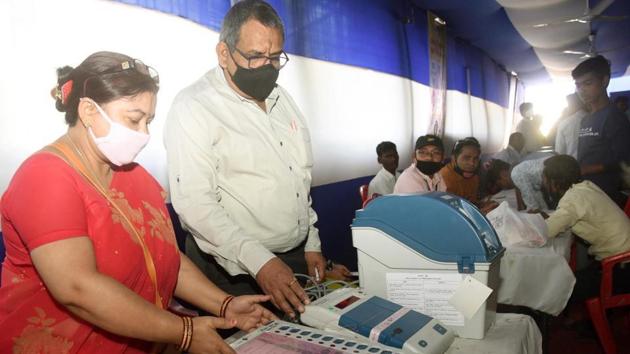
UP chief electoral officer (CEO) Ajay Kumar Shukla said the Election Commission of India (ECI) has made adequate arrangements for personal protective equipment (PPE) kits such as face shields, masks, thermal scanners, gloves, sanitisers, soaps and water for those who have been deputed for the counting.
An average of over 53% of voters had exercised their franchise to decide the electoral fate of 88 candidates, including nine women, for the Naugawan Sadat, Tundla, Bangarmau, Bulandshahr, Deoria, Ghatampur and Malhani assembly seats.
Also Read: D-day for 58 assembly seats across 11 states
“A maximum seven tables have been be placed in a counting hall. The counting of votes for Bulandshahar and Malahani assembly segments are being done in three halls each while counting for the remaining five constituencies are being conducted in two halls each,” Shukla said.
“Adequate security forces have been deployed at the counting centres to maintain law and order. The ECI has deputed seven observers to monitor the exercise. The results of all the seven seats are likely to be declared by Tuesday evening,” he added.
Of the seven assembly seats, where bypolls were held, six and one were held by the Bharatiya Janata Party (BJP) and the Samajwadi Party (SP), respectively, in the 2017 assembly elections.
UP chief minister Yogi Adityanath and the BJP’s state unit president Swatantra Dev Singh had led the party’s campaign on all the seven seats. The SP had also campaigned vigorously. The Bahujan Samaj Party (BSP) and the Congress had also mobilised their resources to increase their strength in the 403-member UP legislative assembly.
AK Saxena, a political observer, said the results of the by-election would set the tone for the 2022 UP assembly polls. The results would reflect the mood of voters both in urban and rural areas in the wake of Covid-19--induced lockdown since the assembly seats are spread across the state.
“Economic slowdown, new agriculture policy and migrants’ issues were raised by the political parties during the campaigning. The results will also reflect the voters’ reaction to these issues,” he said.
The maximum number of candidates in the electoral fray is in the Bulandshahr assembly seat, followed by Malhan (16)i, 14 each in Deoria and Naugawan Sadat, 10 each in Tundla and Bangarmau and six in Ghatampur.
The Naugawan Sadat, Ghatampur, Bulandshahar, Deoria and Malhani assembly seats fell vacant after the death of sitting lawmakers Chetan Chauhan, Kamal Rani Varun, Virendra Singh Sirohi, Janmejai Singh and Prasanath Yadav, respectively.
The Bangarmau assembly seat in Unnao district fell vacant after the disqualification of the then sitting legislator Kuldeep Singh Sengar following his conviction in a rape case on December 20, 2019.


