
 E-Paper



Meet the man delving deep into the country’s ancient volcanoes
The primary focus of Hetu Sheth’s research is extinct volcanoes, which have helped shape mountain ranges and massive landscapes in India as far back as 65 million years ago.


For Hetu Sheth, a professor of igneous petrology and volcanology at the Indian Institute of Technology-Bombay (IIT-B), it’s the philosophical and scientific appeal of volcanoes that have kept him interested in the dynamics of the earth’s interior for 26 years.
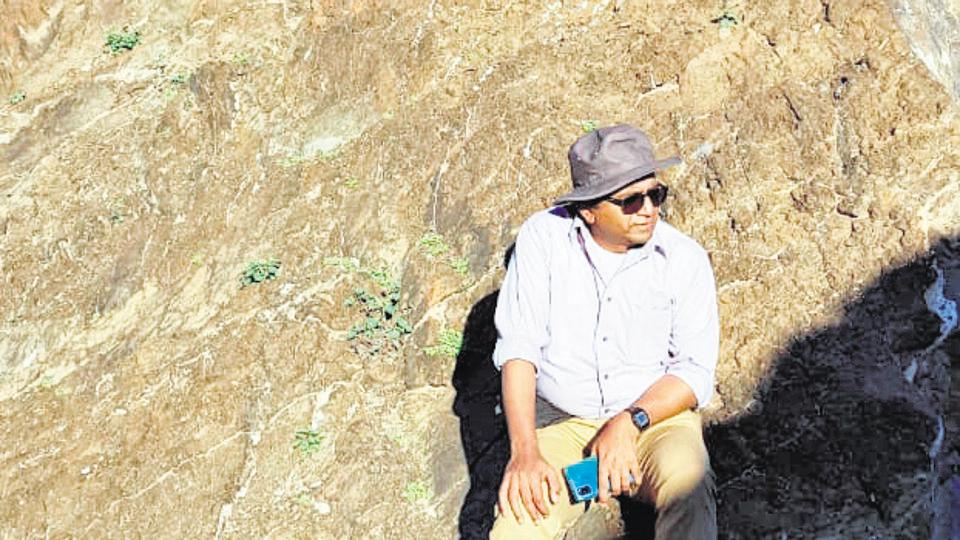
“Understanding the present to help interpret the past and see into the future is the idea at the core of all geology. That mission is a big part of why I love my field,” he says.
Travelling to remote places around the world to try and unravel one of nature’s most powerful and destructive forces can be dangerous, he admits. But the answers a volcano can hold override all else.
“Volcanoes contain a lot of information about how the planet works and how other planets in our solar system do. They help answer questions like how old the earth is, what is the future of the planet, the future of the solar system. It’s a very fundamental process in the solar system and an intellectually stimulating one at that,” says Sheth, 48.
He picked his field, Sheth says, because he loved geography in school. After a Bachelor’s degree in geology from Mumbai’s KJ Somaiya college, a Master’s in Applied Geology and then a PhD, both at IIT-B, he went on to do post-doctoral research at institutions in Ahmedabad, Mexico City, Hawaii, and Mumbai, and has been teaching at IIT-B for 17 years.
“It became clear to me that volcanoes are a very exciting and dynamic phenomenon. They tell us about the depths of the earth that we cannot reach or see,” he says.
It doesn’t take much to be a volcanologist, Sheth adds rather modestly. Along with a basic degree in science, preferably geology, all one needs is to love nature — and be prepared for back-breaking work: scaling mountains and scouring forests for the right rocks, collecting data and measurements, carrying samples back to the laboratory.
“You need to be prepared for hardship. It can be demanding work. But the opportunity to be with nature and the view from the top are always completely worth it.”
The primary focus of Sheth’s research is not active volcanoes, but ancient volcanoes in India — ones that have been extinct for millions of years but helped shape mountain ranges and massive landscapes as far back as 65 million years ago.
“That was the time of the formation of the Deccan volcanic plateau,” Sheth says. “The mountains of the Western Ghats in Maharashtra, such as those around the hill stations of Matheran and Mahabaleshwar, are formed of immense lava flows produced in those great volcanic eruptions. It was one of the largest volcanic events in the history of the planet.”
Sheth studies active volcanoes when he can, making observations and applying that knowledge to the ancient, extinct volcanoes of India. He has visited active volcanoes in India’s Andaman Islands as well as in the US, Italy, Mexico and Japan.
There are so many fundamental questions, and we cannot resolve them immediately, “but the different branches of geology, of which volcanology is one, are working together to find at least some answers,” Sheth says.


