
 E-Paper



Warmer seas up coral bleaching, shorten recovery period in Maharashtra, says study
After the temperatures got closer to normal in May 2016, at 29 degrees Celsius, coral bleaching at Malvan Marine Sanctuary decreased to 6.77%

 Prefer HTon Google


Data collected by the reef research team from Suganthi Devadason Marine Research Institute (SDMRI), Tuticorn, have revealed the dramatic fall in recovery period of corals after bleaching in the past 15 years.
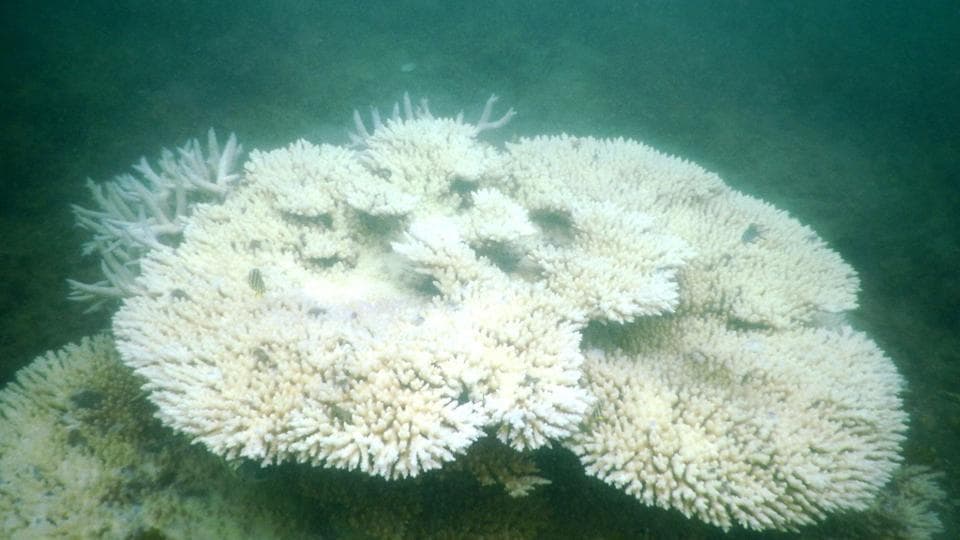
A survey conducted between 2003 and 2005 showed that live coral cover in the Gulf of Mannar was 36.98%, which increased to 42.85% in 2009. But the number decreased to 33.2% in 2010 owing to coral bleaching. The number increased to 38.86% after the recovery period commenced in 2015, but it once again reduced to 22.69% in 2016. The surface temperature of the sea during March-June 2016 was between 31.2 degrees Celsius and 32.6 degrees Celsius.
At Malvan Marine Sanctuary (MMS), in Maharashtra, water temperature was about 30 degrees Celsius as against 22 to 29 degrees Celsius in December 2015. But after the temperatures got closer to normal in May 2016, at 29 degrees Celsius, coral bleaching at MMS decreased to 6.77%. About 84.84% corals remained unaffected.
The findings for MMS are important as it was declared as a marine sanctuary in 1987 by the state to protect corals and other marine ecosystems.
“Coral bleaching at Malvan is a matter of concern,” said N Vasudevan, additional principal chief conservator of forests and state nodal officer for all marine biodiversity conservation projects under UNDP. “Although we cannot control ocean temperature and turbidity, the level of turbidity in water can be reduced by controlling the movement of tourists in the area and government departments concerned need to regulate activities such as sand mining.”
Among the corals that got bleached at MMS, the highest mortality was found among Porites group of corals at 27.78% followed by the death of 17.04% Coscinaraea group of corals. At Gulf of Mannar, Acropora, Montipora and Pocillopora which are among the fast growing corals were most affected.
“During recovery, corals should be stress-free. Fishing and tourism activities therefore need to be regulated. When corals bleach, a disease outbreak is possible that can lead to their death en masse,” said K Diraviya Raj, co-author from SDMRI. “There is a possibility that more corals have got affected in different parts of Malvan, which calls for a detailed study on the locations, distribution, species and current status of corals.”
Globally, mass coral bleaching events have increased leaving very short interval for their recovery.
“The severe heat stress seen in 2014-17 caused widespread bleaching and mortality whether the reefs were locally stressed or highly protected. Reducing local stressors such as over fishing, destructive fishing, from pollutants such as fertilisers, sediments, and plastics, and from habitat destruction, increases the resilience of corals, increasing the odds they can recover from bleaching events, “ said Mark Eakin, coordinator, US-based National Oceanic and Atmospheric Administration Coral Reef Watch.
A recent study by the Australian Research Council Centre of Excellence for Coral Reef Studies found that recurrence of severe bleaching events today is only six years based on bleaching records between 1980 and 2016 of 100 reef locations across the world.
Their analysis showed that Lakshwadeep Islands was among the 56 locations that experienced severe bleaching during the study period. Corals reefs in the island underwent severe bleaching during 1998, 2002, 2007, 2010 and 2016.
Researchers from SDMRI said comprehensive baseline database on the status and distribution of all reef areas with regular updates through annual monitoring would help to take effective management measures. “Coral rehabilitation in the affected reef areas with proven techniques using native climate resistant and resilient coral species would assist in taking remedial measures not only for increase of coral cover but also to support natural recovery process,” said JK Patterson Edward, director, SDMRI.
SDMRI has been successful in wide-scale coral rehabilitation through fragment transplantation in the Gulf of Mannar . To reduce the stress on corals, which are only concentrated around the Sindhudurg Fort, caused by tourism, the state government commissioned SDMRI to set up artificial reefs and coral transplantation in one hectare each area near Kavda rock in Malvan and Vengurla. The two-year pilot project ended in December 2017.
“We have sourced corals locally and therefore the chances of survival are better. Though what we have transplanted shows good survival, it will take a long time to see the results because they grow at a very slow pace. But the survival rate so far is encouraging,” said Vasudevan. “We want to revive corals in other areas to bring down the pressure on the Malvan corals.”


