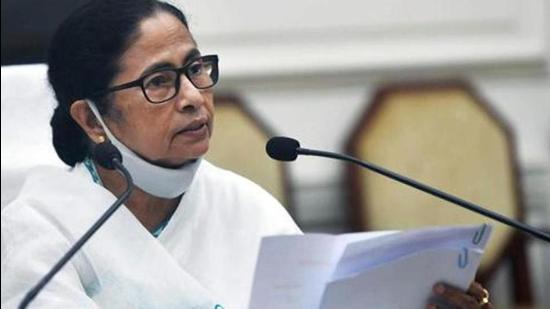
Though all set to test her party’s strength in the Bharatiya Janata Party (BJP)-ruled Tripura and Assam, before forging a national alliance against the saffron camp in the 2024 Lok Sabha polls, Trinamool Congress (TMC) chief Mamata Banerjee will have to chalk out a different strategy for the two northeastern states. In these states, citizenship and illegal immigration from Bangladesh are crucial issues, leaders in her party and as well other sources have told HT.
Banerjee has, so far, vehemently
Though all set to test her party’s strength in the Bharatiya Janata Party (BJP)-ruled Tripura and Assam, before forging a national alliance against the saffron camp in the 2024 Lok Sabha polls, Trinamool Congress (TMC) chief Mamata Banerjee will have to chalk out a different strategy for the two northeastern states. In these states, citizenship and illegal immigration from Bangladesh are crucial issues, leaders in her party and as well other sources have told HT.
Banerjee has, so far, vehemently opposed the National Register of Citizens (NRC). Implemented in Assam in 2018, it resulted in 1.9 million people being left out of the final list published in 2019 as they could not furnish documents to prove that their families lived in Assam before March 25, 1971 — the day before Bangladesh declared its Independence from Pakistan.
Banerjee is also resistant to the Citizenship (Amendment) Act (CAA), which is yet to be enforced in any state although the Parliament passed the bill last year. The new law enables expedited citizenship for Hindus, Christians, Buddhists, Parsis, and Jains who came to India from Pakistan, Bangladesh and Afghanistan before 2015.
Also Read | Scientifically Speaking : Radiation is a deadly threat to human space travel
Tripura goes to the polls in 2023 and the TMC has already decided to contest it seriously. Since Assam will witness its next assembly election in 2026, along with Bengal, the TMC wants to gradually increase its presence in coalition with regional forces in the coming years, said party leaders who are aware of the expansion plans.
Tripura has only 60 assembly seats while Assam has 126. A sizeable chunk of the population in both states speaks Bengali.
Assam
The Assam Accord of 1985 — which classified foreigners under three heads — was preceded by a six-year agitation that also witnessed the death of around 1,800 Muslims in the Nellie massacre of 1983.
Citizenship is still a bone of contention in Assam. The difference in the cut-off dates, when compared with CAA, has further complicated the citizenship issue, with indigenous Assamese people fearing that the new law’s implementation may trigger fresh influx from Bangladesh.
According to the 2011 Census, 61.47% of Assam’s population comprised Hindus, while 34.22% were Muslims. This was more than Bengal’s Muslim population, which stood at 27.01% in 2011 and is now believed to be around 30%.
“The BJP and TMC both made NRC an issue in Bengal during the 2019 Lok Sabha polls. We targeted the BJP because 1.9 million people, among whom 1.2 million speak Bengali, got delisted in Assam. Many of them were sent to detention camps. The BJP, on the other hand, campaigned that a chunk of Bengal’s 30% Muslim population comprises illegal immigrants from Bangladesh, and it is our vote bank,” said a senior TMC functionary who did not want to be named.
“The BJP, which had only two Lok Sabha seats, increased its tally to 18 in Bengal. Most of these constituencies are in north Bengal or areas close to the Bangladesh border where Hindu refugees live in large numbers. The message was loud and clear,” the TMC functionary added. He also confirmed that his party is in talks with Akhil Gogoi, the sole Member of Legislative Assembly (MLA) of the Rajibor Dal and is a staunch critic of CAA.
Incidentally, Gogoi fought the polls as an ally of Assam Jatiya Parishad (AJP). AJP was formed by All Assam Students Union, which, along with the All Assam Gana Sangram Parishad, led the seven-year movement against illegal immigration from Bangladesh and formed government twice after the Assam Accord was signed.
Also Read | In the US-Taliban peace deal, the mystery of the secret annexes
In 2019, the plight of the delisted Bengali Hindus was taken up by several non-governmental organisations (NGOs) and socio-cultural groups such as the All Assam Bengali Youth Students’ Association (AABYSA), the Bharatiya Gana Parishad (BGP) and the All Assam Bengali Parishad.
“Members of many such organisations met us when we took up the NRC issue in Parliament. They are in touch with our state leaders,” said TMC Lok Sabha member, Saugata Roy.
A member of one of these organisations, who did not want to be named as he works for the Assam government, said, “Though Bengali Hindus in Assam faced a lot of problem because of NRC, most of them want the implementation of CAA because it will solve the identity crisis. They voted for the BJP. Mamata Banerjee can win their confidence only if she tweaks her stand on CAA.”
Realising that the citizenship issue might create more confusion among voters in the recent state polls, the BJP took different approaches in Assam and Bengal.
The party’s national president JP Nadda, while releasing the poll manifesto in Assam, said that the CAA cannot be changed through a state legislation and did not commit to its implementation. In Bengal, Union home minister Amit Shah, while releasing the manifesto, said the state Cabinet would decide on implementing CAA if the BJP came to power.
The BJP won the polls in Assam and bagged 77 seats in Bengal, and once again, a chunk of these seats are in north Bengal and districts located along the Bangladesh border.
Sushmita Dev, who left the Congress, where she was national president of the women’s wing, joined the TMC on August 16. She is now playing a key role in the expansion plans for Assam and Tripura.
Dev, the daughter of former Union minister Santosh Mohan Dev, is a former Lok Sabha Member of Parliament (MP) from Silchar, located in Barak Valley in south Assam. Her father, who died in 2017, represented the Silchar Lok Sabha seat as well as the Tripura West Lok Sabha in the adjoining state. Her mother, Bithika Dev, is a former legislator from Silchar.
Dev read the mood of the people before the recent Assam polls. Causing embarrassment for the Congress, she backed the CAA by saying people in Barak Valley, where Hindus comprise 50% of the population, are in its favour.
“...we know what it means to be a migrant. I am in favour of such a law, but this act is not capable of granting citizenship to anyone. I would support it with some amendments, especially if it includes Muslims,” Dev said in March. The Congress central leadership reacted quickly, saying it would never implement CAA in Assam if it came to power.
In the polls, BJP bagged six out of 15 seats in Barak Valley where Muslims comprise about 48% of the population. The All India United Democratic Front (AIUDF) formed by Maulana Badruddin Ajmal bagged five.
Tripura
In Tripura, where the TMC unsuccessfully contested the state polls in 2018, as much as 83.40% people were Hindus and only 8.6% comprised Muslims in 2011. Significantly, 31.8% of the total population belonged to the Scheduled Tribe category. In the small state, illegal immigration from Bangladesh, especially by the ethnic Chakma community, has been an issue since the 1970s.
For the Bengal chief minister, who tagged Hindi-speaking leaders of the BJP as “outsiders” during the state polls, forcing many to address campaign rallies in tutored Bengali, a section of party leaders believe that her mother tongue can be of help in Tripura.
The BJP had won 36 seats in Tripura in 2018, while the Indigenous People’s Front of Tripura, a partner of the National Democratic Alliance, bagged eight. The TMC has no organisational committee in Tripura right now. It wants new committees to be set up right down to the polling booth level by December 31.
Also Read | What does it take to be a para athlete?
Leaders of the Communist Party of India (Marxist), or CPI(M), who ruled Tripura from 1978 to 1988, and again from 1993 to 2018, said the TMC’s base in the state eroded drastically after a mass defection to the BJP in 2017.
“One must also bear in mind that the TMC never enjoyed the support of the tribal communities, especially the Tripuris,” said CPI(M) state secretary Gautam Das.
TMC leaders feel that the dissident group in the BJP and factions in the state Congress may help them in the expansion plan.
Mukul Roy, who left the BJP and returned to the TMC on June 11, played a key role in building the TMC’s base in Tripura by triggering defections in the Congress. Sudip Roy Burman, son of former Congress chief minister Samir Ranjan Burman, left the Congress and joined the TMC along with five MLAs in 2016. Barman joined the BJP with his followers in 2017 when Roy, too, switched sides.
Roy Burman and the MLAs in his lobby have now emerged as the biggest detractors of chief minister Biplab Deb. On August 31, BJP central leaders held a meeting with the MLAs in Agartala to discuss a Cabinet reshuffle. “I refused to take any responsibility under Biplab Deb’s leadership,” Roy Burman told the media after the meeting. The party did not give him a portfolio in the ministry.
“We are confident that people will come forward and join the TMC and we will form a stable and pro-people government,” Sushmita Dev said in Agartala on September 2.
Arguing that not only Bengali Hindus but people from all communities in Tripura want CAA to be enforced, BJP’s Tripura spokesperson Subrata Chakraborty said, “All parties are trying to mislead people. Their strategy did not work in the elections. The CAA does not talk of taking away someone’s citizenship. It promises to give citizenship. As far as Roy Burman is concerned, he never talked of leaving the BJP.”
The strategists
The Bengal chief minister’s nephew and TMC national general secretary, Abhishek Banerjee, announced on June 8 that his party will set up units in other states with the sole aim to win elections and face the BJP head-on. Although he did not specify a region, the announcement led to speculations that TMC would follow BJP’s strategy and try to establish control over some smaller states.
“Abhishek Banerjee is spearheading the TMC’s expansion plans for which the party has renewed its contract with election strategist Prashant Kishor’s company, Indian Political Action Committee, or I-Pac. Kishor has quit I-Pac. He is meeting leaders from regional and national parties. I-Pac employees, on the other hand, are busy carrying out surveys in Tripura and Assam,” a senior TMC functionary said.
In 2016, the BJP formed the North-East Democratic Alliance, a coalition for anti-Congress parties in the northeast. Himanta Biswa Sarma, who is currently Assam’s chief minister, was made its convenor.
While visiting Bengal on August 29, Sarma said, “The West Bengal chief minister’s entry into Assam and Tripura will only help the BJP. Wherever she goes, she will divide the votes of the Congress and other parties. If she comes to Assam, we will give her a red-carpet welcome.”
One Subscription.
Get 360° coverage—from daily headlines
to 100 year archives.
Archives
HT App & Website