Climate and US | 2023: Hoping for serious, urgent climate action
With rifts deepening, the world may miss a chance to fight the crisis of climate change equitably. More importantly, what transpired in the negotiations tells us about the challenges in responding to the climate crisis
This is not a year-ender. However, we are entering 2023 with warnings that it may be one of the warmest or the warmest year on record. The United Kingdom’s Met Office predicted in December that 2023 may see temperatures between 1.08 degrees C and 1.32 degrees C warmer than pre-industrial levels.
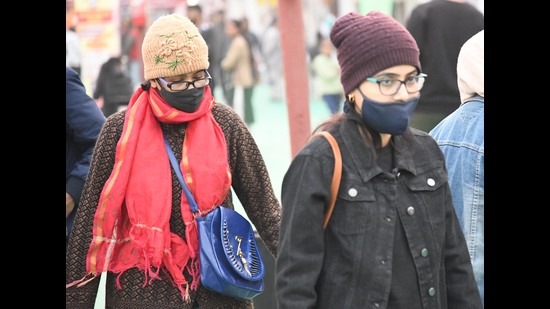
For now, any forecasts of above-normal temperatures seem too much of a stretch as a scary blizzard has put life out of gear in some parts of the United States (US). People in India’s north are dealing with severely low day temperatures with no central heating in their homes. (SANTOSH KUMAR/HT/PHOTO)
For now, any forecasts of above-normal temperatures seem too much of a stretch as a scary blizzard has put life out of gear in some parts of the United States (US). People in India’s north are dealing with severely low day temperatures with no central heating in their homes.
But it’s not the weather.
The climate crisis impacts our lives in more complex ways with high chances of irreversible impacts on ecosystems. The US blizzard may be more than just a winter phenomenon. There is an intense debate among scientists that the climate crisis is distorting the polar vortex, and the jet stream pushing frigid polar air to southern regions, causing snowstorms like the one in the US.
Next year, we move dangerously close to a warming of 1.5 degrees C with a high chance of breaching the threshold temporarily. With unabated emissions, 1.5 degrees C warming will be passed around the end of this decade and may be reached during individual years even earlier, Hans-Otto Pörtner, Intergovernmental Panel on Climate Change co-chair, told me last month.
The National Oceanic and Atmospheric Administration (NOAA) projected in its ENSO bulletin this month that in February-April 2023, there is a 71% chance of ENSO-neutral conditions. La Niña is expected to continue into the winter, with equal chances of La Niña and ENSO-neutral during January-March 2023.
Some new reports have emerged suggesting the possibility of an El Nino occurring later this year. These reports are preliminary at the moment. However, even if ENSO-neutral conditions are likely to last the entire year, it will be much warmer than the past few years when La Nina’s cooling influence managed to moderate the warming impact, even marginally.
During El Niño, trade winds weaken. As a result, according to NOAA, warm water is pushed back east toward the west coast of the Americas. El Nino, characterised by the warming of surface waters in the eastern tropical Pacific Ocean, refers to a warm phase of ENSO, which significantly influences weather and climate patterns such as heavy rains, floods and drought.
In India, El Nino is associated with drought or weak monsoons. On the other hand, La Nina is associated with strong monsoons and above average rains and colder winters.
La Nina has a cooling influence in India even as it recorded a very unusual spring and summer dominated by extreme record-breaking heat spells.
La Niña appears when easterly trade winds intensify the upwelling of cooler water from the depths of the eastern tropical Pacific, causing a large-scale cooling of the eastern and central Pacific Ocean surface near the Equator, says NOAA.
The ongoing La Nina phase began in 2020 and has returned for its third consecutive northern hemisphere winter, making it a rare “triple-dip” event. Its grip, however, has started loosening now.
The years 2016, 2019 and 2020 have been the warmest on record, with 2016 recording an exceptional El Nino event. There is increasing consensus among scientists that climate change accentuates the warming phase of El Nino, and it could be the nudge that will push us to a 1.5 degree C warm world.
That will mean widespread impacts from floods, droughts, extreme rain, and extreme unhabitable heat stress in the tropics. For now, India — among the most vulnerable to extreme heat — must prepare for what’s to come in the New Year to protect people and agricultural output from a deadly summer.
This Spring India experienced severe heat that decreased the quality and quantity of wheat yields apart from putting millions of people through unbearable heat. Without plans, ENSO neutral or El Nino phase can put millions at risk in the country.
Globally, 2022 was marked by landmark decisions of creating a Loss and Damage Fund at the UN Climate Conference (COP27) at Sharm El Sheikh and the Kunming-Montreal Global Biodiversity Framework, which aims to stop and reverse biodiversity loss by 2030, agreed on at UN Biodiversity Summit (COP15) in Montreal.
These agreements capture the plight of species and humanity globally.
But 2022 was also when the Global North and the Global South were the most opposed to each other, and mistrust on the climate crisis and biodiversity stood exposed at the negotiations. The differences were, of course, on who will pay for damage and who will shoulder the responsibility of mitigation.
The Global North, dominated by the US was opposed to principles of equity and common but differentiated responsibilities (different national circumstances of parties) when it came to mitigation; the European Union (EU) wanted to develop and emerging economies to pay up for loss and damage along with the rich nations while the developing countries demanded a predictable flow of finance to transition to low-carbon economies.
With rifts deepening, the world may miss a chance to fight the crisis of climate change equitably. More importantly, what transpired in the negotiations tells us about the challenges in responding to the climate crisis.
Geopolitical tactics to deal with the climate crisis are undergoing change.
The US has passed the Inflation Reduction Act, which provides clean energy subsidies to American companies. The EU this month made a deal to impose a carbon dioxide emissions border tariff on goods from countries that are not mitigating emissions by the EU standards.
While these measures have been criticised for being discriminatory and inequitable, here’s how Michael Greenstone, Milton Friedman Professor in Economics at the University of Chicago, described the situation to me in a recent interview: “A tonne of emissions in Mumbai does the same damage as a tonne of emissions in Memphis. If the world is going to make progress on reducing emissions the raw truth is that reductions have to occur everywhere in the world. There are very few mechanisms to hold countries to their promises. You can name and shame them that hasn’t worked very well, you could have war and invade a country who you feel did not reduce their emissions enough. That would be very hard to justify (laughs). What’s left are mechanisms like the border trade adjustments that influence behaviour through trade. What you are seeing is people no longer being satisfied with making voluntary agreements at COPs (UN Climate negotiations) and trying to put some teeth behind these agreements. That’s what the European policy is about. I expect other countries will introduce similar policies over time.”
As 2022 comes to a close (a rather hectic year for environment reporters like me), here’s hoping for serious, urgent action to deal with climate crisis but with honest and compassionate recognition of inequities globally and within the country.
From the climate crisis to air pollution, from questions of the development-environment tradeoffs to India’s voice in international negotiations on the environment, HT’s Jayashree Nandi brings her deep domain knowledge in a weekly column

 E-Paper