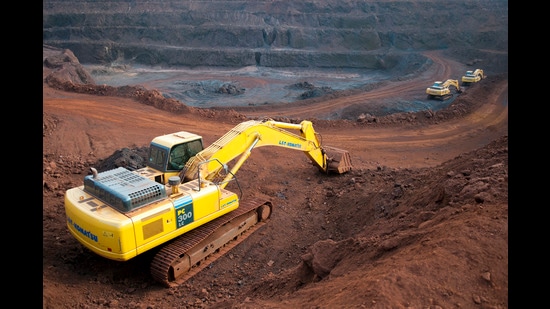
If Western Australia was independent, its motto would be In Iron We Trust. The state has nearly 30% of the world’s iron ore reserves, nearly as much as second and third place Brazil and Russia combined. Most of this red gold is 69% pure iron hematite from out of the Pilbara region, the source of nearly half the state’s mineral revenue. Perhaps, inevitably, Western Australia, the world’s iron ore centre, has developed a symbiotic relationship with China, the world’s largest steel producer. China traditionally is destination for 80% of Western Australia’s iron ore exports.
China traditionally is destination for 80% of Western Australia’s iron ore exports. (MINT)
And there lies a problem. After many years of profit-inspired waffling, Australia has come to accept Beijing is a clear and present geopolitical danger. Indian officials say that after years of being the Quad’s most reluctant member, Australia is today its most ardent supporter. The timeline leading to Canberra falling out with Beijing includes China imposing punitive sanctions for Australia daring to call for an investigation into the source of the Covid-19 virus. Among other things, China tried to put a chokehold on Pilbara iron ore.
Instead, the sanctions saga revealed how dependent China was on Australian iron ore and coal. Chinese steel makers forced their government to back down, arguing that blocking the ore of Oz was suicidal. There was simply no alternative in terms of quality or quantity. Western Australia produces nearly 800 million tonnes a year. China quietly dropped its ban on Australian iron and, more recently, did the same for coal. Mind you, there were other things Made in Australia that the Chinese couldn’t live without. Australian rock lobster exports to Hong Kong jumped 50-fold after the mainland banned them.
The Great Chinese Economic War Down Under was a total humiliation for Beijing. The value of Australian exports to China actually rose 36% in the first half of 2021, though much of this was because of larger global economic trends that had nothing to do with government policy. However, one lesson for China was that the factory of the world suffers from its own economic dependence on the Quad, even though the foursome are largely together because of common concerns about Beijing. And one key economic addiction is Australian iron ore.
On September 5, China took the unprecedented step of condemning a coup d’etat in the West African country of Guinea. For the record, Beijing never complains about coups and the like. Its motivation was iron ore, especially iron ore that is outside Australia. Guinea, among the poorest countries in Africa, is already the single largest source of bauxite for China’s aluminium sector. Now, Beijing has revived plans to exploit eastern Guinea’s Simandou iron ore deposits, the largest untapped high-quality reserves in the world.
The 110 km long Simandou hills of Guinea hold an estimated 2.4 billion tonnes of iron ore of 65.5% purity. Conakry’s estimates say the total figure may be eight billion tonnes. However, high development costs and political uncertainty mean no one has been able to develop the area. The first firm to buy the rights was the Australian mining giant Rio Tinto but it lost its majority stake after failing to develop them.
A number of analyses say Simandou has now become “the top focus” of China’s attempts to diversify away from Australian iron ore. Beijing has given itself a four-year deadline to begin mining operations. This would include building a 650 km-long railway line across Guinea and a new port. Estimates say the mines could produce a steady 150-million tonnes of ore annually, equal to seven per cent of today’s global exports, and make Guinea one of the four largest iron ore exporters.
Chinese firms believe the project’s high cost would be more than compensated by the savings incurred by pushing down the price trajectory of iron ore. China presently imports just over one billion tonnes of iron ore a year. Some estimates say Simandou’s production would force down iron price’s over time by as much as $ 100 a tonne. If it was on line today, this would amount to a savings of $ 100 billion a year for China’s steel sector.
The last Guinean president, Alpha Conde, had been assiduously wooed by Beijing. Guinea was among the first countries to receive emergency shipments of Chinese Covid vaccines. Hence Beijing’s shock when, after Conde was re-elected for a third and constitutionally illegal term, the Guinean military overthrew him. China has since calmed down as the coupsters have indicated no interest in reworking their economic relationships.
The Simandou reserve, discovered in the 1990s, have been nightmarishly difficult to tap. The ownership has changed hands several times, a few billions dollars spent, but no iron ore has yet to be extracted. At present, Simandou consists of four mining blocks. Two northern blocks are owned by SMB-Winning, a consortium of Singaporean and Chinese companies. The two southern blocks are controlled by Simfer, a firm owned by the Australian mining firm, Rio Tinto, and 39.5% by a group of Chinese investors led by Aluminium Corporation of China. The Guinean government holds 15% of each block.
In May, China Baowu Group, the country’s largest steel refiner, put together a consortium to break the Simandou jinx. The consortium is trying to set up a $6 billion investment fund for the project. Baowu’s proposes to invest $4.5 billion in the southern blocks and $1.5 billion in the northern blocks. Chinese steel-makers would put up half the money and 25% would come from a Chinese sovereign wealth fund.
While almost anyone else declaring their intention to develop a place as remote as Simandou would be laughed out of the mineshaft, Chinese prowess at building seemingly impossible infrastructure means this is being taken seriously. Australian mining experts are already fretting, calling this the “Pilbara killer.” Rio Tinto, which effectively still owns about 44% of the Simandou, is supportive. “There is a need for the world to develop Simandou,” said Rio Tinto CEO Jakob Stausholm recently.
Beijing is wary. At least one report by a China Geological Survey report in 2020 talks about the investment’s elevated political risk, citing the Guinea government’s weak respect for contracts and the country’s labour force’s propensity to go on strike. “Chinese companies will face significant challenges during implementation and operation stages of this project,” it warns. Particularly concerning is the Guinean government’s reported plans to extract as much as $15.5 billion in tax from the mines.
It is geopolitics that provides the additional incentive for the Chinese government to consider underwriting something so risky and expensive. That Simandou is now a buzzword in mining conclaves these days is a sign of how great power rivalry is driving governments to seek new supplies and go where no business has gone before. Iron ore isn’t even particularly rare or geographically concentrated. But this is the new world re-order: a series of events that began with a viral attack in Wuhan, worked its way through a failed trade war, is ending with a plan to plough billions of dollars into a remote rain forest region of West Africa.

 E-Paper