
 E-Paper



Hutong Cat | China is polishing its new pearl: Taliban's Afghanistan
China’s eagle focus on Afghanistan was on full display at a pair of multinational meetings it hosted at the end of March.


“The de facto authorities’ failure to adhere to commitments to reopen schools for girls above the sixth grade — in spite of repeated commitments towards girls’ education, including during my visit to Kabul two weeks ago — is deeply damaging for Afghanistan”, United Nations (UN) High Commissioner for Human Rights, Michelle Bachelet, said on March 23.
“I deeply regret today’s announcement by Taliban authorities in Afghanistan that girls’ education from the sixth grade has been suspended until further notice,” UN Secretary-General António Guterres said the same day.
Less than a week later, if you read the flurry of statements on Afghanistan from China — the world’s second-largest economy, ruled by one of the largest political parties worldwide, and which usually swears by UN charters when needed — there’s little to glean about the state of rights and girls’ education in that country from the readouts.
And that’s even after Beijing has full access to Afghanistan and, among a handful of countries to have a functional embassy in Kabul.
Or maybe that’s the contract: You don’t make a scene about the lack of human rights in my country and we allow you to have an embassy and restart mining the untapped copper at Mes Aynak mines in the Logar region near Kabul.
China, like other countries, is yet to diplomatically recognise the Taliban government.
China, unlike other countries, however, has laid out the red carpet to legitimise it.
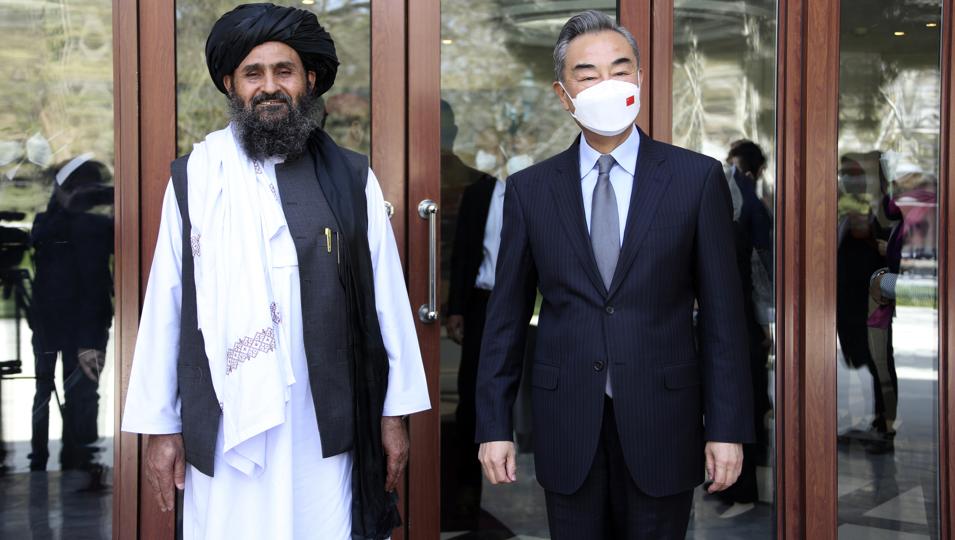
Chinese state councillor and foreign minister, Wang Yi’s unannounced visit to Kabul on March 24, the highest-level visit by a Chinese diplomat after the Taliban’s triumph last August, was in itself a seal of approval
Wang flew down to Kabul from Islamabad to meet acting Afghan foreign minister Amir Khan Muttaqi to discuss political and economic ties, including starting work in the mining sector and Kabul’s possible role in China's Belt and Road infrastructure Initiative (BRI), according to a statement from an Afghan foreign ministry spokesperson.
Just about a week later, Muttaqi was in China, in turn, to endorse China’s voracious ambitions to play a major hand in Afghanistan's stability and development under the Taliban, tap its mineral wealth, while boosting its own stature — and all the time promising not to interfere about how the government in Kabul deals with, say, the future and rights of underage girls.
China’s eagle focus on Afghanistan was on full display at a pair of multinational meetings it hosted at the end of March.
Beijing’s multilateral diplomatic blitz with the Taliban’s Afghanistan in focus revealed that it was moving rapidly to expand its influence in the country, especially with other major powers mired in Russia’s invasion of Ukraine, and its many coming fallouts.
China assembled as many of the interested parties it could gather, put them up together in the fairly obscure Tunxi city in eastern China — I presume in reasonably working luxury — and expounded its thoughts on Afghanistan.
The Chinese government machinery went on an overdrive to highlight a statement from President Xi Jinping to the “Third Foreign Ministers' Meeting among the Neighbouring Countries of Afghanistan”.
Foreign ministers and representatives from Russia, Pakistan, Iran, Tajikistan, Turkmenistan, and Uzbekistan turned up for the meeting.
The multilateral was headlined by a written message from President Xi Jinping, which was read out by foreign minister Wang to the wide-eyed delegates.
Xi’s statement, a pledge of support to Afghanistan, was another strong stamp of legitimacy on the Taliban.
Besides the customary line or a phrase or two about bucolic settings of “the same mountains and rivers’’ shaping — of course — a “shared future”, Xi basically said the Taliban was moving Afghanistan from chaos to order.
“Xi pointed out that having gone through so much in the past, Afghanistan is in urgent need of development in many areas. The country has come to a critical point of transition from chaos to order,” the official translation of his speech from Mandarin to English said.
“China always respects Afghanistan’s sovereignty, independence, and territorial integrity, and has committed to supporting its pursuit of peace, stability, and development,” Xi said.
Maybe much water has flown in the “rivers” since then but the Chinese President’s latest statement was markedly different from what he had said on Afghanistan at the joint summit of the leaders of the Shanghai Cooperation Organisation (SCO) and another regional grouping issued via video link last September.
Xi had then urged “relevant parties” in Afghanistan to eradicate terrorism: “Relevant parties in Afghanistan should be urged to resolutely crack down on and eradicate terrorist organisations in the Afghan territory and prevent terrorist forces in Afghanistan from wreaking havoc”.
He had also said that Afghanistan should be guided to be more open and inclusive, and pursue moderate domestic and foreign policies.
Xi urged those at the meeting to “…facilitate a new political structure (in Afghanistan) that is more open and inclusive, and adopts moderate and prudent domestic and foreign policies and develops friendly relations with other countries, especially its neighbours”.
That was in September.
Formal recognition of the Taliban government may come soon as well.
Wang, after visiting Kabul, said China respects the independent choices made by the Afghan people,” “respects the religious beliefs and national customs of Afghanistan,” and has “never interfered in Afghanistan’s internal affairs.”
At the end of last week’s meeting, Wang also said: “It is believed that diplomatic recognition of the Afghan government will come when conditions are ripe that the concerns of all parties are given a stronger response”.
The overall message sent by China’s dealing with Afghanistan is essentially
a return to business-as-usual with no regard or concern for the human rights abuses the Taliban stand accused of, wrote Shannon Tiezzi, the editor-in-chief at the current affairs portal, The Diplomat.
Wang — like Xi’s awe at Afghanistan moving from “chaos to order” — praised the “tangible results” of the Taliban government in “actively respond[ing] to the concerns of the international community.”
“That message is especially ironic coming just a day after the Taliban reneged on a promise to allow girls in grade six and above to return to school,” Tiezzi wrote.
China took the easy way out: Absolving itself from commenting on the issue, it used its official media to make the acting foreign minister of the Afghan Interim Government Muttaqi talk about it at a meeting with Wang and Pakistani foreign minister Shah Mahmood Qureshi.
Muttaqi, according to a Chinese official statement, said: “The interim government has never banned girls from going to school and has reopened 60 percent of schools so far.”
Muttaqi essentially said the UN was lying. China endorsed.
Let’s get back to the UN High Commissioner for Human Rights, Michelle Bachelet, quoted at the beginning of this write-up, who called on the Taliban to “respect all girls’ rights to education and to open schools for all students without discrimination or further delay”.
“Disempowering half of Afghanistan’s population is counterproductive and unjust,” Bachelet said on March 23, adding that “structural discrimination such as this is also deeply damaging for the country’s prospects of future recovery and development.”
So, women’s rights and education are related to Afghanistan’s recovery and development?
Someone tell Xi and Wang that.
Sutirtho Patranobis, HT’s experienced China hand, writes a weekly column from Beijing, exclusively for HT Premium readers. He was previously posted in Colombo, Sri Lanka, where he covered the final phase of the civil war and its aftermath, and was based in Delhi for several years before that
The views expressed are personal


