At 2.35pm on July 14, India’s space programme will mark an epoch, as the Chandrayaan 3 blasts off from the Satish Dhawan Space Centre, Sriharikota. On board, the country’s third mission to the moon will be a lander (Vikram), a rover (Pragyan) and a propulsion module – the major differentiator from the earlier iteration of the Moon mission that carried an orbiter instead. The integrated craft will reach a 100km circular polar orbit sometime in the
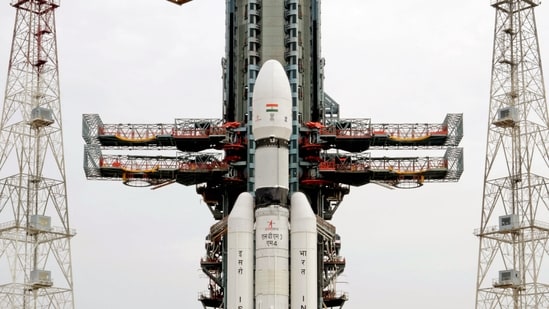
At 2.35pm on July 14, India’s space programme will mark an epoch, as the Chandrayaan 3 blasts off from the Satish Dhawan Space Centre, Sriharikota. On board, the country’s third mission to the moon will be a lander (Vikram), a rover (Pragyan) and a propulsion module – the major differentiator from the earlier iteration of the Moon mission that carried an orbiter instead. The integrated craft will reach a 100km circular polar orbit sometime in the third week of August, and then the lander will slowly descend on the surface of the Moon, becoming in the process the first country to land in the unexplored high-latitude regions of the Moon. Somewhere around August 23, we hope to touch down on the lunar surface. At stake are critical questions of science – how are seismic waves produced on the Moon? Exactly how does the lunar surface act as a thermal insulator? What is the elemental and chemical composition of the Moon? And, what is its plasma distribution profile? These seemingly abstract queries hold the key to understanding our closest interplanetary neighbour better.
The mission builds on the excellent work done by Chandrayaan 2, which launched an orbiter on the lunar orbit that continues to transmit critical data. This orbiter has helped us save in terms of mass for carrying payload this time and store more propellant (since the device continues to work, there is no need to launch a new one). In 2019, the Chandrayaan 2 lander worked very well for more than 90% of its trajectory but veered off course in the final kilometre of the descent, suffering a crash landing. Since then, the landing technology that was developed and used for the first time four years ago, has been honed and sharpened.
Landing on an alien surface is a difficult game; it is an autonomous process where no command and control is given. The mechanics of the landing are decided by the onboard computer, based on sensors that provide information about the location, height, horizontal and vertical velocities, and the intended landing surface. The onboard computer monitors command and control of the navigation and the propulsion process.
Many sensors need to work in tandem for landingFor example, an optical camera checks exactly where you are, a laser or radio-based system tells you how far you are from the surface, and a batch of sensors continually calculates horizontal and vertical velocities. This information is fed real-time into the onboard computer managing the navigation, communication, command and control, for the engines on the spacecraft to fire, in what direction, and at what flow rate. Once the craft lands, the focus will shift to the rover – how it will be unclamped inside the lander, roll down the ramp, start moving, and transmit information to ground controllers through the lander.
This kind of sensitive technology is not usually transferred from one country to another, and it is to India’s credit that it has successfully developed it. It involves scientists with various specialisations, including propulsion, mechanical and thermal engineering, computer, physics, chemistry, orbital mechanism, aerodynamics, navigation command control, electronics, and material and electrical sciences. And, of course, scientists who chalk out perfect orbital mechanical calculations of how much force will be acting on the craft, the location of the Earth from the Sun and the Moon, and interplanetary movements.
This is achieved with an interesting two-step process developed by Indian scientists, renowned for their penchant at frugal engineering, or making the best science out of limited national resources. The first step is studying the complex underlying technology – rocket science in common parlance – and choosing the best possible path in which it can be achieved, taking into account how other missions have performed. This is called the right path approach. It leads to the second step – correcting the process with extensive reviews and mid-course evaluations. One of the strengths of the Indian Space Research Organisation (Isro) system is the multiple rounds of evaluations that highlight some unnoticed design kinks or unintended side effects.
At the Physical Research Laboratory (PRL), we focussed on building the experiments (payloads) to conduct lunar science. There are three payloads on Vikram and two on Pragyan. The first – attached to the lander – will measure moonquakes. Through a seismometer, we hope to understand how seismic waves are produced on the moon, and whether they have a causal link either to the contraction of the Moon or meteorite bombardment, a far more frequent occurrence on the Moon than on Earth due to the former’s non-existent atmosphere. The second, a Langmuir probe, will provide us with the plasma distribution at the landing site. We know that in addition to no atmosphere, the Moon has a very thin exosphere. This, along with solar radiation coming from the Sun, can ionise and produce an ionosphere close to the surface. Our idea is to see what is happening at high latitudes, and understand how latitudinal changes might compare to the more frequent equatorial landings.
The third payload will provide the temperature distribution in the first 10-cm beneath the lunar surface. Picture a thermometer piercing the surface, and mounted sensors beaming back temperature profiles at every cm of depth. This will help solve the mystery of the lunar surface’s peculiar behaviour as a thermal insulator – neither conducting nor transmitting heat.
Two experiments on the rover will provide us with the elemental and chemical composition of the lunar surface. The science from this will be first-of-its kind. We already have the Chandrayaan 2 orbiter transmitting information about chemical composition using onboard experiments. In-situ experiments will be more delicate and exact, helping bolster existing data.
Landmark space missions galvanise the country, excite young people, and ignite scientific temper because they are intimately tied to national pride and hold strategic international importance. But Chandrayaan 3 is a pivotal moment for Indian science as well, not only because of the future real-world use of the technologies developed but also due to the importance of the data collected. We are not going to the Moon simply to show that we can. We are doing it to help the world, know about important elements or minerals, and, maybe one day, even set up a second home for humanity.
Anil Bhardwaj is director, PRL, Ahmedabad. The views expressed are personal.
One Subscription.
Get 360° coverage—from daily headlines
to 100 year archives.
Archives
HT App & Website