
 E-Paper



India’s photographic identity: Who gets to tell this tale?
Photography arrived in India in 1840, and for decades after, its record was largely made by people who did not live inside the country.

 Prefer HTon Google


We have arrived at the 80th Independence Day, and World Photography Day, first proposed by OP Sharma, a Delhi-based photography teacher, is observed in the same month. Independence was also a claim to authorship, a newly independent country deciding it would no longer be described by somebody else’s visual storytelling.
Photography arrived in India in 1840, and for decades after, its record was largely made by people who did not live inside the country, and what got published was rarely made by an Indian photographer. It is worth asking whether the work of reclaiming authorship is finished, or whether it has changed shape into something harder to see.
On the surface, the answer seems to be yes, since a billion phones here now produce a huge share of the world’s daily picture-making. But volume is never the same thing as authorship. This isn’t about copyright, nobody’s ownership of the image itself is in question. A country can photograph its own people more than at any point in its history and still not own the image of itself that actually circulates in the world’s mind. What’s actually at stake is whose picture of India gets noticed, whose name travels with it, and whose gets left out. Deciding which picture of India becomes the picture of India no longer sits with an editor in Delhi or London. It sits with an algorithm nobody elected, and with the aggregator accounts that have learned to feed it, repackaging images as evidence of a country rather than one person’s way of seeing it.
For decades that gaze arrived with a foreign photographer’s passport, and Indian photography spent that period contesting it. Raghubir Singh stood as its antithesis, rejecting the inherited monochrome altogether and building a colour vocabulary out of Indian miniature painting instead. He argued that black carried the guilt of the West, tied to death in a way colour never was in India.
Unfortunately, what remains is still the same thing, the Holi celebration, a camel fair in Nagaur, the temple in Puri, or a widow in Vrindavan, and none of it needs a foreign passport now.
Photographer Soham Gupta lived this from the inside. His early work on Calcutta’s destitute was criticised as a continuing colonial gaze, made by an Indian in his own city. A culture this saturated, this willing to be photographed, makes it easy for any algorithm to reward the same spectacle an outsider once had to travel here to find, only this time nobody needs a fixer or a visa to get it.
It’s also worth remembering there are photographers resisting the pull of all this. Among them, Gauri Gill, Sohrab Hura, Poulomi Basu, each building something different.
None of this argues for the old gatekeepers coming back, since money, training and access kept most of the country out for decades. Responsibility has simply moved to whoever holds the phone.
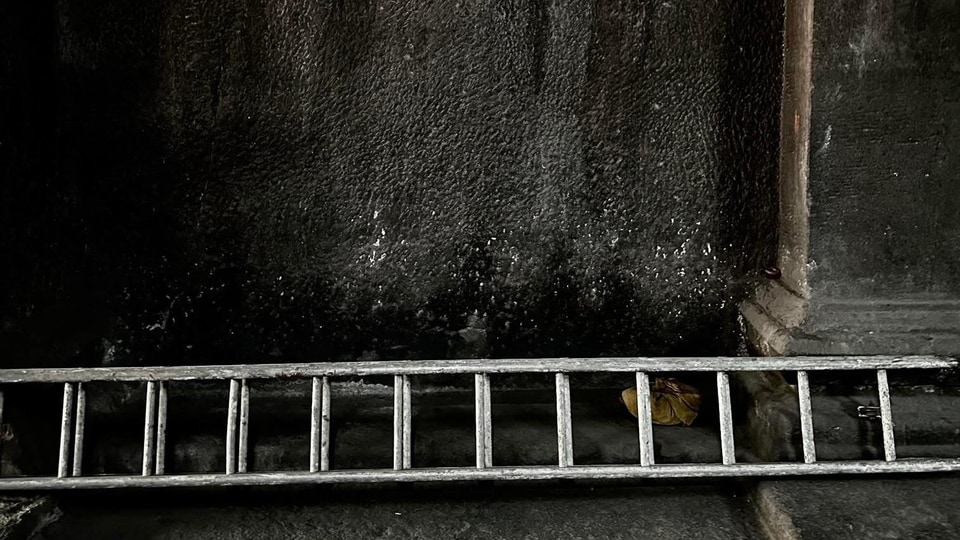
The test is not whether a picture is well composed. It is whether you are actually interested in telling something through it, or only about making your presence felt. A ladder left lying flat against a soot-blackened wall, something small and dried caught between its rungs, is not the kind of photograph anyone posts under a festival’s name. It asks nothing of the viewer except to notice it was there. Nothing decorative does that.
Most of us are too shy to walk up to a stranger with a camera, but a great many of us sit next to one every week without noticing, an Uber driver, the drive and conversation grant access a stranger on the street never would, and there is your portrait, ready-made. Ask permission once, keep it simple, and repeat it ride after ride until it becomes a whole body of work. An algorithm trained to reward a single striking frame has no real appetite for that.
The real reward for a photographer is making a story, not feeding a formula that has run for over a century now. And most of the time, that’s exactly what we end up doing, without even noticing.
Independent India started finding its own photography identity, but that search isn’t finished. The question still remains whether current image-making amounts to real ownership or only to volume. No algorithm, no platform is going to decide that for us. It gets decided the ordinary way, one story at a time, by whoever bothers to actually look before hitting that shutter, and by how many times they are willing to go back to it.
Samar Jodha is a transdisciplinary artist, photographer and TED speaker, and an advisor to Museo Camera, the photography museum and archive in Gurugram. The views expressed are personal


