This National Space Day (August 23) feels especially celebratory given India unlocked a key space capacity — private-sector orbital launch. Skyroot Aerospace’s success with the lift-off of Vikram-1, an orbital-class launch vehicle, and the deployment of multiple payloads into low Earth orbit (LEO) made India the third country in the world to have private launch capacity, after the US and China.
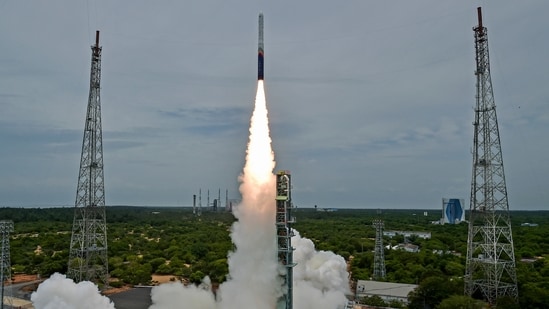
The mission, called Aagaman (Sanskrit for “arrival”) was Skyroot Aerospace’s follow-up to its 2022 suborbital Vikram-S flight, which made it India’s first private company to reach space. For India, the July launch was the dawn of a new space era, as a Skyroot commentator put it.
It was also, in many ways, a payoff of a decade-long bet made by India on space policy reforms.
Today, there are more than 400 space startups and companies in the country, working on everything from satellites, components, space engineering, traffic management and even rocket engines. The diverse payloads that Skyroot’s Aagaman dropped off in orbit included a nanosatellite pathfinder from Grahaa Space, a robotic arm built by Cosmoserve Space to capture space debris, and Skyroot’s own satellite.
Six years ago, all of this would not have seemed possible, that is, if the Department of Space hadn’t opened up the sector to privatisation. Till 2019, the Indian Space Research Organisation (ISRO) was India’s only State-run space programme. It was the designer, manufacturer, launcher, owner and operator of virtually every Indian space asset. Private companies like Ananth Technologies (founded 1992) or MTAR Technologies (founded 1970) built hardware and core components to ISRO’s specifications. For a private company, there was no path to owning a satellite, operating a launch vehicle or selling a space-based service commercially.
{{/usCountry}}Six years ago, all of this would not have seemed possible, that is, if the Department of Space hadn’t opened up the sector to privatisation. Till 2019, the Indian Space Research Organisation (ISRO) was India’s only State-run space programme. It was the designer, manufacturer, launcher, owner and operator of virtually every Indian space asset. Private companies like Ananth Technologies (founded 1992) or MTAR Technologies (founded 1970) built hardware and core components to ISRO’s specifications. For a private company, there was no path to owning a satellite, operating a launch vehicle or selling a space-based service commercially.
{{/usCountry}}This changed in 2020, when the government ended ISRO’s monopoly by opening up the sector and launching IN-SPACe (Indian National Space Promotion and Authorisation Centre), which became a single-window regulator and facilitator for private companies to set up spacetech shops.
The same year, ISRO created NewSpace India Limited (NSIL), a company whose aim was to transfer ISRO-developed technology into private hands. Through NSIL, ISRO has executed 118 technology transfer agreements with private companies in the last five years.
The other important policy shift was opening the doors to ISRO’s testing centres and facilities. Startups didn’t have the capex to build testing chambers from scratch. Instead, ISRO provided launch pad, motor casting, and liquid engine testing facilities at steep discounts so companies could get their technology tested, validated, and simulated.
Another action that worked in the space industry’s favour was encouraging strong academic research and industry collaborations inside top institutions in the country. IIT Madras, for example, is alone responsible for incubating and supporting 11 space-tech startups, including Agnikul Cosmos and GalaxEye.
Another regulatory framework, the Indian Space Policy 2023, offered clear operating guidelines, zoning rules, and a degree of regulatory certainty, enabling venture capitalists to make bets on space ventures. In 2024, the government allowed up to 100% foreign direct investment (FDI) in startups working on satellite components and ground equipment, about 74% FDI for satellite manufacturing and operations, and 49% FDI to build launch vehicles and spaceports, opening up the sector to further capital bets.
Thanks to these policy and regulatory changes, as well as ISRO’s active support, private sector participation has blossomed.
However, this leap has also brought with it the pressures of a maturing market. In 2021, about 21 space startups in India raised $43 million, according to the India SpaceTech Report by Tracxn. By mid-2026, this has become 440 companies and $871 million in cumulative funding. Just ahead of its own rocket launch, Skyroot raised $50-60 million through private venture capital, putting its valuation past $1.1 billion and making it India’s first space-tech unicorn.
This consolidation is part of a classic sign of a decreasing risk appetite. Over 60% of all capital invested in space went to safe bets: Skyroot Aerospace ($150 million), Pixxel ($96 million), AgniKul Cosmos ($76 million) and Digantara ($67 million). Out of 285 startups that Tracxn Data tracked, only 72 have been successfully funded, the rest falling by the wayside. Considering that space hardware requires immense upfront capital expenditure, long R&D cycles, and rigorous regulatory clearances, this is, to a degree, understandable from capital’s vantage. But it also means that more needs to be done to add width, along with depth, to the space sector. This could very likely prove challenging, as both the US and China also seem to be struggling here. In the US, SpaceX and OneWeb alone account for more than half of the capital raised by the top ten space companies. China has more startups by headcount, and though the underlying private capital is shaky, the country has patient State funding to support its space ambitions.
This global space race also comes with new challenges for India’s star-performer ISRO, which has been so far the bulwark of the private industry. There are only two operational launch pads in India, both at Sriharikota, both prioritised for ISRO’s own missions. This leaves private players scrambling or waiting for a long while for tests or launch slots — sometimes as long as 18-24 months. Most startups can’t afford to fund that long a runway before blast-off.
ISRO has been unable to increase their launch frequency. In 2025, ISRO launched only five rockets from Sriharikota, against roughly 165 orbital launches by SpaceX. Fewer launches mean fewer opportunities to catch quality issues, slower institutional learning and a longer wait for indigenous startups to send their payloads into LEO.
India’s reusable launch vehicle programme, called Soorya, also lags behind. It received ₹8,240 crore of Cabinet approval in September 2024, but will not take first flight before 2032. This means that for the next five years, India will spend more on expendable rockets while rivals, including SpaceX and some Chinese operators, are already using reusable rocket fleets.
This pressure to deliver is likely showing up in ISRO’s recent performance. In January 2026, ISRO lost its reliable RSLV-C62 along with 15 international payloads, causing India’s commercial space-ride-share partners, such as Nepal and Brazil, to cancel future bookings.
And, most importantly, it is the very opening up of the private space sector that has caused a recent headache for ISRO, a high attrition rate. Over the recent months, around 100-120 senior scientists have resigned or taken early voluntary retirement. There have been 80 resignations from the UR Rao Satellite Centre (URSC) in Bengaluru, which handles satellite design and integration, while Vikram Sarabhai Space Centre (VSSC), ISRO’s primary rocket-building facility, has seen at least 20 personnel resign. Both Skyroot Aerospace co-founders, Pawan Kumar Chandana and Naga Bahrath Daka, are former ISRO scientists from VSSC.
Though a thriving private sector is a healthy sign of a competitive economy, in an industry like space, senior scientists leaving can cause State projects to be delayed. This has led the Department of Space to issue an order in July last month, tightening resignation rules for personnel on critical projects.
But it is clear that, despite these challenges, India’s space ambitions have skyrocketed, not only amongst players, but also amongst the citizens who have come to associate a particular pride on the global stage with the country’s space capabilities. In the coming years, Skyroot plans to launch Vikram-2, ISRO is aiming to send a crewed flight into space, while India’s Bharatiya Antariksh Station (BAS-1) will be ready by 2028. There are also plans for a manned lunar mission by 2040.
Amid the Space Race 2.0, which will shoot relentlessly into the new decade, India will need to ramp up its infrastructure and improve reliability if it wants to remain one of the top contenders. To make it to the moon, India needs to support the ambitions of the private sector, strengthen its infrastructure and boost its institutions with both patient capital and rocket scientists. And do it at supersonic speed.
Shweta Taneja is an author and columnist based in Bengaluru. She tracks the evolving relationship between science, technology and modern society. The views expressed are personal