
 E-Paper



Japan balances military and moral heft amid uncertainty
Its military buildup is defensive, motivated towards preserving regional order rather than projecting Japanese power overseas.

 Prefer HTon Google


Every year since 1947 and 1955, respectively, on August 6 and 9, Japan solemnly commemorates the nuclear devastation of Hiroshima and Nagasaki in 1945. These anniversaries witness reflection, remembrances, and renewed appeals for nuclear disarmament. Survivors of the bombings, political leaders, and international representatives gather for memorial ceremonies and recall the catastrophic consequences of nuclear warfare.
The 2026 anniversaries come at a time of strategic transition. Japan’s security environment has deteriorated significantly, raising a fundamental question: Are Japan’s responses to these challenges altering its pacifist identity?
Since the end of World War II, Article 9 of the Japanese Constitution embodied the country’s renunciation of war as an instrument of national policy.
Also read | When broadcasting was committed to public good
Japan relied on the US for conventional and nuclear protection while concentrating its own resources on economic reconstruction. The Self-Defence Forces (SDF), established in 1954, were carefully presented as defensive forces rather than instruments of military projection.
That framework is now under strain. North Korea’s nuclear and missile programmes, China’s rapid military modernisation and growing assertiveness around the East China Sea, Russia’s invasion of Ukraine and its expanding naval activities in the Pacific, together with growing uncertainty about the long-term American commitment to regional security, have combined to produce perhaps the most significant reassessment of Japanese defence policy since 1945.
Also read | Evolved procurement key to defence drones' utility
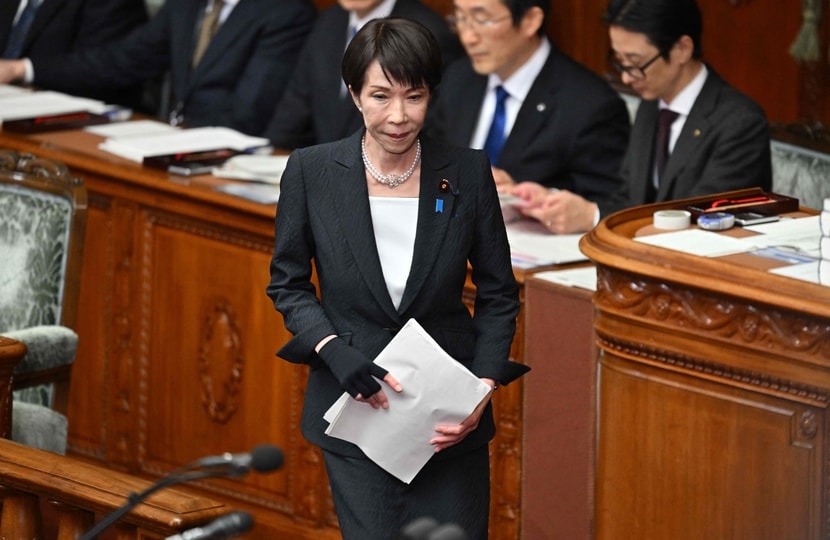
These changes have accelerated under Prime Minister Sanae Takaichi. Building upon the security reforms introduced over the past decade, her government argues that Japan can no longer rely on assumptions that prevailed after the Cold War. In her policy address to the Diet (the country’s parliament) earlier this year, Takaichi called for a fundamental strengthening of Japan’s defence capabilities, an early revision of the country’s Three Strategic Documents, and preparedness for multi-domain conflict involving cyber, space, artificial intelligence and unmanned systems.
This evolving strategy highlights four themes. First, defence-industrial resilience is a national security objective in itself. Second, the relaxation of defence export restrictions is intended to support allies and partners but also to sustain Japan’s industrial base by encouraging greater production and innovation. Third, the concept of “active deterrence” has increasingly replaced the narrower language of passive defence. And fourth, a growing sense of strategic autonomy, guided by anxiety that the US may prefer to manage competition with China, is visible. Japan is not replacing the US security shield but reinforcing it through greater autarky.
Also read | The unbearable weight of learning, in school bags
These developments undoubtedly represent a critical shift in Japanese strategic thinking. Yet it would be an exaggeration to conclude that Japan is abandoning pacifism. Rather than becoming a conventional military power, Japan is better understood as evolving into a normal deterrent power. Its military buildup is defensive, placed within the US-Japan alliance, and motivated towards preserving regional order rather than projecting Japanese power overseas. The constraints of Article 9 continue to shape Japanese policy, even though their interpretation is increasingly flexible.
Japanese society today is less instinctively pacifist than it was at the turn of the century, but it has not become militaristic. A 2025 Cabinet Office survey found that a record 45% supported strengthening the SDF, while nearly 50% preferred maintaining their current strength. Over 93% had a favourable opinion of the SDF, reflecting high levels of public trust.
Strategic continuity is evident on the question of nuclear weapons. Public opposition remains overwhelming. A Jiji Press poll conducted earlier this year found that 62.6% opposed Japan acquiring nuclear weapons, while only 16.7% supported such a move. Nearly half the respondents favoured retaining Japan’s Three Non-Nuclear Principles — not possessing, not producing and not permitting the introduction of nuclear weapons — while 30% were willing to consider a revision.
Japan is regarded as a threshold nuclear State. Its advanced civilian nuclear technology, plutonium stockpiles, sophisticated missile and space capabilities, and highly developed industrial base provide the technological foundations for a nuclear weapons programme. Were the Nuclear Non-Proliferation Treaty to collapse and the US to withdraw its nuclear umbrella entirely, Japan could probably develop an indigenous nuclear capability within a few years.
Exercising that option, however, would be an entirely different matter. Such a decision would involve immense political, diplomatic and psychological costs.
Hiroshima and Nagasaki lie at the heart of Japan’s national identity and international standing.
Developing nuclear weapons would fundamentally alter Japan’s image in Asia, complicate relations with China and the two Koreas, weaken its long-standing leadership in global non-proliferation efforts, and deeply divide Japanese society itself.
Accordingly, the more likely response to declining confidence in American security guarantees is not nuclearisation but continued strengthening of conventional military capabilities.
Japan is moving decisively in this direction while, simultaneously, broadening its security partnerships with Australia, India, European countries and Southeast Asian partners. These relationships are not intended to replace the alliance with Washington but to diversify Japan’s strategic options and reinforce regional stability.
Japan is preparing for a future in which American leadership will remain indispensable but may no longer be sufficient by itself.
Japan continues to champion nuclear abolition and uphold the moral lessons of 1945. At the same time, it is undertaking the most significant strengthening of its military capabilities in the post-War era.
These developments are not contradictory. They reflect the central dilemma confronting Japan today: Preserving peace increasingly requires preparing for conflict, without losing the moral authority that Hiroshima and Nagasaki bestowed upon it for more than eight decades.


