The idiom, "the more, the merrier," is not applicable in politics. In Uttar Pradesh, the two major partners of the Indian National Developmental Inclusive Alliance (I.N.D.I.A)—namely, the Samajwadi Party and the Congress—compete along with the Bahujan Samaj Party for the main opposition space. A similar scenario unfolds in Maharashtra, involving the Shiv Sena and the Nationalist Congress Party — both parties now split down the middle — and the Congress. Meanwhile, the ruling party, the BJP, remains relatively unaffected as it has cultivated an exclusive vote bank. Nevertheless, fence sitters might consider switching allegiances from one bloc to another.
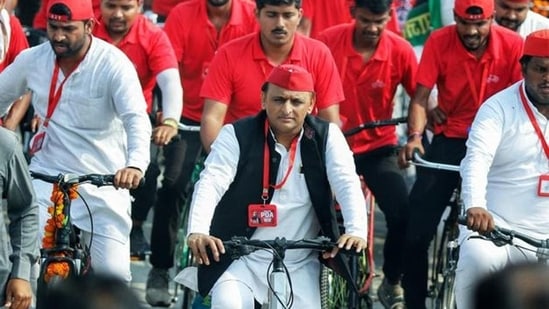
In the 2012 assembly elections, Akhilesh Yadav cycled his way to victory. (ANI)
Why will the first jolt to I.N.D.I.A come from Uttar Pradesh?
In the 2012 UP assembly elections, an old Muslim voter at a tea stall in Muslim-dominated Bahraich district had advocated for ‘Bhaiya (Akhilesh Yadav) in the state and Rahul Gandhi in Delhi.’ Many others present there had dismissed his suggestion as impossible.
In the 2012 assembly elections, Akhilesh Yadav cycled his way to victory. Eventually, the two young leaders came together for the 2017 assembly elections. They failed, not because of the BJP’s oversized influence — by then, it had swept into power under Narendra Modi’s leadership — but because the alliance was only one on paper.
After their first show of bonhomie at a much-hyped press conference, Rahul Gandhi and Akhilesh Yadav walked their separate ways and did not address joint rallies. They lacked trust in their alliance. The success of the Rashtriya Janata Dal and Janata Dal (United) alliance in neighbouring Bihar in 2015 was visible not only in the bonhomie displayed by Lalu Yadav and Nitish Kumar in rallies, it also filtered down to their otherwise warring castes — the Yadavs and Kurmis. The two giant leaders of Bihar had shared a dais after 24 years.
What explains this mistrust?
Though there is a history of mistrust between the two I.N.D.I.A partners in UP, a major irritant apparently is a soft corner of some senior Congress leaders for the Bahujan Samaj Party.
Soon after taking over charge of the party in Uttar Pradesh, Ajay Rai showed his inclination for a tie-up with Mayawati’s party. In a response to a question, “Why BSP?” he had replied, “Only Mayawati can transfer her votes which the Congress would need to bolster its vote bank.” Other senior leaders felt that while the Yadavs would prefer the BJP over the Congress, the Muslims were more likely to return to the fold.
This is at the root of the issue: The revival of the Congress will come at the cost of the SP and its vote bank of Muslims and backward classes. Akhilesh Yadav, while leading the demand for a caste census had also identified PDA (Pichda, Dalit, Adivasi/Alpsankhyak) as a vote bank and electoral strategy.
For the SP, sharing the 80-Lok Sabha seat pie will result in conceding space altogether, something which Mulayam Singh Yadav had cultivated since the early 1990s when the Congress was on the decline.
The alliance thus seems to be faced with an existential question: the Congress is seeking a revival, but the SP is seeking to survive. The Congress is already decimated in UP while the SP has to stem its losing tide after 2012. Neither party has a formula to achieve this without affecting each other's vote banks. The only common factor is the challenge posed by the BJP to both parties.
Akhilesh had recently said, “ Neta ji (as he refers to Mulayam) and even Ram Manohar Lohia used to say that the Congress, when at its weakest, will become the closest ally — they will call you and we must not refuse.”
What about MP and Rajasthan?
The national ambitions of the Samajwadi Party could well be the trigger for discord in the I.N.D.I.A alliance.
Rahul Gandhi recently tweeted: “Mark my words, the Congress party is going to win in Telangana, Madhya Pradesh, Chhattisgarh, Rajasthan, and Mizoram. The Congress party always works for the people. Rajasthan has the finest healthcare policy, Karnataka provides an incomparable social security net, while Chhattisgarh supports entrepreneurs with robust policies. We will oust the corrupt BJP government in Madhya Pradesh, and our six Guarantees will ensure a landslide victory in Telangana. Unlike the BJP, the Congress has a vision for all Indians.”
However, it was the tone and the tenor of the acerbic exchanges between Akhilesh and Madhya Pradesh CM candidate Kamal Nath that raised doubts about the success of I.N.D.I.A. While training guns at each other, they forgot their political foe was actually the BJP. They sparred over seat sharing in October and resorted to name-calling.
There are no permanent friends and foes in politics, and the two may well be shaking hands sooner rather than later, but for now they have decided to go solo in poll-bound states. A similar situation arose in the case of the Shiv Sena, a regional party, and the BJP, whose tacit agreement seemed to have been that the Sena confine itself to the state while allowing the BJP to gain power at the Centre. The two fought when they tried to encroach on each other’s territory.
Apparently, I.N.D.I.A, a conglomerate of regional forces, has still to iron out the creases in the state versus national ambitions of its member parties. Obviously, the Congress would need their support at the national level, but would it cede space to Shiv Sena in Maharashtra, SP in UP and Trinamool Congress in West Bengal, by withdrawing from state politics? It seems unlikely.
Also, in bipolar states where the Congress is a dominant force, would it share space with partners in I.N.D.I.A. So far it has not happened. This itself raises a question mark on its stability.
From her perch in Lucknow, senior journalist Sunita Aron highlights important issues related to Uttar Pradesh

 E-Paper