Keeping up with UP | The denouement of a mass movement
The Ram temple, to be constructed within the year, comes at the end of a chequered history that witnessed heightened religious sentiments and communal riots
Published on: Jul 19, 2023, 18:14:27 IST
By Sunita Aron
Prefer HTon Google
Share via
Copy link
The Ram temple movement is perhaps the longest-ever campaign built on mass mobilisation in independent India’s history. A concerted movement to ensure the construction of a Ram temple in Ayodhya over the site of a 16th-century mosque, Babri Masjid, lasted about close to four decades and witnessed widespread communal clashes as well as a long-running legal battle in local courts as well as in the topmost court of the country. In fact, the first violent incident was reported in 1853 over the contentious issue. The Babri Masjid, built in 1528 was brought down by kar sevaks and other members of Hindu outfits in December 1992.
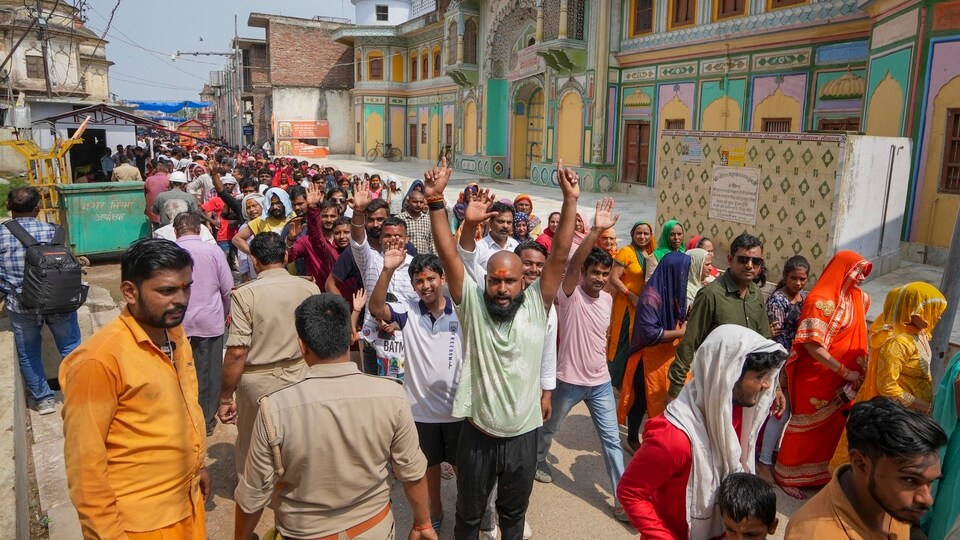
Ayodhya: Devotees visit at the Shri Ram Janmbhoomi Teerth, in Ayodhya, (PTI)
Now the stage is set for another emotional upsurge as the temple gets readied to be inaugurated in January. Prime minister Narendra Modi will inaugurate the temple, slated for completion before the year's end, in January 2024 — the event will be preceded and followed by religious celebrations in temples across the country. The Sangh Parivar plans to organise Ram dhun (religious tunes dedicated to Ram) performances in village temples for 10 days before the inauguration and the pran pratishtha (consecration) of the Ram idol inside the sanctum sanctorum of the temple.
Champat Rai, senior Vishwa Hindu Parishad (VHP) leader and general secretary of the Shri Ram Janmabhoomi Teerth Kshetra Trust (appointed by the Centre for the construction and management of the Ram temple in Ayodhya) had told the media that they aimed to organise nama sanskirtan (mass chanting of holy names) in 500,000 temples across the country. The leadup to the inauguration will begin this year on Diwali — 2.1 million earthen lamps will be lit in Ayodhya. Once the temple is inaugurated, a large number of pilgrims from all over India are expected to visit it for a glimpse of the new structure and idol. No more will they raise the slogan “mandir yahin banayenge” (we will build the temple here). Now, “Jai Sri Ram” will reverberate through the temple city.
At the Shri Ram Janmabhoomi Nyas Karyashala run by the VHP, set up around 1.5 kilometres from the temple site, artisans have been at work, carving 1200 stones for the temple. The temple trust is busy giving shape to a plan for the finale early next year.
In an interview with the Hindustan Times, Champat Rai has credited the people and sadhus of Ayodhya for the construction of Ram Mandir. “They were the ones who were at the forefront of all the Ram temple campaigns as outsiders came and went.”
In the early 1990s, even when the Ram Janmabhoomi movement was peaking, few thought it would turn into a reality. The country was divided into a section favouring the maintenance of the status quo. The late VHP leader Ashok Singhal — one of the major forces behind the movement — had once told the media in Karsewakpuram, “Yes, Ram temple here at sanctum sanctorum will turn into a reality -- it may not happen in our lifetime.” Singhal died in November 2015.
The beginning of mobilisation
The Rashtriya Swayamsevak Sangh (RSS) and VHP leaders Dau Dayal Khanna, Dinesh Tyagi, Gulzari Lal Nanda and Rajju Bhaiya were the first to raise this emotive issue at a Muzaffarnagar public function in 1983, under the banner of the Hindu Jagran Manch (HJM).
Thereafter, Khanna and Singhal visited Ayodhya where they met Ram Chand Paramhans of the Digamber Akhara, a religious group. At a meeting that comprised 50 saints, a decision was taken to form the Shri Ram Janmabhoomi Mukti Yojana Samiti under the chairmanship of Mahant Avaidnath, the spiritual guide of Yogi Adityanath, Uttar Pradesh’s current chief minister. The VHP, constituted in 1964, launched its first formal ‘Rath Yatra’ in October 1985, with saints in the forefront and with the tacit support of the Bharatiya Janata Party (BJP), then a new party.
At first, they demanded the unlocking of what was by then already a disputed structure. In February 1986, a Faizabad sessions judge allowed darshan by opening up the gates that were locked in 1949 after a Ram idol was surreptitiously installed inside the Babri Masjid by a group of Hindus.
Soon after the gates were thrown open for the public in 1986, the VHP and saints intensified public mobilisation in support of building the temple through their various mass mobilisation programmes.
The first was a ‘Ram Shila Puja’ (foundation ritual) held in villages across the country. Nearly 250,000 consecrated shilas (bricks) were sent to Ayodhya from different parts of the country. These bricks, which were stored in a nearby location, will be used in the temple.
In 1989, a shilanyas (sacred foundation ritual) was performed near the disputed structure, the permission for which was granted by the Congress government in the state. Finding itself in a political dilemma, the Congress wanted to win over the Hindus without losing its Muslim vote bank.
Shortly before the 1989 Lok Sabha election, the then Union home minister Buta Singh flew to Lucknow early one day and drove straight to the then chief minister, Narain Dutt Tiwari at his Mall Avenue residence. Senior VHP leaders were waiting for him. Tiwari, who had by then launched a campaign on a development agenda, walked out in a huff after signing on the memorandum: The permission for shilanayas was conditional, binding VHP to a court ruling.
The late Prime Minister Rajiv Gandhi also launched his election campaign from Faizabad in 1989—about four kilometres from the shilanayas site. He spoke about “Ram Rajya”, but not the Ram temple. The Congress tally from Uttar Pradesh fell from 15 to five seats, while the BJP won eight of the 85 seats in UP increasing its tally in the Lok Sabha that year.
The Somnath-Ayodhya rath yatra by BJP's national president Lal Krishna Advani in September 1990 was also mired in political turbulence and violence as it whipped religious frenzy across the route. Bihar chief minister Lalu Yadav, as directed by the then Prime Minister VP Singh, stopped the yatra on October 23 and arrested Advani. The following days were marked by crowds of irate kar sevaks marching towards the disputed shrine even as the police opened fire on them.
In 1992, the Sangh Parivar gave a call to its followers to congregate in Ayodhya. This culminated in the demolition of the Masjid on December 6. It also led to large-scale rioting and arson in UP and other parts of the country, which resulted in the deaths of several members of the Muslim community. Kar sevaks were also killed in the police action during the demolition of the Babri Masjid.
The Narasimha Rao government at the Centre swung into action and dismissed the Kalyan Singh government in UP. Through an ordinance in January 1993, the Centre acquired about 67.7 acres of the land which had also included 2.77 acres of the disputed land.
The VHP and its associated saints continued to keep the issue on simmer, celebrating December 6 as Shaurya Diwas, and by organising small and big rallies every year apart from a larger shiladaan programme.
Negotiations proved unfruitful to resolve the matter: all eyes turned to the courts.
A legal battle first began in 1885, when a Hindu priest filed a petition for building a temple next to the mosque but was denied permission. Several court cases dot the history of the Masjid and the Ram Temple. Finally, in November 2019, the Supreme Court directed the UP government to create a trust to build the temple and allot a suitable place for the construction of a mosque. The country will now witness a finale to a long and chequered history.
From her perch in Lucknow, HT’s resident editor Sunita Aron highlights important issues related to Uttar Pradesh

 E-Paper




 Prefer HTon Google