He was not yet nine but the accident of his birth had marked him. In class, everyone was seated according to academic merit, but him. The young boy was made to sit in a corner by himself, not on a bench but on a strip of gunny cloth he had brought from home. The janitor cleaning the school wouldn’t touch the cloth he sat on, so each evening the boy would stuff it back into his bag, carrying it home and back again the next morning, every day, all year.
When his friends were parched, they would walk to the school tap and quench their thirst. All they needed was a permission slip from the teacher. But the boy wasn’t allowed to touch the tap unless an upper-caste person had already opened it. The school peon’s presence was mandatory; if he was unavailable, the boy went without water that day.
Unfortunately, this harrowing account, written 90 years ago, remains painfully current today, as caste discrimination has spread its tentacles from schools into colleges and universities. In the past decade, at least 115,850 students have died by suicide, according to National Crime Records Bureau data — growing at a faster clip than the suicide rate nationally.
But this is only a fraction of the true toll. India’s elite institutions are strangely bipolar: Churning out graduates on par with the world’s best, keeping pace with innovation despite severe resource constraints, while failing to provide basic, habitable conditions for thousands of marginalised students, and fostering apathy towards first-generation learners and anyone deemed unworthy of the hallowed campus. As a result, the success of these institutions and their alumni sits uneasily alongside probes into a rash of student suicides, and complaints that professors and students alike are hostile to those branded “quota students” — a humiliating label still reserved for historically marginalised beneficiaries of affirmative action, never for others, such as economically weaker students from privileged castes or so-called management-quota beneficiaries.
{{/usCountry}}But this is only a fraction of the true toll. India’s elite institutions are strangely bipolar: Churning out graduates on par with the world’s best, keeping pace with innovation despite severe resource constraints, while failing to provide basic, habitable conditions for thousands of marginalised students, and fostering apathy towards first-generation learners and anyone deemed unworthy of the hallowed campus. As a result, the success of these institutions and their alumni sits uneasily alongside probes into a rash of student suicides, and complaints that professors and students alike are hostile to those branded “quota students” — a humiliating label still reserved for historically marginalised beneficiaries of affirmative action, never for others, such as economically weaker students from privileged castes or so-called management-quota beneficiaries.
{{/usCountry}}Since the turn of the century, there have been two major efforts to investigate the malaise, both against a backdrop of public outcry over student suicides. The first, a 2006 panel led by former University Grants Commission chief Sukhadeo Thorat — constituted by the Union government — found that two-thirds of Scheduled Caste (SC) and Scheduled Tribe (ST) students at the All India Institute of Medical Sciences received no support from teachers, were confined to caste-specific enclaves in hostels, and were explicitly asked to declare their caste in public.
A second wave of anti-reservation protests was roiling the country at the time, and the report’s stark findings prompted the government to introduce equity regulations in 2012 that outlawed certain behaviours and mandated equal-opportunity cells and anti-discrimination officers.
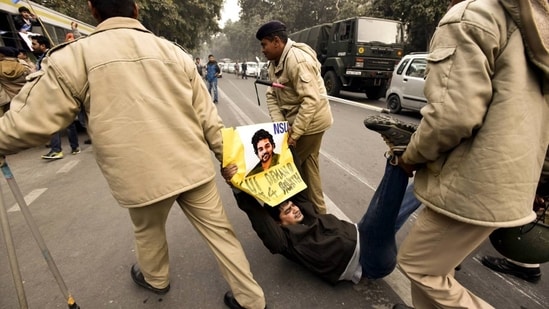
The dismal record of its implementation over the past decade — the suicides of Rohith Vemula in Hyderabad and Payal Tadvi in Mumbai the most sordid among a succession of such deaths — prompted a Supreme Court petition by the two students’ mothers, a fresh set of UGC regulations, and another landmark report by a National Task Force, one whose findings are bleak. It shows how feeble the gains since the 2012 guidelines have been: 210 student suicides in higher educational institutions in just eight months of 2025; 65% of institutions with no mental-health service providers; only 4% with any suicide-risk assessment; and 45% with no faculty sensitisation workshop in the preceding 18 months.
Worryingly, the panel found sharply divergent views on discrimination among students and faculty. Socially privileged groups dismissed it as a relic of the past, irrelevant to them, while marginalised groups reported evolving forms of bias — scholarships withheld, career opportunities stonewalled, grievance systems absent.
This is not to say there has been no progress. This newspaper reported two decades ago that the then AIIMS director ignored government queries about the humiliation of Dalit and tribal students, and refused to let the Thorat panel put up notices on campus calling for consultations. In contrast, the NTF visited 19 campuses and received responses from another 2,000. The sting of the anti-reservation protests have been somewhat blunted, eroded not just by time but by the sheer number of SC/ST/OBC students now on Indian campuses, and by a near-unanimous political consensus on reservations.
That anti-discrimination measures are still sparingly implemented, and barely work in the rare cases they are enforced, points to more insidious, unchanging reasons beneath the surface. First, Indian policymakers and academics believe scientific institutions should confine teaching to the technical aspects of a subject; any discussion of the society that shapes that science is anathema. This attitude springs from a devotion to black-box, technocratic solutions — one that refuses to see science as anything more than a string of formulae and equations, views helping first-generation students as a dilution of merit, and forgets that the evolution of scientific thought was itself a crusade against social dogma, a commitment to the advancement of all humanity, and, historically, a fount of philosophy and debate.
Second, a large share of administrators and students genuinely believe marginalised students are usurpers, that they have taken seats from more deserving candidates, that they have no business being on those campuses, and that making life difficult for first-generation learners somehow does scientific education a favour.
These attitudes have never been reconciled to reservation — political acceptance of quotas has been cynical, and has done little to counter entrenched resentment among upper castes — and so feel little remorse when students from certain communities struggle, drop out, or take more tragic steps.
Such ideas calcify across campuses, generation after generation, because the education system does little to foster any notion of equity. It fails to reimagine merit as opportunity, or to see college admissions as resting on both tangible scores and intangible potential.
Such a reality is jarring for the thousands of students who see education as the only ladder out of crushing social servitude and economic penury, whose families stake everything on their reaching such a campus, and whose hopes of modernity clash violently with the prejudices held dear by those more powerful than them. As a number of reports document, even professors from marginalised locations are not spared. Unless this reality is acknowledged and countered by the government, unless administrators genuinely commit to building more equitable institutions, and unless the student body grows representative not just in numbers but in attitude, India’s educational institutions will continue to fail those who need them most.
That young boy, once struggling to make sense of caste in his classroom, would go on to become India’s first law minister and the guardian of the Constitution, calling on his followers to wield education as the weapon of their emancipation.
To honour the promise BR Ambedkar made in that Constitution will require a new compact for our marginalised students, and an honest reckoning with their social realities.
(The views expressed are personal.)