In his Independence Day address from the Red Fort, Prime Minister (PM) Narendra Modi said armed Naxalism had been decisively weakened but warned of what he called “dimagi Naxals” — people with a Maoist mindset who, he said, remained alert to opportunities of creating violence and disorder and, therefore, needed to be identified and isolated.
The concern underlying his remarks deserves serious attention. Even when an armed movement loses territory and cadres, the networks and ideas that sustained violence in the first place do not necessarily disappear with the gun. India has paid a heavy price in the Maoist conflict to become complacent. The State has both the right and the duty to ensure that such insurgency does not quietly re-emerge.
That duty carries an equally important democratic obligation: The State must be precise about whom it is targeting, for what conduct, and on what evidence.
Insurgencies are rarely sustained by armed cadres alone. Violent organisations may rely on recruitment, finance, shelter, communications, propaganda, logistics, and people who facilitate them. Those who finance violence, recruit for it, harbour cadres, assist operations, or conspire to commit offences cannot claim immunity where evidence establishes criminal conduct. The law must take its course — firmly.
Also Read | ‘Proud to be a dimaagi naxal’: Opposition leaders after PM Modi's ‘isolate them’ remarks
{{/usCountry}}Also Read | ‘Proud to be a dimaagi naxal’: Opposition leaders after PM Modi's ‘isolate them’ remarks
{{/usCountry}}The difficulty begins when conduct gives way to presumed thought.
“Dimagi Naxal” is a political expression, not a legal category. Criminal liability cannot rest merely on a presumed state of mind. The law can examine conduct, intent, conspiracy, incitement, financing, and deliberate assistance, and all of these attract legal culpability. What a constitutional democracy must guard against, however, is the slide from evidence to association, and from association to assumption.
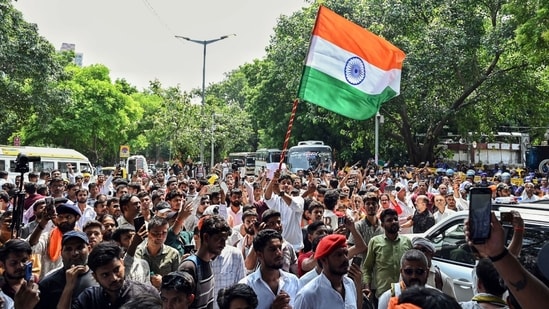
That distinction goes to the heart of citizenship. A student protesting an examination, a college graduate demanding jobs, a farmer questioning policy, a tribal activist opposing displacement, or a journalist scrutinising a security operation does not become an extremist merely because the criticism is inconvenient. The government may disagree, and the police may regulate protests. But dissent alone cannot make loyalty to India suspect.
Also Read | Dimagi Naxal Party's Instagram account temporarily restricted after blowing up on platform
Indian law recognises the distinction. Section 152 of the Bharatiya Nyaya Sanhita deals sternly with acts that endanger India’s sovereignty, unity, and integrity, including armed rebellion and subversive activity. Yet, its explanation protects criticism of government measures or administrative action when aimed at securing change through lawful means and without exciting the activities prohibited by the section.
That is not a concession democracy makes to its critics. It is constitutional democracy in operation.
The PM did not describe recent youth protests as “dimagi Naxalism”, and it would be unfair to attribute such a connection to him. But political expressions rarely remain confined to their original context. Once repeated by parties, television studios and social media, their boundaries can expand quickly. That is why clarity matters.
Words spoken from the Red Fort carry exceptional authority. When the PM says that a category of people must be “identified” and “isolated”, citizens are entitled to know what separates that category from legitimate dissent. If the expression refers to those knowingly enabling Maoist violence, the distinction should be stated clearly, and the law applied firmly. If it were ever allowed to extend merely to radical, unpopular or sharply critical opinion, a democratic India should draw the line.
A republic requires obedience to the Constitution and the law; it does not require unquestioning loyalty to the government of the day and citizens retain the right to disagree. At the same time, civil liberties cannot become camouflage for organised violence. The dividing line is not left versus right, government versus Opposition, or nationalist versus critic. It is between lawful dissent and conduct that knowingly enables violence.
That standard protects the state as much as the citizen. Vague categories can weaken security by blurring the distinction between the genuinely dangerous and those that merely disagree. Intelligence agencies and police should concentrate on networks capable of financing, facilitating or organising violence rather than being drawn into broad ideological scrutiny of inconvenient voices.
India’s success against armed Naxalism should, therefore, be followed not by an indiscriminate search for another internal enemy, but by ensuring that areas from which the gun retreats are filled by schools, hospitals, roads, livelihoods, responsive administration and political hope. The greatest victory over extremism is not merely that an insurgent no longer carries a rifle. It is that a young person no longer believes a rifle is necessary to be heard.
India should not have to choose between national security and democratic freedom. Properly understood, the two reinforce each other. A State unable to defeat violence cannot protect liberty. But a democracy that treats disagreement itself as a security threat risks diminishing the freedom that security is meant to defend. If the Naxal gun is finally disappearing from India’s forests, that is a major national achievement. The task ahead is equally important: Identify and isolate those who profess violence, but do not allow the Naxal label to hang indiscriminately.