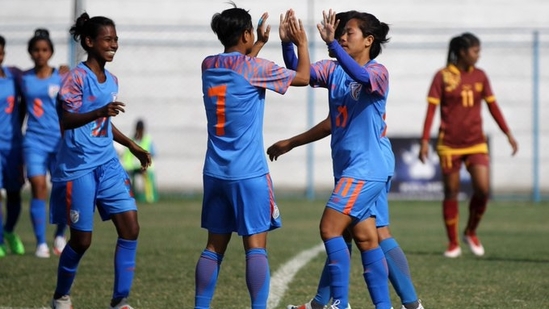
As someone deeply involved in women’s football, I have seen its unbelievable growth, globally and in India. Even though India was runner-up in the Asian women’s championship in 1980 and 1983, many among us were unaware of the existence of a national women’s football team growing up. This was true when I started playing in 2008. I don’t blame people for their ignorance because the games were not televised, and very little information was available in the media.
Indian women's football team (Indian Football Team / Twitter)
Over the years that has changed, and now we see a surge in interest and support for the sport. But the recent turn of events at the Kerala Blasters Football Club has made me question myself. Is the sport really growing, is it just my positive attitude, or is it about what are the criteria for growth?
One crucial aspect indicating growth is the rise in viewership and attendance worldwide. Last month’s Women’s FA Cup final between Chelsea and Manchester United registered a turnout of 77.390 people, a record. The Women’s European Championship final between England and Germany in 2021 had 87,192. Barcelona drew 91,648 spectators to its Women’s Champions League clash against Wolfsburg at Camp Nou last year, marking the highest-ever attendance in women’s club football history. These numbers should be considered as evidence of growth.
But defining overall growth is complicated, especially because equal pay for men’s and women’s national teams is still some way off. Countries such as Norway, the United States, Sweden, Brazil, Spain and Wales have announced plans for gender parity in pay, but these comprise just a fraction of the nations playing football.
The women’s game is growing in India too. We are ranked 60th in the world. But problems linger, exemplified by Kerala Blasters’ inexplicable decision to suspend its women’s team for financial reasons over a fine incurred by its men’s team for walking off the pitch during a match. The men can continue like nothing happened while the women’s team activity is stalled. How is this fair?
The past few days have been disheartening as a player and a fan. How is one supposed to process this at a time when conversations on gender parity are growing? On the one hand are efforts at gender equality in sports such as tennis and table tennis, where equal prize money is being offered in India. On the other hand, the temporary pausing of the women’s team highlights the challenges that still exist.
Some may argue that it was a logical decision and made business sense, as the men’s team gets more revenue. To this, I can only smile and be amazed. First, no Indian football club earns more than it spends, not even close. Second, it is unfair to compare genders without providing women with equal resources, infrastructure, and opportunities. We must level the playing field and allow women the chance to play professionally full-time before making such comparisons. I am not trying to undermine the Kerala Blasters or its management, but this is not the first time we have seen this, nor will it be the last. Look at how the 2022-23 Indian Women’s League (IWL) was played in Ahmedabad at the height of summer, leading to games kicking off at 8 am and 4.30 pm. Or the unsavoury controversy surrounding Alex Ambrose, who was sacked from the Under-17 team due to sexual misconduct charges but was offered another contract later, though it was later rescinded.
It is disheartening to witness the struggles faced by women footballers in India. After 15 years, we still have only a handful of full-time professional women footballers. The lack of sustainability in the sport makes it challenging to expect significant growth. In contrast, the success of women’s cricket in India — with full-time professionals and substantial progress in leagues, salaries, infrastructure, and training — serves as an excellent example of what can be achieved.
The recently released Vision 2047 document by the All India Football Federation offers hope. It outlines a roadmap that, if even partially realised, could put us in a much better position. To achieve this vision, we need to focus on improving grassroots systems, increasing the frequency of matches, domestically and internationally, and providing our team with much-needed experience and exposure. Only then can our women players realise their true potential.
Aditi Chauhan is the India national women’s team goalkeeper. The views expressed are personal

 E-Paper