
 E-Paper



Mind the Gap: How free bus rides are changing the lives of women
There’s a great deal of debate over free bus rides for women. Bus tickets for women, savings are up and so are opportunities.

 Prefer HTon Google


Shobha, the mother of a daughter who needs fortnightly hospital visits for a chronic kidney ailment, is talking about how her life changed after the Karnataka government introduced free bus rides for women in June 2023.
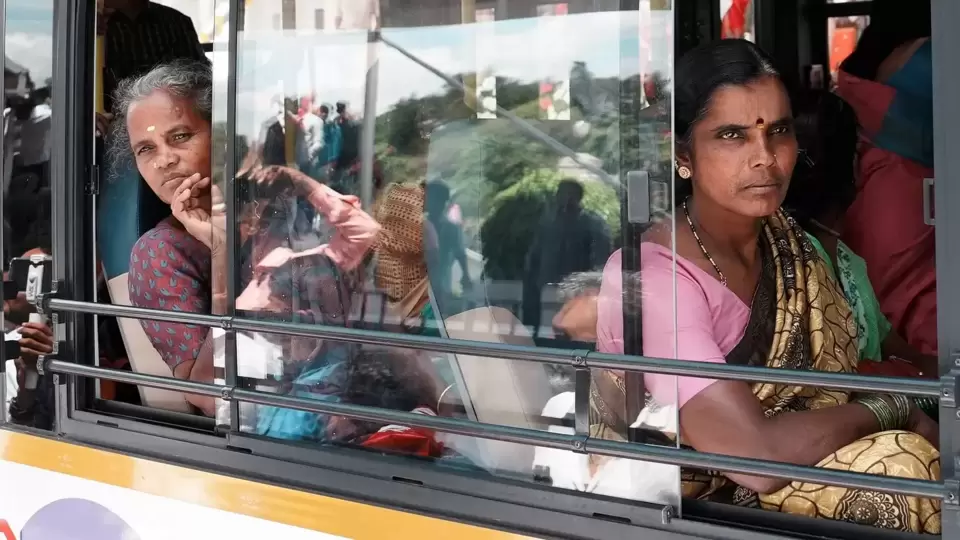
“For me, using an auto was out of the question. Even the bus fare was expensive,” the Bengaluru-based home-maker said. “Now if I can save ₹50, I can buy some fruit for my daughter.”
Since she stopped having to buy tickets on the bus, Shobha said, she has saved ₹40,000 in the post office—money she is keeping aside for her daughter’s education.
Shobha is speaking at a conference to launch a report on the impact of free bus fares across India. The study by Sustainable Mobility Network, a coalition of 20 organisations that focus on clean, equitable and accessible transport systems, and Nikore Associates, an economics research and policy advisory think-tank, finds that subsidised bus travel schemes are a “transformative policy intervention for advancing women’s urban mobility.”
In a country where the bus is the primary mode of transport for three in four women in cities and are a “foundational element of women’s mobility” particularly in lower-income groups, the subsidies provide substantial financial relief for women, finds the report.
Hazira Leena, a beautician in Bengaluru, spoke of how earlier she would take an uber to go to clients. Now it makes sense for her to hop on the bus which costs nothing. Her savings? At least ₹7,000 a month.
Across India, in cities that have fully subsidized fares and even those that are only partly subsidized (Mumbai, Pune, Nagpur), women are saving between 32% to 53.5% of their monthly transport expenses, finds the report. This money is being ploughed into family budgets for childrens’ education, healthcare and emergency funds.
But the bus is also expanding opportunity. Rama Gera who works with women waste-pickers at Bhalsawa on the outskirts of Delhi spoke about a woman who had developed terrible allergies sorting through waste but had no choice but to keep at it because as a single mother she had no other source of income. With a pink ticket on the bus, she now commutes the 7-kilometre distance to reach the middle-class colony where she has taken up part-time work in four or five households.
Ticket to ride

In October 2019, the Aam Aadmi Party became the first government in the world to introduce free bus travel to enhance women’s mobility and safety.
That idea has caught on and subsidized bus fares for women have now been implemented in Karnataka, where it was a poll promise of the Congress government, Tamil Nadu, Jammu & Kashmir, and Telangana. Earlier this week, Chandrababu Naidu announced free bus rides for women in Andhra Pradesh, scheduled to roll out on Independence Day.
Partly subsidized fares of 50% have also been rolled out in cities in Maharashtra including Mumbai, Pune and Nagpur.
In all these states, this much is clear: More women are taking the bus. In 2019 in Delhi, women were just 33% of commuters on the bus. In 2023, it was 42%, finds research published in March this year by Harshita Jamba and others for WRI India, an independent charity that works on socially equitable development. Over 60% of the 2,000-odd women interviewed in that study said they used the bus for work and education, another 16% were for medical visits, household shopping and accompanying children.
The further they went, the greater women’s access to opportunities in study, jobs and healthcare, found the WRI study. An earlier study in 2017 by Girija Borker found that women students in Delhi University would rather take admission in colleges where their commute would be shorter, even if they had got admission into higher ranked colleges further away from home. Now, women are able to travel further and more frequently, and students are benefitting the most.
The link between free bus rides and women’s employment is, as yet, mixed. Cities with well-functioning bus systems, such as Bengaluru and Hubli, show higher employment gains. In Mumbai with limited bus fleets and peak-hour ticket shortages, only 3% of women reported employment improvement.
There are safety concerns, including poor lighting in bus-stops. Delhi also reports a problem unique to it where women complain that drivers whiz by when they see too many women at the stop. “It’s not like the fare is going from their pocket, but they won’t stop if they see too many of us,” said Rinku, a domestic worker in Delhi.
There is open resentment too from paying male passengers who heckle women for being ‘freeloaders’. In a post that went viral in January this year, a man from Bengaluru asked why all women, regardless of their income, travelled free.
Cost-benefit analysis

Savings, an increase in ridership, access to greater opportunities and a possible boost to employment are all the undeniable benefits of subsidized bus travel. But these come at a cost. In Delhi, government estimates are ₹1,200 crore a year. In Karnataka, the cost of the Shakti scheme which crossed 500 crore riders earlier the month is ₹12,614 crores. In Andhra Pradesh, the projected cost is ₹2,200 a year.
In Delhi, a new BJP government headed by chief minister Rekha Gupta has announced tweaks to the existing scheme that will replace pink tickets with a new Aadhar-linked pass that requires proof of address so that it’s limited to Delhi residents. This would exclude those who live in surrounding areas like Gurgaon and Noida as well as marginalised women who lack formal documents.
But suggests Avinash Dubedi, programme head for transport, WRI India, perhaps we need to look at subsidised bus tickets as a service.
In our crowded, choked cities, the social and environmental benefits of public transportation in terms of reducing vehicular traffic and bringing down emissions cannot be over-stated. It’s a goal that needs to be expanded, not shrunk.
Savings on public transport expenditure benefit not just the individual woman but her entire family. “Daily bus fares determine whether women can work or study,” said Mitali Nikore, founder of Nikore Associates. But, she adds, subsidies cannot work alone without corresponding fleet expansion or improvement in safety. “Gender-inclusive cities need comprehensive policies and infrastructure investments, not just fare subsidies.”
Please don’t look away

One of my endeavours in writing on gender is to highlight positive stories of hope and achievement rather than simply report on crime and violence. But this week’s photographs of sick and starving children are so horrific that they simply cannot be ignored.
The situation in Gaza is dire. Everybody is suffering. But those paying the heaviest price are mothers and their children.
In the middle of a “man-made starvation”, to use the World Health Organization’s term, 1,000 people have been killed since May by Israeli forces while seeking food in Gaza. These starving people must now choose between getting killed while getting aid, or letting their families die without it. Food and aid is available in trucks waiting at the border. But distribution is under the control of the Gaza Humanitarian Foundation that allows only a trickle through just four sites, opened on average for 11 minutes.
Over 100 aid organisations are saying their own humanitarian workers are starving. Journalists and stringers for media organisations have no food. Mothers must choose how to apportion scarcely available food. Over 20% of pregnant and breast-feeding women are malnourished, some severely.
Please don’t look away.


