
 E-Paper



Mother Mary Comes to Me: In which Arundhati gives it those ones
Mother Mary Comes to Me is partly an account of Roy's troubled relationship with her mother Mary Roy, and partly the auto-biography of many periods of her life

 Prefer HTon Google


Did you know Arundhati Roy has a first name which she’s dropped? She writes in her new book that when she was 18, “I dropped my first name, Susanna. Starting then, I gradually, deliberately, transformed myself into somebody else.”
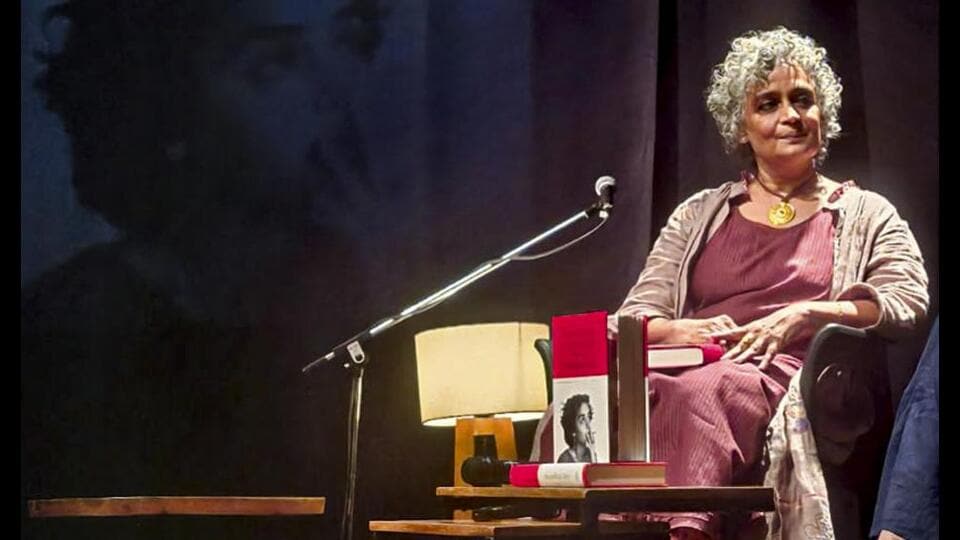
That’s one of many little nuggets she reveals in Mother Mary Comes to Me. The other eye-catching one is that she had an abortion without anaesthesia when she was 22. “It was horrible. But it was done.” She then caught the overnight train to Hoshangabad on her way to Pachmarhi, where she was filming.
The book is partly an account of her troubled relationship with her mother, Mary Roy, and partly the autobiographical story of different periods of her life. It’s a riveting, if often disturbing, read.
Arundhati usually refers to her mother as Mrs Roy. On the back cover, she calls her “my gangster”. But I couldn’t help feeling she was more of a monster. When Arundhati was six and on her first plane journey, she asked her mother why her aunt was so much thinner than her. Mrs Roy turned on her in fury. So terrifying was the experience that the six-year-old prayed for the plane to crash. “I wanted it to crash and for all of us to die.” Her mother often called Arundhati “a bitch”. What she said to her brother, Christopher, was worse. “When he was a teenager, she once said to him, ‘You’re ugly and stupid. If I were you, I’d kill myself’.”
There was, of course, another side to Mary Roy. She was a strong-willed, determined woman who created a school called Pallikoodam, which was well-considered and widely talked about. The students were not just taught the school curriculum, Mrs Roy personally supervised their bathing and toilet-cleaning lessons. When the boys began to tease the girls about breasts and bras, Mrs Roy fetched a bra from her own cupboard and bluntly proclaimed: “This is a bra. All women wear them. Your mother wears them, your sisters will too, soon enough. If it excites you so much, you are very welcome to keep mine.”
The chapters about Mrs Roy can be distressing. You often can’t believe what you read. But you carry on. The autobiographical chapters feel very different. Here Arundhati reveals herself as she has never done before.
The book takes you through the early years of her life, when she acted in or wrote the script for films like Massey Sahib, In Which Annie Gives It Those Ones and Electric Moon. Derek Malcolm, The Guardian’s film critic, was unimpressed. “You will have to change the title, because ‘Gives It Those Ones’ doesn’t mean anything in English”. Arundhati and her team made the most of that comment. The publicity flyer proclaimed: “Well obviously Mr Malcolm, in England you don’t speak English anymore.”
Arundhati’s first piece was published quite by accident. It was an essay called In A Proper Light. The editor of Sunday, who dropped by to pick up a friend, chanced upon the essay. “And so, as casually as that, my first piece of prose was published … It was 1992. I was thirty-two years old.”
The book also talks about the one day she spent in jail. “The sound of the prison door slamming shut behind me was unnerving. Clearly, I was entering a parallel universe and would be vulnerable as long as I was there.” In fact, she wasn’t. She made friends and, I suspect, charmed the inmates.
When you get to the end you realise the complexity of her relationship with her mother. She hated her at times but loved her on other occasions. Months before Mrs Roy died, she messaged her daughter: “There is no one in the world whom I have loved more than you.” That startled Arundhati but she replied in the same vein. “You are the most unusual, wonderful woman I have ever known. I adore you.”
Despite their terrible times, I suspect Arundhati misses her. “Bye-O”, she ends the book. “I’ll be seeing you.”
Karan Thapar is the author of Devil’s Advocate: The Untold Story. The views expressed are personal


