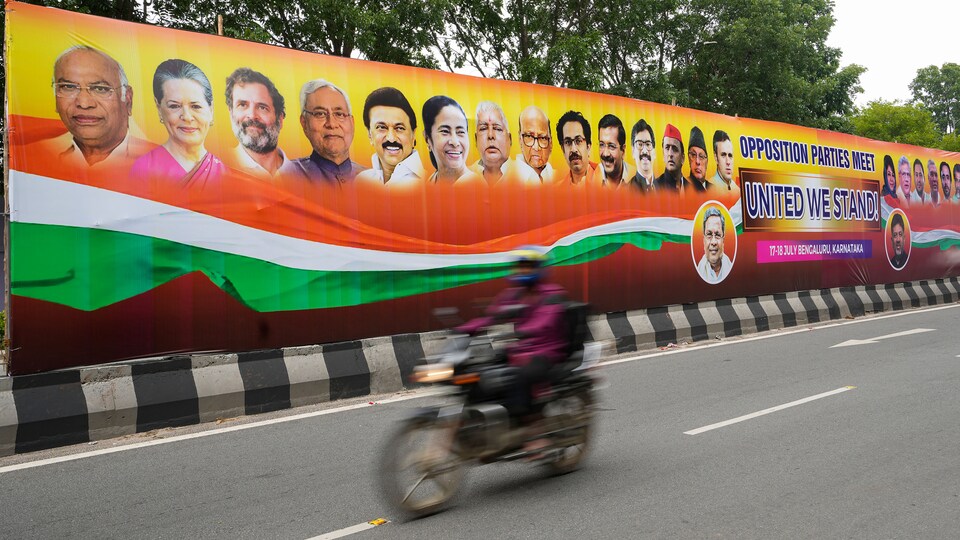
New Delhi: Days before the first meeting of the Opposition parties in Patna, two senior Opposition leaders—CPIM general secretary Sitaram Yechury and Congress’ Jairam Ramesh—were working on a statement of resolve. The draft, originally penned by Yechury and significantly modified by Ramesh, would have addressed why the Opposition parties have come to Patna and talked about securing the character of secular democratic India and retaining the supremacy of the Indian Constitution.
A poster of opposition leaders put up outside the venue of the united opposition meeting. (PTI)
Even as a number of leaders spoke on these lines at the post-meeting press conference, the draft was quietly shelved as a senior Trinamool leader along with a few other Opposition satraps couldn’t agree on a pre-written statement. “We let go of the statement. It was impossible to get all 15 parties to agree on a joint statement,” one of the authors told HT.
The incident was a pointer to the practical difficulty of getting all constituents of this Opposition bandwagon to agree on an issue. On Monday, Congress general secretary KC Venugopal indicated at a similar challenge when asked about the second meeting of the Opposition.
“You should understand, there are 26 political parties, this is not a one-party alliance. We are trying to evolve the unity on various issues. Certainly, what are other issues to decide for the future, will be discussed tomorrow in the meeting itself. Whatever issues are coming before us, we will discuss, but till now also we have discussed, and tomorrow also we will discuss. We will resolve all the issues within one or two meetings,” Venugopal said.
At least three Opposition leaders told HT that resolutions on unity and on common issues are the easiest part. The challenges will come when this sense of unity needs to be translated into concrete action points and seat adjustments.
Seat adjustment puzzle
Is the Congress ready to join hands with Aam Admi Party for a seat-sharing agreement in Punjab or Delhi?
Would it be possible for West Bengal chief minister Mamata Banerjee to vacate some seats for the Congress or the Left in her state?
The simple answer to these two questions is: NO.
The Congress leaders are clear that in Delhi or Punjab, it would be suicidal to enter into any agreement with the Aam Admi Party—the political outfit that was born out of a protest against the Congress-led UPA government and then pushed the party out of power in both Delhi and Punjab.
“AAP has continued to target the Congress and acted as a B team of the BJP,” said former Union minister Ajay Maken, one of the staunch critics of AAP. “It fielded candidates in Goa and in Karnataka. In Goa, AAP ate away from the Opposition vote. The people of Karnataka rejected AAP,” said Maken.
Similarly, Trinamool a party in power in West Bengal since 2011, has reduced the Congress to zero in the 2021 assembly election and doesn’t have any plan to spare seats for a rival who has been a partner of CPI(M)-led Left Front for the past few polls.
The Congress leaders suggested that their party will go to poll with pre-existing alliances with DMK in Tamil Nadu, JMM in Jharkhand, JDU and RJD as partners in Bihar and NCP and Sena (UBT) in Maharashtra.
“As far as we are concerned, the only open question for an alliance is in Uttar Pradesh. We want a pact with Samajwadi Party. Let’s see if it happens or not,” said a senior Congress strategist.
Leadership issue
Mamata Banerjee is serving her third term as the chief minister. Sharad Pawar is a four-term chief minister of Maharashtra and had also been a Union minister such as Banerjee. Bihar chief minister Nitish Kumar is an incumbent since 2000 barring a nine-month period helmed by Jitin Ram Majhi.
If one has to pick a Prime Minister face among these leaders, it will, no doubt, be a challenging task.
Not to forget that the Congress, too, is a contender. As a pan-India party, the Congress is expected to come up with more seats than any other Opposition constituent in 2024. In the 17th Lok Sabha, Congress has 49 MPs while DMK, the second largest Opposition party has 24 MPs.
The history of the third front—alternative arrangements to the Congress as well as BJP—is marred by individual aspirations for the top post resulting in the collapse of the government. To be sure, no third-front government or a non-Congress, non-BJP Prime Minister has completed its full term in the history of India.
The BJP has already posed this question to the Opposition: who will be their face against Prime Minister Narendra Modi in 2024?
The Opposition parties don’t have a ready answer.
On Monday, Venugopal tried to evade the answer and said, “Don't worry about the leadership (of the Opposition alliance). We are more worried about the country's situation. Issues are important. Our common agenda is to defeat these people.”
Ramesh quickly added, “What is this leadership that is silent on Manipur? What kind of leadership is this to give clean chit to China?” taking a dig at PM Modi.
Why Congress’ leadership will not be acceptable
There were clear indications that the first meeting of the Opposition will be in Delhi. The parleys between Congress president Mallikarjun Kharge and Sharad Pawar and Nitish Kumar and other leaders had a common mission: To hold a meeting in Delhi under the leadership of the Congress.
West Bengal chief minister Mamata Banerjee had other plans. She single-handedly changed the venue from Delhi to Patna. In the press conference of the Opposition parties on June 23, Banerjee said, “Earlier many attempts (to forge alliance) failed in Delhi. So, we came to Patna. This is the land of Jaiprakash Narayan.”
What Banerjee actually meant was that the writ of the Congress will not run over other Opposition parties. Banerjee, whose equations with Rahul Gandhi are not exactly cordial, has tried to scuttle Congress’ plans and leadership dreams.
But Banerjee is not alone. There are anti-BJP Opposition parties such as Bharat Rashtra Samithi (BRS) or fence sitters including Biju Janata Dal (BJD) and YSR Congress Party (YSRCP) who are vehemently against the Congress. If a grand coalition of Opposition parties is to be stitched, the Congress is perhaps not the best tailor.
BRS, which is a vocal opponent of the BJP, has not joined these Opposition meetings as they don’t want to share a dais with the Congress ahead of the Telangana election.
Similarly, YSRCP leader and Andhra Pradesh chief minister Jagan Mohan Reddy has a good equation with some Opposition leaders but remains vehemently anti-Congress for the raw deal he got from the Congress High Command after his father’s death.
Time time, the regional parties want to take the command. Banerjee, Kumar, and Pawar might collectively hold more bargaining power than the Congress. For the national party, it’s a question of whether it is ready to play a supportive role.
New Delhi Junction is a weekly column on political parties as they get ready for the 2024 general elections.

 E-Paper