Opening Saudi airspace to Israel is a plus. But an air battle is in the offing
In the larger context of the politicisation of airspace, opening Saudi airspace to Israeli carriers is a positive development. Though it primarily profits these two countries, India is an unintended beneficiary.
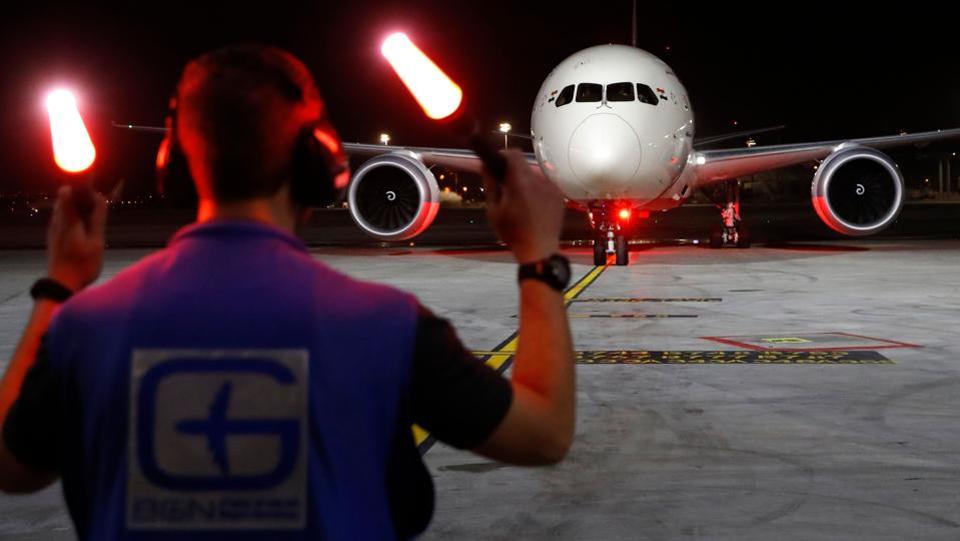
Hours before United States (US) President Joe Biden left Israel for Jeddah last week, the Saudi Arabia Authority of Civil Aviation declared that the Kingdom’s airspace would be open to all carriers without discrimination. This meant Israeli carriers could fly over Saudi airspace for their destinations to and from South and Southeast Asia. It is seen by many as a small step towards an impending Saudi-Israeli normalisation. In addition, the overflight facility reduces travel time considerably, saves fuel, and makes travel cheaper. Currently, Israel’s national carrier El Al takes the median line of the Red Sea for the flight from Tel Aviv to Mumbai, which takes over nine-and-a-half hours, and this journey can now be covered in about five-and-a-half hours.
Nations have been extremely sensitive to the sovereign control over their airspace and never hesitate to use this to influence and intimidate their adversaries. (Jack Guez/AFP)
The permission to use Saudi airspace for Israeli flights was first granted to India when Air India on March 28, 2018, took its maiden Delhi-Tel Aviv flight. This was a sign of bonhomie between Prime Minister (PM) Narendra Modi and Saudi Crown Prince Mohammed bin Salman. The privilege was gradually expanded to the national carriers of Bahrain and the United Arab Emirates (UAE) following the conclusion of the Abraham Accords with Israel in 2020.
Nations have been extremely sensitive to the sovereign control over their airspace and never hesitate to use this to influence and intimidate their adversaries. For example, the denial of airspace for Israel has been the longest and most powerful boycott instrument used by several Arab countries.
This, however, was not always the case. In Israel’s early years, flights from continental Europe to India and Southeast Asia had a stopover in Ben Gurion Airport or Lod international airport, as it was called then. BOAC, the forerunner of today’s British Airways, had a stopover in Israel before destinations in India and beyond. For example, in early 1952, Dr Walter Eytan, the director-general of the Israeli ministry of foreign affairs, the equivalent of India’s foreign secretary, travelled to India to meet PM Jawaharlal Nehru to push for normalisation. He made a stopover in Karachi. Obviously, he could not leave the airport but stayed in a hotel attached to it. The situation worsened in the early 1960s as the Arab boycott of Israel intensified. The development of long-haul flights also eliminated the need for a stopover in Israel.
Things began to change slowly after Egypt (1978), and Jordan (1994) normalised relations, and Israel started using their airspace for flights to Asia. Slowly countries like Qatar and UAE began allowing Israeli passport holders to travel through their airports but without the use of their airspace. Finally, Air India broke this chain in 2018.
However, as several examples illustrate, the prevalence of formal diplomatic relations does not ensure the unrestricted use of sovereign airspace. National decisions often tend to be immune from a cost-benefit analysis. India and Pakistan periodically resort to this tactic to bleed the airlines of the other. If the Indian carriers have to look for costlier alternative routes for their West-bound destinations, Pakistan also suffers due to the loss of revenues generated by overflight facilities. For example, the closure of Pakistani airspace in 2019 following the Balakot strike cost India at least ₹550 crores and a corresponding loss to Pakistan. During the Gulf Cooperation Council crisis between June 2017 and January 2020, Qatar was denied the use of the airspace of Bahrain, UAE and Saudi Arabia, incurring additional costs to Doha. In June 2020, Qatar Airways even made a $5 billion compensation claim against the countries for closing their airspace. Likewise, the ongoing Ukraine crisis has hampered Russia’s ability to use several West European airspace. Some Russian carriers used longer and circuitous routes to bring home diplomats and citizens stranded in the West.
Thus, in the larger context of the politicisation of airspace, opening Saudi airspace to Israeli carriers is a positive development. Though it primarily profits these two countries, India is an unintended beneficiary. At the same time, El Al will be a big competitor to the now privatised Air India. Thanks to the Saudi gesture, an interesting air battle of a different kind is around the corner.
P R Kumaraswamy is a professor of contemporary Middle East in Jawaharlal Nehru University

 E-Paper