
 E-Paper



Strong institution or hand? Lessons from Seshan case
How can a balance between strong leadership and institutional accountability be struck?

 Prefer HTon Google


In India’s democracy, tension between individual leadership and institutional integrity surfaces from time to time. While strong leaders can propel institutions forward, weak ones risk undermining their credibility. This relationship is particularly tested in institutions like the Election Commission of India (ECI), which are prone to receiving political pressure.
In recent years, the ECI has faced criticism for its unwillingness to act against political parties, notably the Bharatiya Janata Party (BJP), for infractions and violations of the Model Code of Conduct. Such instances have ignited debates about the institution’s capacity and the fortitude of its leaders to withstand political pressures.
But, a strong leader with unchecked power can be just as problematic. Such concentration of authority often leads to authoritarianism, eroding the very principles of accountability and transparency that the ECI is meant to uphold. How can a balance between strong leadership and institutional accountability be struck?
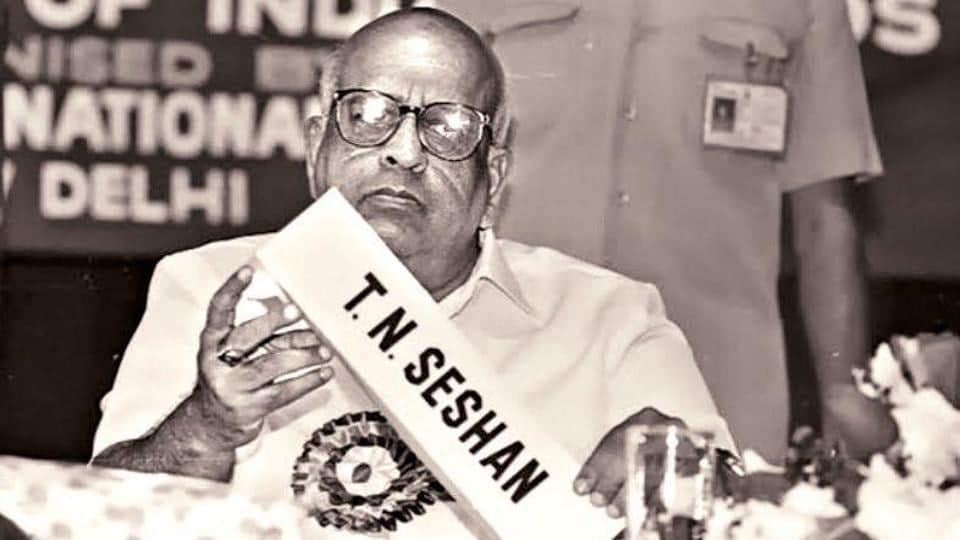
In the ECI’s long history, these questions first came to a boil in 1995, in TN Seshan Vs. Union of India. Tirunellai Narayanaiyer Seshan, India’s 10th chief election commissioner (CEC), went head-to-head with the Centre, and the Supreme Court adjudicated.
When Seshan assumed the role of CEC, he inherited a sleepy institution from passive predecessors. Uncompromising and incorruptible, he began institutionalising sweeping reforms and insisted on strict compliance with the Model Code of Conduct, quickly becoming a thorn in the side of politicians who had become used to the bare minimum oversight from the ECI.
He, however, was not a popular man. Rude and refusing to accommodate or negotiate, the CEC made reckless allegations attacking various individuals and institutions.
Seshan knew that politicians across parties wanted him gone, but he was not worried. He knew that removing a CEC was as cumbersome as removing a judge. The composition of the ECI as a single-member body meant that he had unbridled powers—the ECI was Seshan, and Seshan was the ECI.
In 1993, the Centre, under PV Narasimha Rao, sought to make the ECI a multi-member body through an ordinance. A furious Seshan took the matter to the Supreme Court, arguing that the government’s intention was to clip his wings. There were two main questions before the court: Was it constitutionally sound to add more election commissioners (ECs) to the ECI? And, were the new ordinance and the orders that would come with it constitutionally valid? Seshan was sure he would come out on top.
But, presiding over the five-judge bench hearing the case was Chief Justice of India (CJI) AM Ahmadi — whose aversion to placing absolute power in the hands of individuals was well known. Just two years earlier, this had been tested in the courtroom. In the Second Judges Case, Ahmadi dissented against the majority of the bench on expanding the powers of the CJI with regards to appointing judges, despite knowing that he was slated to become the CJI in a few months. He cautioned against misinterpreting the Constitution and the perils of placing vast discretionary powers in the hands of an individual.
And so, in the TN Seshan matter, the bench comprising Justices Ahmadi, JS Verma, NP Singh, SP Bharucha, and MK Mukherjee observed: “... (it) would be wrong to project the individual and eclipse the Election Commission ... To project the individual as mightier than the institution would be a grave mistake. Therefore, even if the Election Commission is a single-member body, the CEC is merely a functionary of that body; to put it differently, the alter ego of the Commission, and no more.”
The judgment authored by Ahmadi explained that Article 324, Clause 2 of the Constitution allows for the ECI to include the CEC and any other commissioners appointed by the President, with the CEC acting as chairman. The court dismissed the argument that a multi-member Commission would be against the Constitution. Further, the court denied the CEC veto power over other ECs, ruling that decisions should be made by majority vote.
And thus, the ECI was forever changed. But what are its lessons for today?
Weak institutional checks can lead to unchecked individual power, but weak leaders can threaten the very foundation of constitutional institutions — both disastrous possibilities.
Yet, if we must choose between the two, then we should remember that individuals will come and go, but institutions endure. The mechanisms that govern these institutions must be robust enough to withstand personal ambitions and political pressures. It is perhaps to this end that the Supreme Court had mandated that the CEC and ECs be selected by a panel consisting of the Prime Minister, the Leader of Opposition and the CJI — to ensure that the power of selection for these positions is not held exclusively by any one organ of the State.
Rajendra Prasad said in the Constituent Assembly, “... a Constitution, like a machine, is a lifeless thing. It acquires life because of the men who control it and operate it, and India needs today nothing more than a set of honest men who will have the interest of the country before them.” We may apply the same thinking to constitutional institutions to better understand the needs of our democracy.
Insiyah Vahanvaty is the author of The Fearless Judge : The Life and Times of Justice A.M. Ahmadi. The views expressed are personal


