
 E-Paper



Terms of Trade | Can the socially retrograde turn economically progressive?
The political shift from socially progressive to regressive, and vice versa, is often, although not always, accompanied by a change in economic fortunes.

 Prefer HTon Google


The election of a Marxist-Leninist politician as the president of economically floundering Sri Lanka was a big news point this week. Anura Kumara Dissanayake, locally known as AKD, the leader of National People’s Power, increased his vote share from just about 3% in the 2019 elections to almost 55% in this week’s presidential polls.
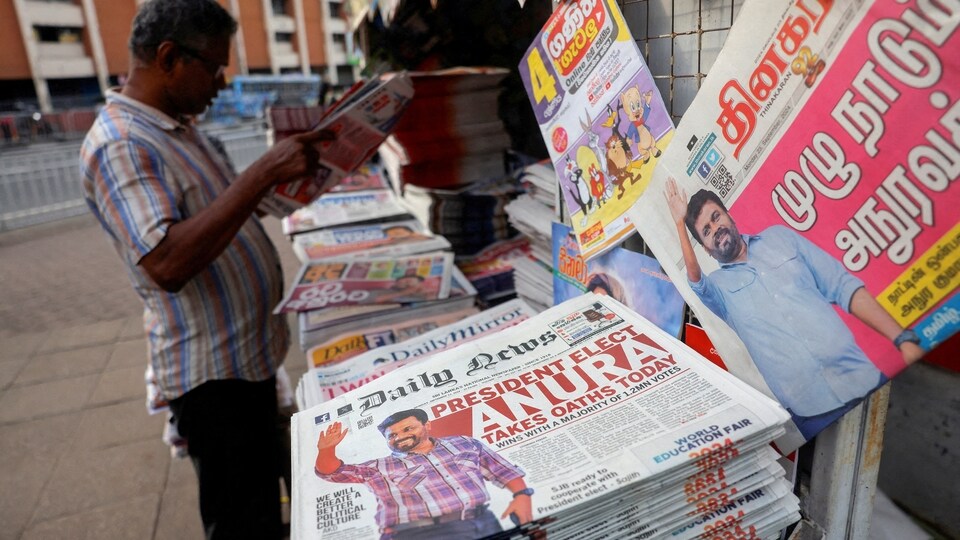
The 2024 elections were held in the aftermath of a crippling economic crisis in Sri Lanka, which triggered a revolt against the incumbent government in 2022. This week's poll results entail a big rejection of almost all mainstream political parties in the island nation.
While a lot of Left-leaning voices and politicians have hailed the Sri Lanka election results as almost revolutionary – to be sure, Dissanayake would face a tough challenge renegotiating the IMF conditionalities — there is also a dark side to this victory. Dissanayake and his party have been known to have sided almost completely with the majoritarian Sinhalese politics against the rights of ethnic Tamils and Muslims in the island nation.
There is an interesting counterfactual to be asked here. Had Dissanayake and his party taken a principled position against majoritarian ethnic politics in Sri Lanka, would they have managed to protect their political capital, which has been encashed to capture power in these elections? Sinhalese are almost three-fourths of Sri Lanka’s population and nobody has a real shot at power without their support.
The larger question this column is trying to frame is not confined to Sri Lanka.
Let us look at the state of Haryana, which will go to polls next week. The numerically dominant Jats — they are almost one-fifth to one-fourth of the state’s population — are the core of the Congress’s support base in the state. Jats have traditionally been a peasant community but also gained notoriety for their retrograde views on things such as women’s rights and own-choice marriages and oppressive practices vis-à-vis those weaker in the social hierarchy. Both of these vices can be located in the motivation to keep intact the community’s control over land and the rural economy.
However, the community’s political positioning and imagery have changed drastically over the past few years with the khaps — clan-based cliques — turning their battles against things such as the now-repealed farm laws or demand for guaranteed minimum support prices instead of persecuting couples who were marrying against its diktats or othering Muslims. A key reason for such dominant communities turning against established politics and its majoritarian vices is a discernible deterioration in their own material conditions.
The Sinhalese voters in Sri Lanka realised to their own detriment that in their obsession with the ethnic othering game, they were completely blindsided by the economic meltdown, which was presided over by an extremely majoritarian government. The Jats too realised that the ultra-nationalist and majoritarian rhetoric — it reached a peak during the 2013 riots in western Uttar Pradesh – was actually accompanied by a larger economic regime which was antithetical to their economic interests in the rural economy without generating opportunities elsewhere.
Is this turn from socially regressive to economically progressive — as long as one defines the latter in terms of the petty producer and ordinary consumer being pitted against big capital or inequality — to be celebrated or criticised unambiguously? The answer lies somewhere between these two extremes.
Here is why.
Community-driven socially retrograde practices are rooted in two broad but often overlapping factors. The first is almost entirely social as part of historical contradictions. The present-day antipathy towards Muslims in the name of some Muslim king having demolished temples centuries ago – destroying religious places across and within religions was almost an established practice of warfare across communities in ancient and medieval India – is one such example.
Such antipathy, when weaponised politically, as seen in the case of India, can become an extremely potent force. To be sure, sometimes it can just be the majoritarian instinct promoting such politics in a democratic competition.
However, more often it is the economic motivation, which disguises itself as a social form of retrogression. A very large part of caste violence in India can be explained in these terms where the proverbial upper caste backlash against the socially marginalised seeks to prevent or reverse the upward mobility or a better economic bargain of the latter. Depriving them of economic opportunities is often a compelling motivation behind other ethnic minorities. In fact, economists have also argued that a lot of Hindu-Muslim riots in India can be explained as a backlash against the rising prosperity of Muslims.
Can these motivations change with time?
In the case of the second, change in larger economic dynamics can often alter the situation on the ground. When big capital allies with the state to usurp a larger part of the agrarian surplus in the economy, it makes eminent sense for the kulak class (read Jats) to direct its fire against big capital and its perceived political ally rather than the underclass in the village. Such a change of strategy can often be accompanied by bonhomie, even if temporary, towards the socio-economic underclass or a hitherto religious adversary. The political alliance between the Muslims and Jats in western Uttar Pradesh is one such example.
The first however is more resilient and adaptive in nature and can resurrect itself after long periods of dormancy. A good example to make this point is the large-scale shift in political loyalties from the economic left (the communists) to the religious right (the BJP) in the state of West Bengal in India within just a few years.
What is also true however is that the political shift from socially progressive to regressive, and vice versa, is often, although not always, accompanied by a change in economic fortunes. The rejection of the Rajapaksas — President Gotabaya Rajapaksa fled the country during the 2022 mass protests — after Sri Lanka’s economic meltdown is one such example of progressive political change. The rise in popularity of the Muslim League at the cost of the Krishak Praja Party in pre-independence Bengal because of how jute prices crashed and Muslim peasantry suffered between the 1937 and 1946 elections — Georgetown University historian Tariq Omar Ali’s book gives a fascinating account of this — is an example of a politically retrograde turn driven by economic factors.
What is the larger point of saying all this? A society’s long-term social moorings are more complicated than the simplistic binaries of progressive or regressive. And the shift from one to another, when it happens, is often driven by economic rather than cultural factors.
Roshan Kishore, HT's Data and Political Economy Editor, writes a weekly column on the state of the country's economy and its political fall out, and vice-versa


