
 E-Paper



Terms of Trade | The tale of Nitish Kumar and his palace coups
Nitish Kumar’s politics challenges established notions of a Mandal-Kamandal binary

 Prefer HTon Google


If one were to use slightly dramatic language, Nitish Kumar is the proverbial king who keeps staging his own palace coups. While he gets to keep the king’s chair after every coup, the courtiers keep changing.
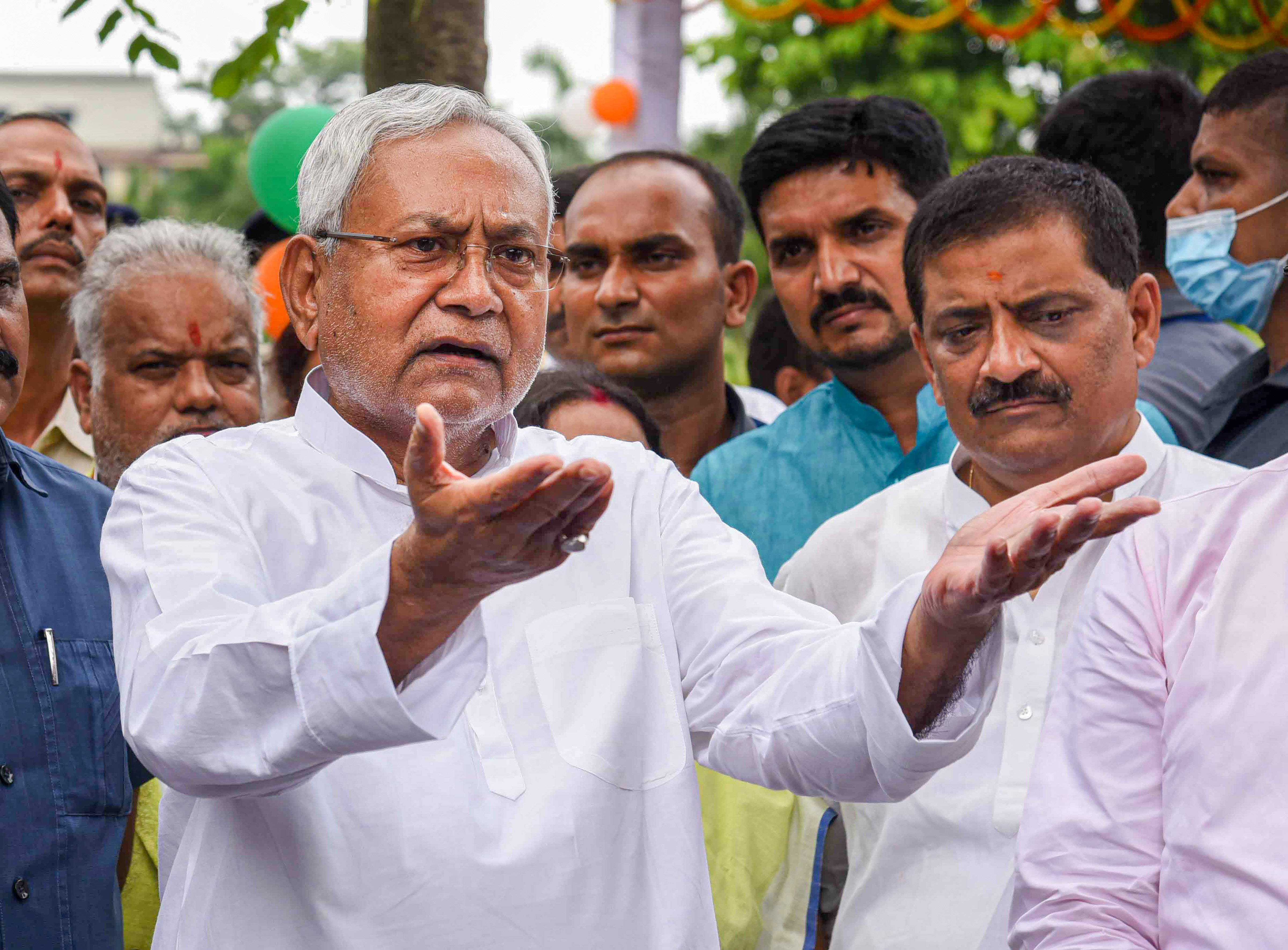
Kumar staged his latest palace coup this week, his third in a decade, when he dumped the Bharatiya Janata Party (BJP) to once again join hands with the Rashtriya Janata Dal (RJD). How does he manage to pull these feats, that too repeatedly?
Answering this question requires taking a hard look at the Mandal versus Kamandal binary, which many claim is the central political fault line in the politics of two of India’s largest states — Uttar Pradesh and Bihar.
Old-school proponents of both Mandal and Kamandal want us to believe that theirs is a project of consolidating three-fourths of the Indian electorate. In Mandal’s case, the consolidation, we are told, will include everyone except the so-called upper castes. The peak of Kamandal’s success, the BJP and its fellow travellers argue, will mean that all Hindus unite behind a political platform. Put simply, the central tenet of Mandal and Kamandal politics is to achieve complete othering of the remaining one-fourth of the electorate — upper castes in Mandal’s case and religious minorities in Kamandal’s.
What this kind of blanket rhetoric seeks is a complete muting of the inherent tensions within the imagined constituencies of both Mandal and Kamandal. At the root of this kind of sweeping generalisation is the belief that identity, either at the level of broad caste groups or religion, is the only driver of political preferences in India. As will be obvious to anyone, it is an extremely poor assumption to make in politics.
A brief recap of Bihar’s political history is the best way to understand this argument.
When Nitish Kumar decided to walk out of the Janata Dal in 1994, it was not a rebellion against the Mandal plank per se. Nitish’s grudge was basically that Lalu Prasad’s model of Mandal politics was not true to the ethos of Mandal’s stated cause of equality for all socially backward sections of the society. In crude terms, his was a rebellion against Yadav dominance in the name of Other Backward Classes (OBC) dominance.
Nitish Kumar realised very soon that this rebellion was a lost cause until he could find allies outside the fold of Mandal, which is when he joined hands with the BJP and gained crucial support of the latter’s upper caste base. Most upper caste voters, while they have never reconciled themselves to the loss of feudal dominance and OBC reservations in jobs, both of which are a product of the larger Mandal movement, were more than happy to at least share some political power if not completely own it. An even bigger motivation was to unseat Lalu Prasad from power, who was seen as the agent of this change in Bihar.
Nitish, who was always mindful of this inherent tension in what is often referred to as his “coalition of extremes” took enough care to cultivate a different kind of a Mandal constituency by policies such as carving out mahadalits within the ranks of Scheduled Caste groups and announcing reservations for OBCs in local body polls in the state. The latter institutionalised the undoing of upper caste feudal hierarchy in villages, a process which was started by Lalu Prasad in the realm of day-to-day extra-parliamentary politics.
Nitish’s policy did make an important difference within the Mandal fold though. Reservations at the village level opened up avenues for political representation of even the non-dominant OBCs, unlike the Yadavs whose numbers are big enough to make them competitive in assembly and even parliamentary elections in the state. MR Sharan, an economist at the University of Maryland, has explained these developments very well in his book Last among Equals: Caste, Power and Politics in Bihar’s Villages. The fact that OBC reservation at the panchayat level is being taken up by many other states and political parties is a vindication of Nitish’s foresight on this question.
If one were to put it in simplistic terms, Lalu’s model of Mandal politics has been one where the Yadavs have played the role of vanguardist rabble-rousers, but also appropriated most of the tangible realpolitik gains for themselves. It is the latter fact which has created discontent within Mandal ranks against the Yadavs and by extension the RJD. To be sure, the circumstances in which Lalu took power were such that a good cop approach would not have been able to challenge the entrenched feudal dominance in the state’s politics.
Nitish, on the other hand, took full advantage of the fact that Lalu had already done most of the bad cop’s job and kept his focus on institutionalising some of Mandal’s progress while taking utmost care not to antagonise his ally’s upper caste support base.
One of the biggest bits of evidence of this came in 2009 when Nitish Kumar rejected the report of the Bihar Land Reforms Commission appointed by his own government. The report which was prepared under the leadership of Debrabrata Bandhopadhyay, widely credited as the architect of land reforms in West Bengal, had advocated large-scale tenancy reforms in the state, something which would have been detrimental to the class interest of not just upper castes but also dominant OBCs such as Yadavs. It is no wonder that Lalu Prasad also attacked Nitish over this issue. The unlikely alliance between upper castes and Lalu Yadav against land reforms is one of the biggest proofs of blurred class lines within what is claimed as the Chinese wall of (privileged) upper castes and (exploited) OBCs in Bihar.
The BJP, unlike in the neighbouring state of Uttar Pradesh, which has had a far more turbulent communal history than Bihar from the pre-independence period, could not really gain a foothold in Bihar even at the peak of the Ram temple agitation. In 1991, the BJP was running a government in Uttar Pradesh, whereas in Bihar it was not even the main opposition party in the 1990 elections.
The Mandal consolidation which happened in the aftermath of the Babri Mosque demolition in 1992 – the BJP lost power in Uttar Pradesh despite increasing its vote share marginally – made it clear that the BJP would have to gain the support of a significant section of OBCs to retain power even in Uttar Pradesh. While the BJP would not be able to find a worthy ally in Uttar Pradesh – its recent success in Uttar Pradesh is a different story which also has the ingredients of lower OBC rebellion against dominant OBC Mandal politics – it found a willing partner in Nitish Kumar to enter into a mutually beneficial pact.
The alliance would provide the much-needed numbers and acceptability for the BJP to be able to form a government at the Centre and Nitish would gain upper caste support in order to unseat Lalu Yadav in Bihar. A moderate Atal Bihari Vajpayee as the BJP’s face at the centre was crucial in sustaining this otherwise ideologically incompatible alliance. It will not be an exaggeration to say that the BJP-JD (U) alliance in Bihar fought elections without an aggressive Hindutva or Mandal rhetoric until 2010. This arrangement became untenable when Narendra Modi, the Hindutva mascot, was made the BJP’s prime ministerial candidate for the 2014 elections, which is when Nitish Kumar walked out of the coalition for the first time.
All major parties have drawn wrong conclusions from their political victories in the post-2014 phase. The BJP’s 2014 success, which was as much a result of anti-incumbency against the Congress government at the Centre and genuine endorsement of Modi’s economic promises, was seen by many in the party as a complete endorsement of Hindutva politics in Bihar. A communally charged campaign in 2015 would backfire badly to teach the BJP that it was horribly wrong in its assumption.
The JD (U) believed that an electoral consolidation in the name of Mandal, which is what led to the grand alliance’s sweeping victory in 2015, was a guarantee of lack of tension in the period between two elections. The JD(U)’s parting of ways with the RJD in 2017 proved once again that while it is easy to exploit a Mandal unity during elections, it was far more difficult to preserve it when it came to managing realpolitik and sharing its spoils.
The RJD, after being deserted by the JD (U) despite a sweeping victory in the 2015 elections, has tried to create two grand alliances with other smaller parties and championing a Mandal rhetoric in 2019 and 2020. It failed to win a majority both times. This is a clear indication that the RJD, on its own, cannot claim to be the sole custodian of Mandal politics.
The BJP, after the NDA swept the 2019 general elections in Bihar, decided that it was safe to sabotage the JD (U) from the backdoor – it gave tacit support to Chirag Paswan’s LJP against the JD (U) in the 2020 elections – to make the BJP the dominant partner in the alliance. The tactic ended up igniting the fires of an existential crisis for Nitish and the JD (U), which is perhaps the decisive factor behind the JD(U)’s latest somersault. The BJP now realises that rights of staging a palace coup rest only with Nitish Kumar in Bihar.
It is extremely likely that the RJD and JD (U) would make a fresh attempt at forging a broad Mandal alliance by raising the demand for a caste census which will then be used to raise the demand for raising OBC reservations from its present level of 27%. Such an agitation, if it gathers momentum, is bound to create trouble for the BJP’s rainbow Hindu coalition, as it will risk losing either its upper caste or OBC support base depending on which side it takes.
However, the fate of Mandal 1.0 tells us that even if such a victory were to be achieved, it is no guarantee of a permanent truce between the various constituents of the Mandal bandwagon in Indian politics. Former prime minister H D Devegowda expressed this pain of history in a tweet the day Nitish jumped ship to join the RJD once again, lamenting the various fissures the Mandal spectrum has suffered in this country:
At the risk of being dubbed a cynic, Nitish Kumar’s decision to part ways with the BJP has more to do with a desperate urge to survive a hegemonic political force in the form of the BJP rather than a vindication of Mandal and Kamandal being only relevant binary in Indian politics.
Every Friday, HT’s data and political economy editor, Roshan Kishore, combines his commitment to data and passion for qualitative analysis in a column for HT Premium, Terms of Trade. With a focus on one big number and one big issue, he will go behind the headlines to ask a question and address political economy issues and social puzzles facing contemporary India
The views expressed are personal


